Encyclopedia of Life · EOL (see source)
Species
Least ConcernSPECIES
- KingdomPlantae
- PhylumTracheophyta
- ClassMagnoliopsida
- OrderMalpighiales
- FamilySalicaceae
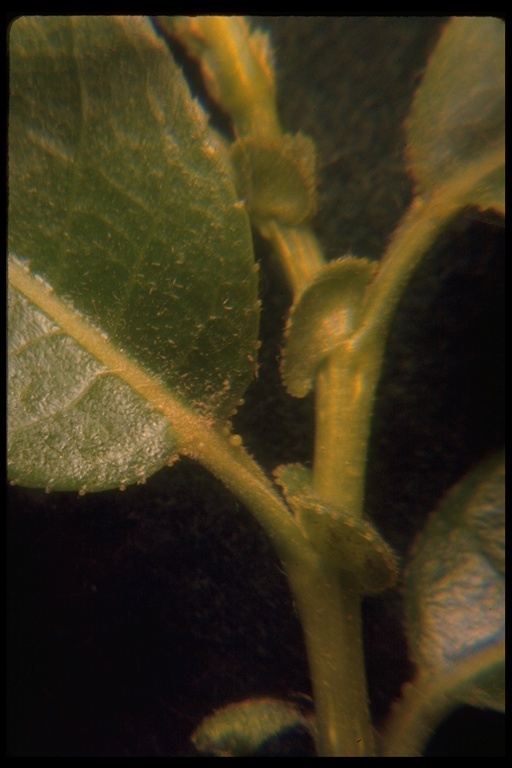
More info for the terms: capsule, dioecious, fruit, seed, shrub, treeThis description covers characteristics that may be relevant to fire ecology and is not meant for identification. Keys for identification are available (for example, [22,30,41,45]), although it is challenging to identify in the field [96].Shining willow is a deciduous [28] small tree or tall shrub, occasionally growing up to 40 feet (12 m) tall [9,45]. It typically has several stems [28,57], becoming increasingly shrubby with increasing elevation [11].The bark is smooth and thin [28], and the bole and branches are brittle [62]. Twigs are relatively stout [62]. It has lanceolate leaves [21,57] that are 2 to 5 inches (5-13 cm) long [62]. Shining willow is dioecious, so individual trees bear either pistillate or staminate catkins [9,20]. The fruit is a hairless [62] capsule [9,20,57], but the seed coat is covered with soft, cottony hairs [62,110]. The typical variety differs from tail-leaf willow by having glaucous undersides to the leaves [21,57].
via GBIF · IUCN · Kew POWO
Museum specimens
- Specimen records
- 4,099
- With media
- 3,358
- Family
- Salicaceae
- Collections
- UNIVERSITY OF ALBERTA MUSEUMS, UNLV, CAS, ENCB-IPN, MSC
- Recorded in
- Canada, United States
Wikidata facts
Show 8 more facts
- taxon rank
- species
- taxon name
- Salix lucida
- Commons category
- Salix lucida
- Commons gallery
- Salix lucida
- IUCN conservation status
- Least Concern
- short name
- S. lucida
- taxon common name
- shining willow
Sources (2)
via Wikidata · CC0
Gallery (3)
Available in 13 languages
- Español
- Français
- Deutsch
- Русский
- Azerbaijani
- Cebuano
- Egyptian Arabic
- Icelandic
- Svenska
- Ukrainian
- Upper Sorbian
- Waray
via Wikidata sitelinks · CC0