
San Marino
Sign in to saveAlso known as sm, Most Serene Republic of San Marino, SMR
San Marino, officially the Republic of San Marino (RSM), is a landlocked country in Southern Europe, completely surrounded by Italy. Located on the northeastern slopes of the Apennine Mountains, it is the larger of two microstates within Italy, the other being Vatican City. San Marino is the fifth-smallest country in the world, with a land area of just over 61 square kilometres (24 sq mi) and a population of 34,042 as of 2025. Its capital, the City of San Marino, sits atop Monte Titano, while its largest settlement is Dogana, in the municipality of Serravalle.
OverviewAI-generated
San Marino, officially the Republic of San Marino, is a sovereign state and microstate located in Southern Europe. It is an enclave and landlocked country situated within Italy. The capital is the City of San Marino. The nation operates as a parliamentary republic with a diarchy, governed by the Grand and General Council. Its official language is Italian, and it uses the euro as currency.
The country has a population of approximately 34,132 people. It covers an area of 61 square kilometers. The highest point is Monte Titano. San Marino is a member of the United Nations, the Council of Europe, and the Organization for Security and Co-operation in Europe. Its top-level Internet domain is .sm. The state shares its border with Italy and the European Union.
Synthesized by Vinony from 65 facts across 9 sources: Wikidata, Open Meteo, Openweathermap, World Bank, OpenStreetMap, REST Countries, PubMed, Vinony graph, Geo. Generated from structured data (not the Wikipedia text) and checked against those facts — may still contain errors.
Weather now
cached 20h ago7-day forecast
via Open-Meteo
Country
- Capital
- City of San Marino
- Population
- 34,132
- Region
- Europe · Southern Europe
- Demonym
- Sammarinese
- Currencies
- EUR (€)
- Languages
- Italian
- Calling code
- +378
- Drives on
- Right
- FIFA code
- SMR
- TLD
- .sm
- Timezones
- UTC+01:00
- Borders
- ITA
via REST Countries
Indicators · World Bank
- GDP
- $2B(2023)
- Population
- 33,977(2024)
- Life expectancy
- 85.8 yrs(2024)
- Urban population
- 97.2 %(2024)
- Internet users
- 97.4 %(2024)
- Forest area
- 16.7 %(2023)
via World Bank Open Data · CC BY 4.0
Wikipedia views (30d)
126,435 totalvia Wikimedia Pageviews API
Research
2,052 papers- 2022 ESC Guidelines on cardiovascular assessment and management of patients undergoing non-cardiac surgery.European heart journal · 2022Halvorsen S, Mehilli J, Cassese S et al.DOI: 10.1093/eurheartj/ehac270
- San Marino.Department of State publication. Background notes series · 1985United States. Department of State. Bureau of Public Affairs
- Effect of nutrition on neurodegenerative diseases. A systematic review.Nutritional neuroscience · 2021Bianchi VE, Herrera PF, Laura RDOI: 10.1080/1028415X.2019.1681088
- The role of nutrition on Parkinson's disease: a systematic review.Nutritional neuroscience · 2023Bianchi VE, Rizzi L, Somaa FDOI: 10.1080/1028415X.2022.2073107
- San Marino.Hall's journal of health · 1889
- Managing COVID-19 in four small countries: Initial response to the pandemic in San Marino, Montenegro, Malta and Cyprus.ReviewHealth policy (Amsterdam, Netherlands) · 2022Calleja N, Gualtieri A, Terzic N et al.DOI: 10.1016/j.healthpol.2022.01.008
- Healthcare programs in the eight European nations members of the World Health Organization Small Countries Initiative for health: Andorra, Cyprus, Iceland, Luxembourg, Malta, Monaco, Montenegro, and San Marino.ReviewTurk pediatri arsivi · 2020Gualtieri A, Antonelli A, Romeo NDOI: 10.14744/TurkPediatriArs.2020.84829
- Strongyloides stercoralis infection in San Marino Republic: first epidemiological data from an observational study.Epidemiology and infection · 2019Cappella ED, Piscaglia AC, Cadioli A et al.DOI: 10.1017/S0950268819000980
via PubMed
Wikidata facts
- Instance of
- country
- Named after
- Marinus
- Official name
- la République de Saint-Marin
- Demonym
- san-marinesisch
- Country
- San Marino
- Contains
- Chiesanuova
- Continent
- Europe
- Capital
- San Marino
- Official language
- Italian
- Currency
- euro
- Population
- 33600
- Area
- 61.2
- Head of state
- Italo Righi
- Form of government
- diarchy
- Legislature
- Grand and General Council
- Shares border with
- European Union
- Highest point
- Monte Titano
- Official website
- www.gov.sm
- Image
- View of Mount Titano - San Marino.jpg
- Life expectancy
- 85.41707
- Nominal GDP
- 1855382833
- Calling code
- +390549
- Licence plate code
- RSM
Show 51 more facts
- Mains voltage
- 230
- Motto
- San Marino For All
- Coat of arms
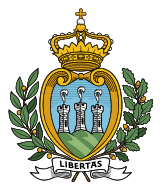
- coat of arms of San Marino
- top-level Internet domain
- .sm
- Commons category
- San Marino
- enclave within
- Italy
- public holiday
- Ferragosto
- Commons gallery
- San Marino
- category for people who died here
- Category:Deaths in San Marino
- category for people born here
- Category:People born in San Marino
- category for films shot at this location
- Category:Films shot in San Marino
- category of associated people
- Category:Sammarinese people
- described by source
- Jewish Encyclopedia of Brockhaus and Efron
- diplomatic relation
- China
- topic's main Wikimedia portal
- Portal:San Marino
- history of topic
- history of San Marino
- IPA transcription
- san .maˈriːno
- mobile country code
- 292
- lowest point
- Ausa River
- driving side
- right
- geography of topic
- Geography of San Marino
- executive body
- Congress of State
- office held by head of state
- Captain Regent of San Marino
- has characteristic
- free country
- located in/on physical feature
- Italian Peninsula
- total fertility rate
- 1.26
- maritime identification digits
- 268
- native label
- San Marco
- Unicode character
- 🇸🇲
- inception
- 0301-09-03
- language used
- Italian
- postal code
- 47890
- GS1 country code
- 800-839
- P6413
- San Marino
- economy of topic
- economy of San Marino
- demographics of topic
- demographics of San Marino
- Human Development Index
- 0.853
- P11012
- Apple Inc.
- hashtag
- SanMarino
- on focus list of Wikimedia project
- Wikipedia:Vital articles/Level/4
- P12749
- Gagliano Aterno
- birth rate
- 6.1
- male population
- 16380
- death rate
- 7.8
- rural population
- 763
- female population
- 17281
- urban population
- 32897
- P8168
- Staromusyatovo
- foundational text
- Constitution of San Marino
Sources (15)
via Wikidata · CC0
Travel guide
Understand
The Republic of San Marino (Italian: Repubblica di San Marino) is the world's oldest republic and Europe's third smallest state. It is the sole survivor of the patchwork of independent city-states that used to make up the Italian peninsula before the unification of Italy. It lies above sea level with spectacular views of the surrounding countryside and Adriatic coast, only from Rimini.
Legend has it that the founder of San Marino, Saint Marinus, a stonemason, arrived from the island of Rab in Dalmatia, and climbed Mount Titano to found a small community of Christians, persecuted for their faith by the Emperor Diocletian. The country is said to have been founded in 301 AD. San Marino gave itself a constitution in 1600, the oldest written constitution still in effect, and the only republican constitution written in Latin that still has the force of law.
During the tumultuous period starting with the French Revolution, San Marino managed to preserve its independence through several strokes of luck. First, a Sammarinese politician befriended Corsican general Napoleon Bonaparte during his Italian campaign, but wisely declined his offers for more territory. Later, the small republic gave refuge to other Republicans throughout Italy, including Garibaldi, which made him disposed to respect Sammarinese wishes to stay independent. San Marino also gave honorary citizenship to Abraham Lincoln, which inspired the Great Emancipator to laud San Marino's old and stable republican institu…
Get in
San Marino is only accessible through Italy. There are no border controls when travelling between Italy and San Marino, so it's safe to say that you need a Schengen visa to enter (if you are required to get one, that is). If you want a passport stamp, you can obtain one for €5 from the at Contrada Omagnano, 20.
If you plan on staying for more than 30 days in the country, you need to get a permit from the government.
Get around
thumb|Costa dell'Arnella, a walking path between Borgo Maggiore and the City of San Marino Once you're inside the walled city, it's small enough to simply walk around. There are only a few streets on which cars are able to drive (and only if they are small cars). Be aware that the City of San Marino is quite vertical, making it potentially difficult for those with mobility issues to climb the switchback cobblestone streets. However, there are elevators scattered throughout town that allow easier movement up and down the city.
There is a cable railway (funivia) connecting the city of San Marino to Borgo Maggiore. €3 for a one-way ticket, €5 round-trip (Aug 2024).
Outside of the capital, walking is not so easy. San Marino is the only country in the world with more vehicles than people, and it shows—sidewalks are inconsistent at best, especially when going between towns. However, there is a shaded stone path, Costa dell'Arnella, between the City of San Marino and Borgo Maggiore. It starts at the western end of Contrada Omerelli and ends a short distance from the Borgo Maggiore cable car station. Because the City of San Marino is so high up, the path is quite steep.
The bus from Rimini is somewhat useful for travel between towns, and San Marino also has its own bus system.
See
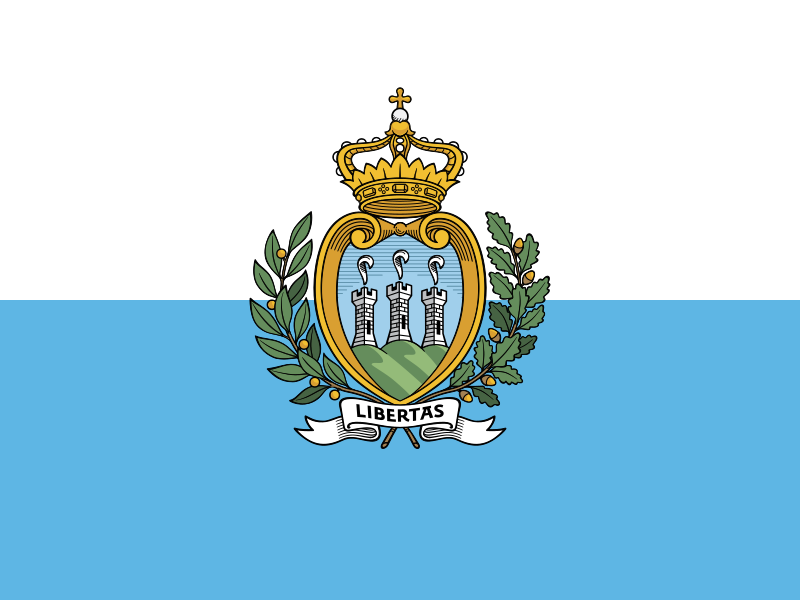
thumb|The fortress of Città di San Marino seen from the side of torre Guaita on Monte Titano San Marino’s main attractions are the three towers, which feature on the national flag. Only the and the are open to visitors. They are small castles at the top of Mount Titano, offering excellent views over San Marino and Italy as well as the Adriatic Sea. The third and smallest of the towers, , is inaccessible and was once used as a prison.
Cesta is the largest of the towers and inside, there is the Museum of Archaic Arms showcasing arms and armour from the Middle Ages to the 1800s. You can purchase the “Yellow Card” for €3 which lets you enter one castle, or the “Red Card” which lets you enter both and is €4.50. Between the two towers is a path which follows the city walls along the side of a cliff. The towers offer good photo opportunities.
Other attractions include:
Otherwise, walk around! The narrow cobbled streets are full of surprises and you can go up and down the city to explore. You can climb the city walls and walk along it at places. There are virtually no cars and the streets have a very medieval feel.
Outside of the capital, nearby Borgo Maggiore has a historic centre. You can also see the San Marino lake in Faetano where fish can be caught.
Do
The Parco naturale del Monte Titano has several hiking trails. To find them, go to the Cesta tower and walk through the gateway to the right of the museum entrance.
Biking is also popular and at “San Marino Experience” you can rent an ebike.
Self-guided audio tour of San Marino – An audio guide that leads visitors through the historic centre, including the towers, main squares and landmarks. Ideal for exploring the city independently at your own pace. Official website
Eat
Italian dishes, like pasta, pizza, gelato (Italian ice-cream), and whatever you eat in Italy. Restaurants are easy to find, and some offer tables with great views.
Supermarkets in San Marino are few and far-between, although the following can help in this area:
Drink
thumb|A bottle of Sammarinese wine The local beers, mostly by Titanbräu and Birrificio, are very tasty. Spirits are also very commonly found, especially limoncello, a lemon liquor. Try the locally produced wine. The coffee, like in its Italian neighbour, is superb.
Sleep
Although San Marino has a few hotels, the seaside resort of Rimini has a lot more and is probably a cheaper option.
Stay safe
San Marino is an extremely safe country. You are unlikely to face any major dangers or threats.
As is the case anywhere, you should watch out for pickpockets and keep an eye out for your belongings at all times.
Driving laws are similar to those of Italy. If you plan on driving around in the country, you are required to carry a red warning triangle with you.
The city of San Marino is built on a mountain and many walkways in the city are quite steep. Try not to run on them.
As is the case throughout Europe, San Marino's emergency number is 112.
Stay healthy
This is a very healthy place. If you become ill, procedures are the same as the European Union, although serious conditions will likely see you transferred to Rimini.
Tap water is drinkable.
Travel guide from Wikivoyage (CC BY-SA 4.0)
~40 min read
Encyclopedic overview
San Marino, officially the Republic of San Marino (RSM), is a landlocked country in Southern Europe, completely surrounded by Italy. Located on the northeastern slopes of the Apennine Mountains, it is the larger of two microstates within Italy, the other being Vatican City. San Marino is the fifth-smallest country in the world, with a land area of just over 61 square kilometres (24 sq mi) and a population of 34,042 as of 2025. Its capital, the City of San Marino, sits atop Monte Titano, while its largest settlement is Dogana, in the municipality of Serravalle.
San Marino claims to have been founded in AD 301 and to be the oldest extant sovereign state, and the oldest constitutional republic. It is named after Saint Marinus, a stonemason from the Roman island of Rab (in present-day Croatia), who is supposed in mythic accounts to have established a monastic community on Monte Titano. The country has a rare constitutional structure: the Grand and General Council, a democratically elected legislature, selects two heads of state, the Captains Regent, every six months. They are chosen from opposing political parties, and serve concurrently with equal powers and preside over several institutions of state, including the Grand and General Council. Only the Federal Council of Switzerland also follows that structure, except with seven heads of state, and different responsibilities and functions. It has the most ancient Constitution, dating from 1600.
Excerpted from Wikipedia’s “San Marino” article, available under the CC BY-SA 4.0 licence.
Gallery (16)
On the map
2 mapped locations
Available in 267 languages
- Español
- Français
- Deutsch
- 中文
- 日本語
- Русский
- Português
- Italiano
- العربية
- हिन्दी
- Abkhazian
- abstract
- Achinese
- Afrikaans
- Albanian
- Albanian
- Amharic
- ami
Show 248 more
- Angika
- Aragonese
- Aramaic
- Armenian
- Arpitan
- Assamese
- Asturian
- Awadhi
- azb
- Azerbaijani
- Bahasa Indonesia
- Balinese
- Bangla
- Bashkir
- Basque
- bat_smg
- Bavarian
- be_x_old
- Belarusian
- Betawi
- Bhojpuri
- Bikol
- Bishnupriya
- Bislama
- Bosnian
- Breton
- Bulgarian
- Buriat
- Burmese
- Catalan
- cbk_zam
- cdo
- Cebuano
- Central Kurdish
- Chechen
- Cherokee
- Church Slavic
- Chuvash
- Cornish
- Corsican
- Crimean Tatar
- Croatian
- Czech
- dag
- Danish
- Divehi
- dty
- Egyptian Arabic
- eml
- Erzya
- Esperanto
- Estonian
- Ewe
- Extremaduran
- Faroese
- Fiji Hindi
- Filipino
- Finnish
- fiu_vro
- Friulian
- Fula
- Gagauz
- Galician
- Ganda
- gcr
- Georgian
- Gilaki
- Goan Konkani
- Gothic
- Greek
- Guarani
- Gujarati
- Haitian Creole
- Hakka Chinese
- Hausa
- Hawaiian
- Hebrew
- Hungarian
- Icelandic
- Ido
- Igbo
- Iloko
- Inari Sami
- Interlingua
- Interlingue
- Irish
- Jamaican Creole English
- Javanese
- Kabardian
- Kabyle
- Kannada
- Kara-Kalpak
- Karachay-Balkar
- Kashmiri
- Kashubian
- Kazakh
- kge
- Khmer
- Kikuyu
- Kinyarwanda
- Komi
- Komi-Permyak
- Kongo
- Kotava
- Kurdish
- Kyrgyz
- Ladino
- Lao
- Latgalian
- Latin
- Latvian
- Lezghian
- Ligurian
- Limburgish
- Lingala
- Lingua Franca Nova
- Lithuanian
- lld
- Lombard
- Low German
- Lower Sorbian
- Luxembourgish
- Macedonian
- Madurese
- Malagasy
- Malay
- Malayalam
- Maltese
- Manipuri
- Manx
- Māori
- map_bms
- Marathi
- Mari
- Mazanderani
- Minangkabau
- Mingrelian
- Mirandese
- Moksha
- Mongolian
- Moroccan Arabic
- Navajo
- nds_nl
- Neapolitan
- Nederlands
- Nepali
- Newari
- Northern Frisian
- Northern Sami
- Norwegian
- Norwegian Nynorsk
- Novial
- nrm
- Nyanja
- Obolo
- Occitan
- Old English
- olo
- Oromo
- Ossetic
- Pampanga
- Pangasinan
- Papiamento
- Pashto
- Picard
- Piedmontese
- Polski
- Pontic
- Punjabi
- Quechua
- rki
- roa_rup
- roa_tara
- Romanian
- Romansh
- Rundi
- Samoan
- Sanskrit
- Santali
- Sardinian
- Saterland Frisian
- Scots
- Scottish Gaelic
- Serbian
- Serbian (Latin)
- Shan
- Shona
- Sicilian
- Silesian
- simple
- Sindhi
- Sinhala
- Slovak
- Slovenian
- Somali
- Sranan Tongo
- Standard Moroccan Tamazight
- Sundanese
- Svenska
- Swahili
- szy
- Tajik
- Talysh
- Tamil
- Taroko
- Tatar
- Telugu
- Tetum
- Tibetan
- Tiếng Việt
- Tigrinya
- Tok Pisin
- Toki Pona
- Tongan
- Tsonga
- Tumbuka
- Türkçe
- Turkmen
- Udmurt
- Ukrainian
- Upper Sorbian
- Urdu
- Uyghur
- Uzbek
- Venetian
- Veps
- Volapük
- Waray
- Welsh
- West Flemish
- Western Frisian
- Western Panjabi
- Wolof
- Wu Chinese
- Xhosa
- Yakut
- Yiddish
- Yoruba
- Zaza
- Zeelandic
- zh_classical
- zh_min_nan
- zh_yue
- Zhuang
- Zulu
- فارسی
- ไทย
- 한국어
via Wikidata sitelinks · CC0