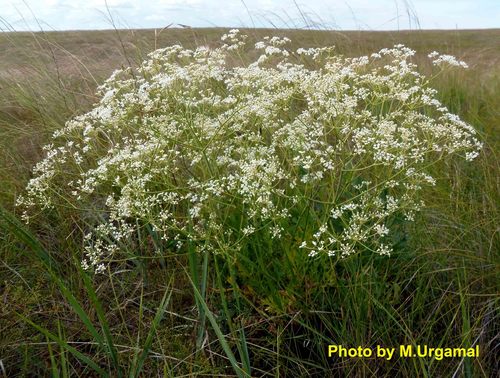
(c) Urgamal Magsar, all rights reserved, uploaded by Urgamal Magsar
Saposhnikovia
Sign in to saveSaposhnikovia is a monotypic genus of flowering plants in the family Apiaceae. Its only species is Saposhnikovia divaricata, known as fángfēng 防風 (lit. "protect against the wind") in Chinese, bangpung in Korean, and siler in English. The plant is still frequently referenced under the obsolete genus name Ledebouriella in many online sources devoted to traditional Chinese medicine. It was first described as Stenocoelium divaricatum by Nikolai Turczaninow in 1844, and transferred to Saposhnikovia in 1951.
Species
Spread-wide saposhnikovia
GENUS
- KingdomPlantae
- PhylumTracheophyta
- ClassMagnoliopsida
- OrderApiales
- FamilyApiaceae
via GBIF · Kew POWO
Wikidata facts
Show 5 more facts
- taxon name
- Saposhnikovia
- taxon rank
- genus
- topic's main category
- Category:Saposhnikovia
- taxon common name
- 防风属
Sources (2)
via Wikidata · CC0
~3 min read
Encyclopedic overview
6 sectionsContents
- Description
- Distribution and habitat
- Harvesting
- Phytochemistry
- See also
- References
Saposhnikovia is a monotypic genus of flowering plants in the family Apiaceae. Its only species is Saposhnikovia divaricata, known as fángfēng 防風 (lit. "protect against the wind") in Chinese, bangpung in Korean, and siler in English. The plant is still frequently referenced under the obsolete genus name Ledebouriella in many online sources devoted to traditional Chinese medicine. It was first described as Stenocoelium divaricatum by Nikolai Turczaninow in 1844, and transferred to Saposhnikovia in 1951.
==Description== Glabrous, much-branched, perennial herb, arising from branched, annular, tuberous rootstock up to 2 cm thick, with crown surrounded by fibrous, remnant, sheathing bases of petioles. Height 30–100 cm. Basal leaves numerous, petioles flattened with ovate sheaths, 2–6.5 cm in length; leaf-blades oblong-ovate to broad-ovate, up to 35 x 18 cm (usually smaller), bi- to tripinnatifid, pinnae 3–4 pairs, petiolulate, terminal lobes lanceolate, 3-lobed at apex. Upper leaves simplified with sheathing petioles, reduced upwards, often absent, leading to aphyllous branching. Umbels compound, devoid of involucral bracts, rays 5–9, bracteoles 4–5, pedicels 4–9, flowers white or yellow, petals circa 1.5 mm. Mericarps broadly ovate to oblong, flat, up to 5 x 3mm, tuberculate when young but becoming smooth at maturity, lateral ribs winged. Flowering August–September and fruiting September–October.
Excerpted from Wikipedia’s “Saposhnikovia” article, available under the CC BY-SA 4.0 licence.
Gallery (2)
Available in 9 languages
via Wikidata sitelinks · CC0