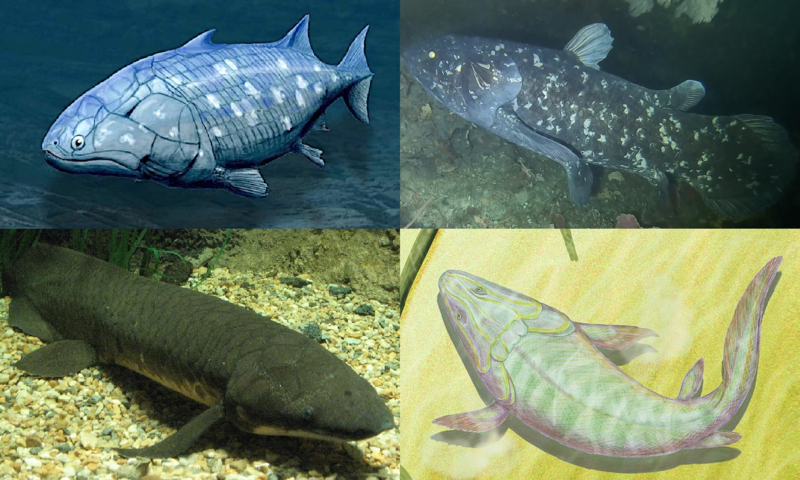
File:Sarcopterygii.png · Wikimedia Commons · See Wikimedia Commons
Sarcopterygii
Sign in to saveAlso known as lobe-finned fishes, lobe-finned fish
Sarcopterygii (; )—sometimes considered synonymous with Crossopterygii ()—is a clade (traditionally a class or subclass) of vertebrate animals which includes a group of bony fishes commonly referred to as lobe-finned fishes. These vertebrates are characterised by prominent muscular limb buds (lobes) within their fins, which are supported by articulated appendicular skeletons. This is in contrast to the other clade of bony fishes, the Actinopterygii, which have only skin-covered bony spines supporting the fins.
OverviewAI-generated
Sarcopterygii is a taxon within the phylum Chordata, classified at the rank of Gigaclass. It is part of the Osteichthyes group and has an accepted status in taxonomic records. The lineage dates back to approximately 423 million years ago.
Organisms in this group inhabit marine, brackish, and freshwater environments. Specimens are held by institutions including NMMNHS, MNHN, and KU. Records associated with Sarcopterygii are located in the United States and ViêT Nam.
Synthesized by Vinony from 12 facts across 4 sources: Wikidata, iDigBio, WoRMS, Vinony graph. Generated from structured data (not the Wikipedia text) and checked against those facts — may still contain errors.
Species
Gigaclass
- PhylumChordata
via
Museum specimens
- Specimen records
- 5
- Collections
- NMMNHS, MNHN, KU
- Recorded in
- United States, ViêT Nam
Wikidata facts
- Instance of
- clade
- Parent taxon
- Euteleostomi
- Image
- Latimeria chalumnae01.jpg
Show 9 more facts
- taxon name
- Sarcopterygii
- Commons category
- Osteichthyes
- taxon rank
- superclass
- Code of nomenclature
- International Code of Zoological Nomenclature
- topic's main category
- Category:Sarcopterygii
- taxon common name
- mesnatoplavutarice
- topic has template
- Template:Sarcopterygii
- start time
- 423000000-
- on focus list of Wikimedia project
- Wikipedia:Vital articles/Level/4
Sources (1)
via Wikidata · CC0
~18 min read
Encyclopedic overview
14 sectionsContents
- Characteristics
- Classification
- Ahlberg (1991)
- Nelson ''et al''. (2016)
- Betancur-Rodrigues ''et al''. (2017)
- Tedersoo (2017)
- Taxonomy
- Evolution
- Hypotheses for means of pre-adaptation
- History through to the end-Permian extinction
- Phylogeny
- See also
- Footnotes
- References
Sarcopterygii (; )—sometimes considered synonymous with Crossopterygii ()—is a clade (traditionally a class or subclass) of vertebrate animals which includes a group of bony fishes commonly referred to as lobe-finned fishes. These vertebrates are characterised by prominent muscular limb buds (lobes) within their fins, which are supported by articulated appendicular skeletons. This is in contrast to the other clade of bony fishes, the Actinopterygii, which have only skin-covered bony spines supporting the fins.
The tetrapods, a mostly terrestrial clade of vertebrates, are now recognized as having evolved from sarcopterygian ancestors and are most closely related to lungfishes. Their paired pectoral and pelvic fins evolved into limbs, and their foregut diverticulum eventually evolved into air-breathing lungs. Cladistically, this would make the tetrapods a subgroup within Sarcopterygii and thus sarcopterygians themselves. As a result, the phrase "lobe-finned fish" normally refers to not the entire clade but only aquatic members that are not tetrapods, i.e. a paraphyletic group.
Excerpted from Wikipedia’s “Sarcopterygii” article, available under the CC BY-SA 4.0 licence.
Gallery (51)
Available in 71 languages
- Español
- Français
- Deutsch
- 中文
- 日本語
- Русский
- Português
- Italiano
- العربية
- हिन्दी
- Afrikaans
- Asturian
- azb
- Azerbaijani
- Bahasa Indonesia
- Balinese
- Bangla
- Basque
Show 52 more
- Belarusian
- Bulgarian
- Catalan
- Cebuano
- Croatian
- Czech
- Egyptian Arabic
- Esperanto
- Estonian
- Filipino
- Finnish
- Galician
- Georgian
- Greek
- Hebrew
- Hungarian
- Icelandic
- Irish
- Kazakh
- Kyrgyz
- Latin
- Latvian
- Ligurian
- Lithuanian
- Macedonian
- Manx
- Nederlands
- Northern Frisian
- Norwegian
- Norwegian Nynorsk
- Occitan
- Polski
- Quechua
- Romanian
- Scots
- Serbian
- Serbian (Latin)
- simple
- Slovak
- Svenska
- Tiếng Việt
- Tongan
- Türkçe
- Ukrainian
- Uzbek
- Waray
- Wu Chinese
- Zeelandic
- zh_yue
- فارسی
- ไทย
- 한국어
via Wikidata sitelinks · CC0