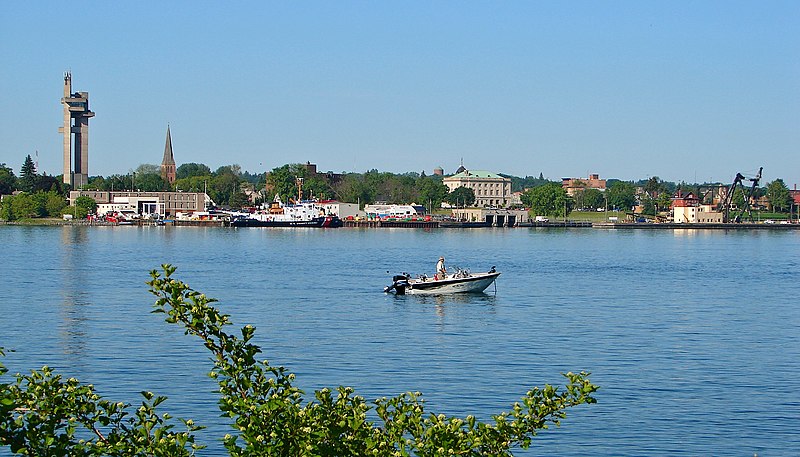
Sault Ste. Marie
Also known as Sault Sainte Marie, Sault Ste. Marie, Michigan, Sault Ste. Marie, MI
city in Michigan, United States
AI overview
Sault Ste. Marie is a city located in Michigan's Upper Peninsula, positioned along the St. Marys River at the border with Canada. The city is historically significant as a major shipping hub, as it sits at a crucial point connecting Lake Superior to the lower Great Lakes through the Soo Locks.
AI-generated from the Wikipedia summary — may contain errors.
Key facts
- Country
- United States
- State
- Michigan
- County
- Chippewa
- Incorporated
- 1879 (village), 1887 (city)
- Type
- Council–manager
- Mayor
- Don Gerrie
- Manager
- Brian Chapman
- Total
- 20.02 sq mi (51.86 km )
- Land
- 14.76 sq mi (38.22 km )
- Water
- 5.27 sq mi (13.64 km ) 26.74%
- Elevation
- 617 ft (188 m)
- Density
- 903.8/sq mi (348.95/km )
- Time zone
Article
Sault Ste. Marie (/ˌsuː seɪnt məˈriː/ SOO saynt mə-REE) is a city in the Upper Peninsula of the U.S. state of Michigan. It is the county seat of Chippewa County and is the only city within the county. With a population of 13,337 at the 2020 census, it is the second-most populated city in the Upper Peninsula, behind Marquette. It is the primary city of the Sault Ste. Marie, MI Micropolitan Statistical Area, which encompasses all of Chippewa County and had a population of 36,785 at the 2020 census. Sault Ste. Marie was settled by mostly French colonists in 1668, making it the oldest city in Michigan.
Sault Ste. Marie is located along the St. Marys River, which flows from Lake Superior to Lake Huron and forms part of the United States–Canada border. Across the river is the larger city of Sault Ste. Marie, Ontario; the two cities are connected by the Sault Ste. Marie International Bridge. Between the two cities are the Soo Locks, a set of locks allowing ship travel between Lake Superior and the Lower Great Lakes.
Gallery (12)
On the map
Connections
Categories
1668 establishments in New FranceCities in Chippewa County, MichiganCounty seats in MichiganInland port cities and towns in the United StatesMichigan State Historic Sites in Chippewa CountyMicropolitan statistical areas of MichiganPopulated places established in 1668Populated places on the Great LakesSault Ste. MarieSault Ste. Marie, MichiganSeats of government of American Indian reservations