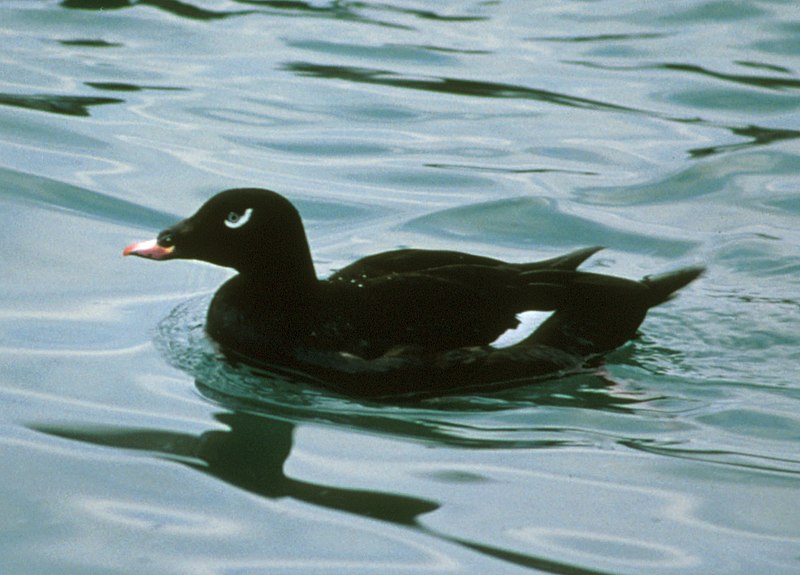
File:Wwscoter12.JPG · Wikimedia Commons · See Wikimedia Commons
scoter
Sign in to saveAlso known as Melanitta
The scoters are stocky seaducks in the genus Melanitta. The drakes are mostly black and have swollen bills, the females are brown. They breed in the far north of Europe, Asia, and North America, and winter further south in temperate zones of those continents. They form large flocks on suitable coastal waters. These are tightly packed, and the birds tend to take off together. Their lined nests are built on the ground close to the sea, lakes or rivers, in woodland or tundra. These species dive for crustaceans and molluscs.
OverviewAI-generated
Melanitta is a taxon at the genus rank within the family Anatidae. It belongs to the order Anseriformes, class Aves, and phylum Chordata. The genus is classified under the subfamily Anatinae. Its taxonomic status is accepted, and it was described by Boie in 1822. The species within this genus inhabit marine environments.
The common name for this group is ビロードキンクロ属. Information regarding Melanitta is documented in the Encyclopædia Britannica 11th edition. The subject is associated with the main category Category:Melanitta and has a corresponding Commons category and gallery.
Synthesized by Vinony from 18 facts across 3 sources: Wikidata, WoRMS, Vinony graph. Generated from structured data (not the Wikipedia text) and checked against those facts — may still contain errors.
Species
ビロードキンクロ属
Genus
- PhylumChordata
- ClassAves
- OrderAnseriformes
- FamilyAnatidae
Die Gattung Melanitta beinhaltet einige gedrungene Arten aus der Tribus der Meerenten und Säger. Die Erpel sind größtenteils schwarz und besitzen angeschwollene Schnäbel, die Enten besitzen braunes Gefieder. Der Gattungsname stammt von den altgriechischen Wörtern melas ("schwarz") und netta ("Ente").[2] Sie brüten im äußersten Norden Europas, Asiens und Nordamerikas und überwintern weiter im Süden in den gemäßigten Zonen dieser Kontinente. Sie bilden dort große und dichte Schwärme auf geeigneten Küstengewässern, wo sie oftmals gleichzeitig in die Luft abheben. Ihre gepolsterten Nester bauen die Arten auf dem Boden in Gewässernähe im Wald oder in der Tundra. Sie tauchen zur Nahrungsaufnahme nach Krustentieren und Mollusken. Arten Die Gattung besteht aus 6 Arten,[1] gruppiert in zwei Untergattungen: Die fossile Art Melanitta ceruttii, welche während des späten Pliozäns in Kalifornien vorkam, wurde in die Gattung Histrionicus gesetzt. Literatur Martin Collinson, David T. Parkin, Alan G. Knox, George Sangster and Andreas J. Helbig, Species limits within the genus Melanitta, the scoters (PDF, 311 KB) Einzelnachweise ↑ a b Waterfowl, IOC Bird List ↑ James A Jobling: The Helm Dictionary o
via
Wikidata facts
Show 6 more facts
- Commons category
- Melanitta
- taxon rank
- genus
- taxon name
- Melanitta
- topic's main category
- Category:Melanitta
- Commons gallery
- Melanitta
- described by source
- Encyclopædia Britannica 11th edition
Sources (1)
via Wikidata · CC0
~1 min read
Encyclopedic overview
2 sectionsContents
- Taxonomy
- References
The scoters are stocky seaducks in the genus Melanitta. The drakes are mostly black and have swollen bills, the females are brown. They breed in the far north of Europe, Asia, and North America, and winter further south in temperate zones of those continents. They form large flocks on suitable coastal waters. These are tightly packed, and the birds tend to take off together. Their lined nests are built on the ground close to the sea, lakes or rivers, in woodland or tundra. These species dive for crustaceans and molluscs.
==Taxonomy== The genus Melanitta was introduced by the German zoologist Friedrich Boie in 1822. The type species was designated in 1838 as the velvet scoter by Thomas Campbell Eyton. The genus name combines the Ancient Greek meaning "black" and meaning "duck".
Excerpted from Wikipedia’s “scoter” article, available under the CC BY-SA 4.0 licence.