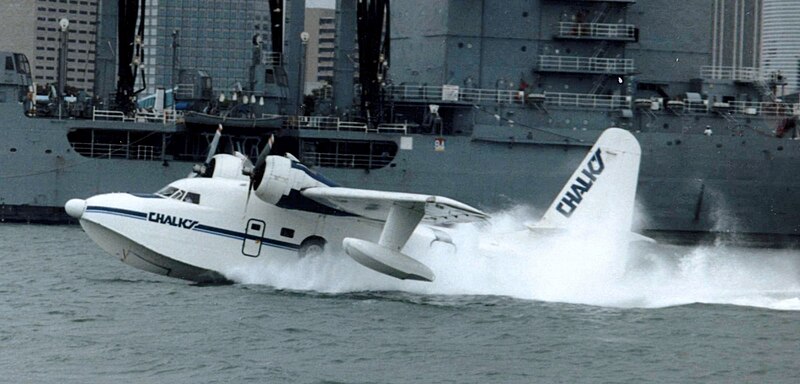
File:Grumman_HU-16D_Albatross_Chalks_MIA_03.87.jpg · Wikimedia Commons · See Wikimedia Commons
seaplane
Sign in to saveAlso known as hydroplane, hydroaeroplane, water-based aircraft
thumb|upright=1.35|A Grumman Albatross|Grumman G-111 Albatross amphibious flying boat landing thumb|OS2U Kingfisher in 1944. Seaplanes were commonly used in World War II for reconnaissance and search and rescue. They were launched from ships or seaplane tenders, or could take off from water in the right conditions. A seaplane is a powered fixed-wing aircraft capable of taking off and landing (alighting) on water. Seaplanes are usually divided into two categories based on their technological characteristics: floatplanes and flying boats; the latter are generally far larger and can carry far mor
A seaplane is a powered fixed-wing aircraft designed to take off and land on water, typically classified as either a floatplane or flying boat. Seaplanes were particularly important during World War II, when they were widely used for reconnaissance, search and rescue, and other missions, either launched from ships and tenders or operating independently from water surfaces.
AI-generated from the Wikipedia summary — may contain errors.
Wikidata facts
- Image
- 00 0092 Picton Harbour - Seaplane.jpg
Show 5 more facts
- Commons category
- Seaplanes
- topic's main category
- Category:Seaplanes
- Commons gallery
- Seaplane
- wing configuration
- fixed-wing aircraft
- military designation
- AH
via Wikidata · CC0
~54 min read
Encyclopedic overview
19 sectionsContents
- Types
- Floatplane
- Design
- Flying boat
- History
- Early pioneers
- Birth of an industry
- World War I (1914–1918)
- Between the wars
- World War II
- Post-War
- Late 20th century
- Twenty-first century developments
- Uses and operation
- See also
- References
- Bibliography
- Further reading
- External links
thumb|upright=1.35|A Grumman Albatross|Grumman G-111 Albatross amphibious flying boat landing thumb|OS2U Kingfisher in 1944. Seaplanes were commonly used in World War II for reconnaissance and search and rescue. They were launched from ships or seaplane tenders, or could take off from water in the right conditions. A seaplane is a powered fixed-wing aircraft capable of taking off and landing (alighting) on water. Seaplanes are usually divided into two categories based on their technological characteristics: floatplanes and flying boats; the latter are generally far larger and can carry far more. Seaplanes that can also take off and land on airfields are in a subclass called amphibious aircraft, or amphibians. Seaplanes were sometimes called hydroplanes, but currently this term applies instead to motor-powered watercraft that use the technique of hydrodynamic lift to skim the surface of water when running at speed.
The use of seaplanes gradually tapered off after World War II. This was in part due to investments in airports during the war, but mainly because landplanes were less constrained by weather conditions that affected seaplanes. In the 21st century, seaplanes maintain a few niche uses, such as for aerial firefighting, air transport around archipelagos, and access to undeveloped or roadless areas, some of which have numerous lakes. In British English, seaplane is sometimes used specifically to refer to a floatplane, rather than a flying boat.
Excerpted from Wikipedia’s “seaplane” article, available under the CC BY-SA 4.0 licence.
Gallery (52)
Available in 73 languages
- Español
- Français
- Deutsch
- 中文
- 日本語
- Русский
- Português
- Italiano
- العربية
- Afrikaans
- Aragonese
- Armenian
- Azerbaijani
- Bahasa Indonesia
- Bangla
- Basque
- Belarusian
- Breton
Show 54 more
- Bulgarian
- Catalan
- Central Kurdish
- Cherokee
- Chuvash
- Corsican
- Croatian
- Czech
- Danish
- Esperanto
- Estonian
- Finnish
- Galician
- Greek
- Hebrew
- Hungarian
- Icelandic
- Irish
- Kazakh
- Latvian
- Limburgish
- Lithuanian
- Macedonian
- Malay
- Malayalam
- Nederlands
- Norwegian
- Norwegian Nynorsk
- Piedmontese
- Polski
- Romanian
- Rusyn
- Serbian
- Serbian (Latin)
- simple
- Slovak
- Slovenian
- Svenska
- szy
- Tajik
- Tamil
- Tatar
- Telugu
- Tiếng Việt
- Türkçe
- Ukrainian
- Urdu
- Uzbek
- Venetian
- Welsh
- Wu Chinese
- فارسی
- ไทย
- 한국어
via Wikidata sitelinks · CC0