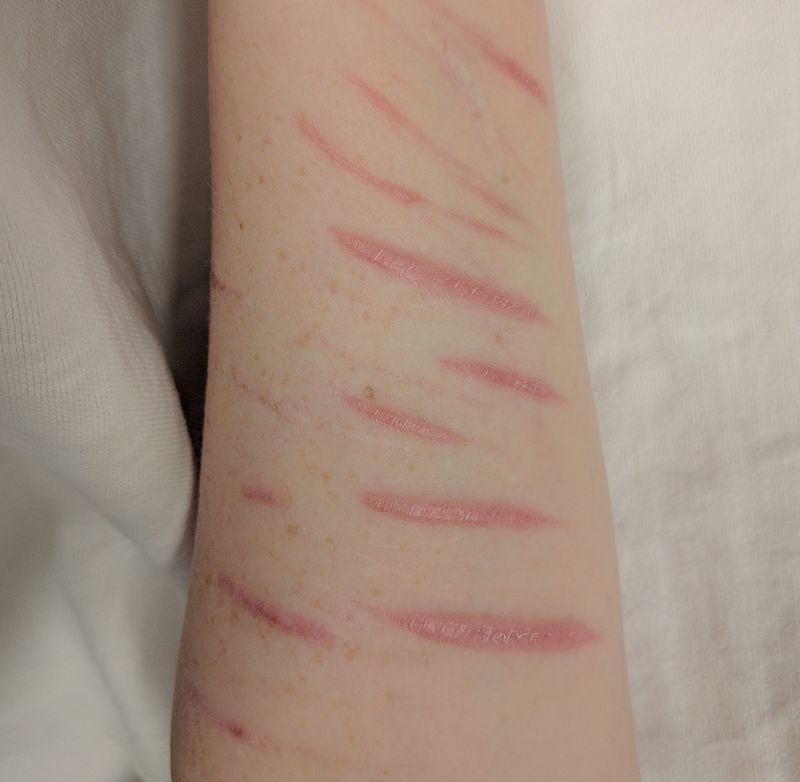
File:SelfHarm2017.jpg · Wikimedia Commons · See Wikimedia Commons
self-injury
Sign in to saveAlso known as self-poisoning, self-harm, deliberate self-harm, DSH, self-mutilation, self-Injurious Behavior, cutting, self-abuse
Self-harm is intentional behavior that causes harm to oneself. This is most commonly regarded as direct injury of one's own tissues, usually without suicidal intention. Other terms such as cutting, self-abuse, self-injury, and self-mutilation have been used for any self-harming behavior regardless of suicidal intent. Common forms of self-harm include damaging the skin with a sharp object or scratching with the fingernails, hitting, or burning. The exact bounds of self-harm are imprecise, but generally exclude tissue damage that occurs as an unintended side-effect of eating disorders or substan
Self-injury is intentional behavior where someone deliberately harms their own body, most commonly by cutting, scratching, hitting, or burning themselves, usually without the intention of ending their life. Understanding self-injury matters because it's a real coping behavior that affects many people and requires proper recognition and compassionate support rather than judgment.
AI-generated from the Wikipedia summary — may contain errors.
Key facts
- Medical condition.name
- Self-harm
- Medical condition.image
- SelfHarm2017.jpg
- Medical condition.alt
- Healed scars on the forearm
- Medical condition.caption
- Healed scars on the forearm from self-harm
- Medical condition.field
- Psychiatry, surgery, or emergency medicine if serious injuries occur
- Medical condition.synonyms
- Deliberate self-harm (DSH), self-injury (SI), nonsuicidal self-injury (NSSI), cutting
- Medical condition.causes
- Mental disorders, psychological factors, genetics, drug and alcohol usage
via Wikipedia infobox
Wikidata facts
- Instance of
- medical diagnosis
- Subclass of
- intentional human activity
- Image
- SelfHarm2017.jpg
Show 6 more facts
- Commons category
- Self harm
- health specialty
- clinical psychology
- topic's main category
- Category:Self-harm
- exact match
- purl.obolibrary.org/obo/HP_0000742
- possible treatment
- psychotherapy
- NCI Thesaurus ID
- C118206
via Wikidata · CC0
~37 min read
Encyclopedic overview
29 sectionsContents
- Classification
- Terminology
- Concealment
- Signs and symptoms
- Causes
- Mental disorder
- Psychological factors
- Genetics
- Drugs and alcohol
- Pathophysiology
- Autonomic nervous system
- Treatment
- Therapy
- Avoidance techniques
- Epidemiology
- Gender differences
- Elderly
- Developing world
- Prison inmates
- Awareness
- Other animals
- See also
- References
- Citations
- Sources
- Medical books, chapters, and overview articles
- Medical reviews and meta-analyses
- Other medical and scientific sources
- External links
Self-harm is intentional behavior that causes harm to oneself. This is most commonly regarded as direct injury of one's own tissues, usually without suicidal intention. Other terms such as cutting, self-abuse, self-injury, and self-mutilation have been used for any self-harming behavior regardless of suicidal intent. Common forms of self-harm include damaging the skin with a sharp object or scratching with the fingernails, hitting, or burning. The exact bounds of self-harm are imprecise, but generally exclude tissue damage that occurs as an unintended side-effect of eating disorders or substance abuse, as well as more societally acceptable body modification, such as tattoos and piercings.
Although self-harm is by definition non-suicidal, it may still be life-threatening. People who do self-harm are more likely to die by suicide, and 40–60% of people who die by suicide have previously self-harmed. Still, only a minority of those who self-harm are suicidal.
Excerpted from Wikipedia’s “self-injury” article, available under the CC BY-SA 4.0 licence.