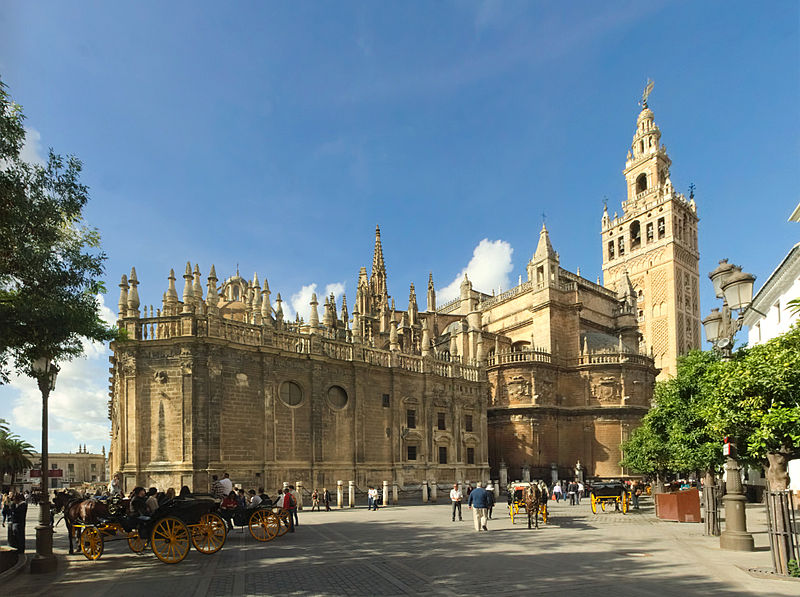
File:Sevilla_Cathedral_-_Southeast.jpg · Wikimedia Commons · See Wikimedia Commons
Seville
Sign in to saveAlso known as Sevilla, Seville, Spain, Ishbiliya, Ixbiliya
Seville ( ; , ) is the capital and largest city of the Spanish autonomous community of Andalusia and the province of Seville. It is situated on the lower reaches of the River Guadalquivir, in the southwest of the Iberian Peninsula.
Seville is the capital and largest city of Andalusia, a region in southwestern Spain, located along the Guadalquivir River. It is an important urban center in the Iberian Peninsula's southern part.
AI-generated from the Wikipedia summary — may contain errors.
Key facts
- Settlement.name
- Seville
- Settlement.native_name
- Sevilla
- Settlement.native_name_lang
- es
- Settlement.settlement_type
- Municipality
- Settlement.image_flag
- Flag of Sevilla, Spain.svg
- Settlement.flag_size
- 120px
- Settlement.image_shield
- Escudo de Sevilla (Sevilla).svg
- Settlement.shield_size
- 90px
- Settlement.motto
- NO8DO ([Ella] No me ha dejado – [She] has not abandoned me)
- Settlement.mapframe
- yes
- Settlement.mapframe switcher
- zooms
- Settlement.mapframe zoom
- 10
- Settlement.mapframe marker
- city
- Settlement.mapframe shape
- yes
- Settlement.mapframe caption
- Interactive map of Seville
- Settlement.map_caption
- Location of Seville
- Settlement.subdivision_type
- Country
- Settlement.subdivision_name
- Spain
via Wikipedia infobox
Wikidata facts
- Instance of
- municipality of Spain
- Official name
- Sevilla
- Demonym
- Sevíllčanka
- Country
- Taifa of Seville
- Located in
- Seville metropolitan area
- Continent
- Europe
- Population
- 689423
- Area
- 140.8
- Elevation
- 18
- Time zone
- UTC+01:00
- Body of water
- Guadalquivir
- Head of government
- Juan Espadas Cejas
- Capital of
- Taifa of Seville
- Shares border with
- Palomares del Río
- Location
- Comarca Metropolitana de Sevilla
- Official website
- www.sevilla.org
- Image
- Sevilla Luft 120308.JPG
- Dialing code
- 95
- Licence plate code
- SE
- Flag
- NO8DO
- Patron saint
- Ferdinand III of Castille
- Significant event
- Siege of Seville
- Connects with
- European route E1
Show 18 more facts
- topic's main category
- Category:Seville
- twinned administrative body
- Ramallah
- Commons category
- Seville
- postal code
- 41000–41099
- category for people born here
- Category:Births in Seville
- category for people who died here
- Category:Deaths in Seville
- category of associated people
- Category:People from Seville
- Commons gallery
- Sevilla
- history of topic
- history of Seville
- native label
- Sevilla
- male population
- 326634
- female population
- 361958
- P8168
- Klaus Kobusch
- member of
- Creative Cities Network
- on focus list of Wikimedia project
- Wikipedia:Vital articles/Level/4
- located in/on physical feature
- Baetic Depression
- P12749
- Kuantan Singingi
Sources (14)
via Wikidata · CC0
~69 min read
Encyclopedic overview
65 sectionsContents
- Name
- Etymology and derivatives
- Motto
- History
- Early periods
- Middle Ages
- Early modern period
- Late modern history
- Recent developments
- Geography
- Climate
- Government
- Municipal government and administration
- Regional and provincial capital
- Districts and neighbourhoods
- Demographics
- Main sights
- Churches
- Palaces and mansions
- Fortifications
- Civic buildings and other monuments
- ''Parque de María Luisa''
- Museums
- Other parks and gardens
- Culture
- Theatres
- Festivals
- Holy Week in Seville
- Bienal de Flamenco
- Velá de Santiago y Santa Ana
- Feria de Abril
- Salón Náutico Internacional de Sevilla
- Music
- Flamenco
- Gastronomy
- Economy
- Infrastructure
- Research and development
- Transport
- Bus
- Metro
- Tram
- Train
- Bicycle
- Bicycle rentals
- Airport
- Port
- Roads
- Public transportation statistics
- Education
- Sport
- In fiction
- In travel writing
- Twin towns – sister cities
- Titles
- Notable people
- Historical
- 20th-century artists
- Models
- Singers
- Athletes
- Other notable people
- See also
- References
- External links
Seville ( ; , ) is the capital and largest city of the Spanish autonomous community of Andalusia and the province of Seville. It is situated on the lower reaches of the River Guadalquivir, in the southwest of the Iberian Peninsula.
Seville has a municipal population of about 686,741 as of 2024, and a metropolitan population of about 1.5 million, making it the largest city in Andalusia and the 5th-largest city in Spain. Its old town, with an area of , contains a UNESCO World Heritage Site comprising three buildings: the Alcázar palace complex, the Cathedral and the General Archive of the Indies. The Port of Seville, located about from the Atlantic Ocean, is the only river harbour in Spain. The capital of Andalusia experiences hot temperatures in the summer, with daily maximums routinely above in July and August.
Excerpted from Wikipedia’s “Seville” article, available under the CC BY-SA 4.0 licence.
Gallery (52)
On the map
3 mapped locations
Available in 154 languages
- Español
- Français
- Deutsch
- 中文
- 日本語
- Русский
- Português
- Italiano
- العربية
- Achinese
- Afrikaans
- Akan
- Albanian
- Albanian
- Amharic
- Aragonese
- Armenian
- Asturian
Show 135 more
- Aymara
- azb
- Azerbaijani
- Bahasa Indonesia
- Balinese
- Bangla
- Bashkir
- Basque
- bat_smg
- Bavarian
- be_x_old
- Belarusian
- Bosnian
- Breton
- Bulgarian
- Catalan
- cbk_zam
- Central Kurdish
- Chechen
- Cheyenne
- Chuvash
- Cornish
- Croatian
- Czech
- dag
- Danish
- Egyptian Arabic
- Erzya
- Esperanto
- Estonian
- Extremaduran
- Filipino
- Finnish
- Friulian
- Galician
- Georgian
- Gilaki
- Greek
- Hakka Chinese
- Hausa
- Hebrew
- Hungarian
- Icelandic
- Ido
- Interlingua
- Interlingue
- Irish
- Javanese
- Kabardian
- Kabyle
- Kazakh
- kge
- Kurdish
- Kyrgyz
- Ladino
- Latin
- Latvian
- Ligurian
- Limburgish
- Lingala
- Lithuanian
- lld
- Lombard
- Luxembourgish
- Macedonian
- Madurese
- Malagasy
- Malay
- Malayalam
- Maltese
- Māori
- Marathi
- Mingrelian
- Mirandese
- Moksha
- Mongolian
- Moroccan Arabic
- Nederlands
- Northern Frisian
- Norwegian
- Norwegian Nynorsk
- Nyanja
- Occitan
- Old English
- Ossetic
- Pampanga
- Papiamento
- Pashto
- Polski
- Punjabi
- Quechua
- Romanian
- Rusyn
- Sanskrit
- Sardinian
- Scots
- Scottish Gaelic
- Serbian
- Serbian (Latin)
- Sicilian
- Silesian
- simple
- Slovak
- Slovenian
- Svenska
- Swahili
- Tajik
- Talysh
- Tamil
- Tatar
- Tiếng Việt
- Tswana
- Türkçe
- Ukrainian
- Urdu
- Uyghur
- Uzbek
- Venetian
- Veps
- Volapük
- Walloon
- Waray
- Welsh
- West Flemish
- Western Frisian
- Western Panjabi
- Wu Chinese
- Yiddish
- Yoruba
- Zaza
- zh_min_nan
- zh_yue
- فارسی
- ไทย
- 한국어
via Wikidata sitelinks · CC0