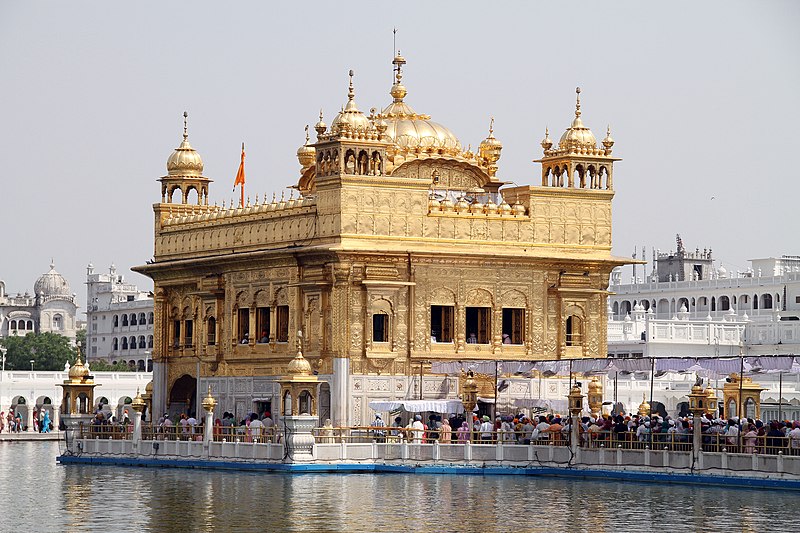
File:Hamandir_Sahib_(Golden_Temple).jpg · Wikimedia Commons · See Wikimedia Commons
Also known as Sikhi, Sikh, Gurmat, Nanakism
دینی یکتاپرستانه که در سده پانزدهم میلادی در پنجاب بنیان نهاده شد.
AI overview
Sikhism is an Indian religion and philosophy that began in the Punjab region around the end of the 15th century, making it one of the world's most recently founded major religions. It is practiced by approximately 25–30 million followers, called Sikhs, and remains an important spiritual tradition today.
AI-generated from the Wikipedia summary — may contain errors.
Key facts
- Religion.name
- Sikhism
- Religion.image
- Hamandir Sahib (Golden Temple).jpg
- Religion.imagewidth
- 250px
- Religion.caption
- Golden Temple in Amritsar, Punjab, India. It is the spiritual capital of Sikhism.
- Religion.main_classification
- Indian
- Religion.scripture
- Guru Granth Sahib
- Religion.governance
- Panj Takht
- Religion.language
- Punjabi and its dialectsSant BhashaKhalsa bole
- Religion.founder
- Guru Nanak
- Religion.founded_date
- 15th–16th century CE
- Religion.founded_place
- Punjab
- Religion.headquarters
- Akal Takht, Amritsar, Punjab, India
- Religion.number_of_followers
- 25–30 million (individually referred to as Sikhs, collectively referred to as Sikh Panth)
- Religion.area
- Predominant religion in Punjab, India (58%), and widespread worldwide as minorities (Sikh diaspora)
via Wikipedia infobox
Wikidata facts
- Instance of
- lifestyle
- Part of
- Bhakti movement
- Named after
- guru-shishya tradition
- Founded by
- Guru Nanak
- Follows
- Hinduism
- Image
- Sikh pilgrim at the Golden Temple (Harmandir Sahib) in Amritsar, India.jpg
Show 18 more facts
- foundational text
- Guru Granth Sahib
- location of formation
- Punjab
- native label
- ਸਿੱਖੀ
- topic's main category
- Category:Sikhism
- topic's main Wikimedia portal
- Portal:Sikhism
- Commons category
- Sikhism
- OpenStreetMap tag
- religion=sikh
- topic has template
- Template:Sikhism
- inception
- 1469-00-00
- on focus list of Wikimedia project
- Wikipedia:Vital articles/Level/4
- different from
- Sikkim
- practiced by
- Sikh
- P8248
- man
- Unicode character
- ☬
- ethnic group
- polyethnicity
- has characteristic
- bhakti
- member count
- 23000000
- described by source
- Encyclopædia Britannica 11th edition
via Wikidata · CC0
Gallery (52)
Available in 161 languages
- Español
- Français
- Deutsch
- 中文
- 日本語
- Русский
- Português
- Italiano
- العربية
- हिन्दी
- abstract
- Afrikaans
- Albanian
- Albanian
- Angika
- Aragonese
- Armenian
- Arpitan
Show 142 more
- Assamese
- Asturian
- Awadhi
- azb
- Azerbaijani
- Bahasa Indonesia
- Bangla
- Bashkir
- Basque
- bat_smg
- be_x_old
- Belarusian
- Betawi
- Bhojpuri
- Bishnupriya
- Bislama
- blk
- Bosnian
- Breton
- btm
- Bulgarian
- Buriat
- Burmese
- Catalan
- Cebuano
- Central Kurdish
- Chechen
- Croatian
- Czech
- Danish
- Divehi
- Egyptian Arabic
- eml
- Esperanto
- Estonian
- Extremaduran
- Faroese
- Fiji Hindi
- Filipino
- Finnish
- fiu_vro
- Friulian
- Galician
- gcr
- Georgian
- Greek
- Guarani
- Hakka Chinese
- Hausa
- Hebrew
- Hungarian
- hyw
- Icelandic
- Iloko
- Interlingua
- Irish
- Jamaican Creole English
- Javanese
- Kannada
- Kanuri
- Kara-Kalpak
- Kashmiri
- Kazakh
- kbp
- Kurdish
- Ladino
- Lao
- Latin
- Latvian
- Limburgish
- Lingua Franca Nova
- Lithuanian
- Lombard
- Low German
- Macedonian
- Maithili
- Malagasy
- Malay
- Malayalam
- Marathi
- Mazanderani
- Mingrelian
- Mirandese
- mnw
- Moksha
- Mongolian
- Moroccan Arabic
- Nederlands
- Nepali
- Newari
- Norwegian
- Norwegian Nynorsk
- Occitan
- Pashto
- Picard
- Piedmontese
- Polski
- Punjabi
- rki
- Romanian
- Romany
- Rusyn
- Sanskrit
- Scots
- Serbian
- Serbian (Latin)
- Shan
- Shona
- simple
- Sindhi
- Sinhala
- skr
- Slovak
- Slovenian
- Somali
- Svenska
- Swahili
- Talysh
- Tamil
- Tatar
- Telugu
- Tibetan
- Tiếng Việt
- Toki Pona
- Türkçe
- Ukrainian
- Urdu
- Uzbek
- Veps
- Waray
- Welsh
- West Flemish
- Western Frisian
- Western Panjabi
- Wu Chinese
- Yakut
- Yiddish
- zh_min_nan
- zh_yue
- فارسی
- ไทย
- 한국어
via Wikidata sitelinks · CC0