File:Lappo.svg · Wikimedia Commons · See Wikimedia Commons
siphon
Sign in to saveAlso known as syphon, syphons, siphons
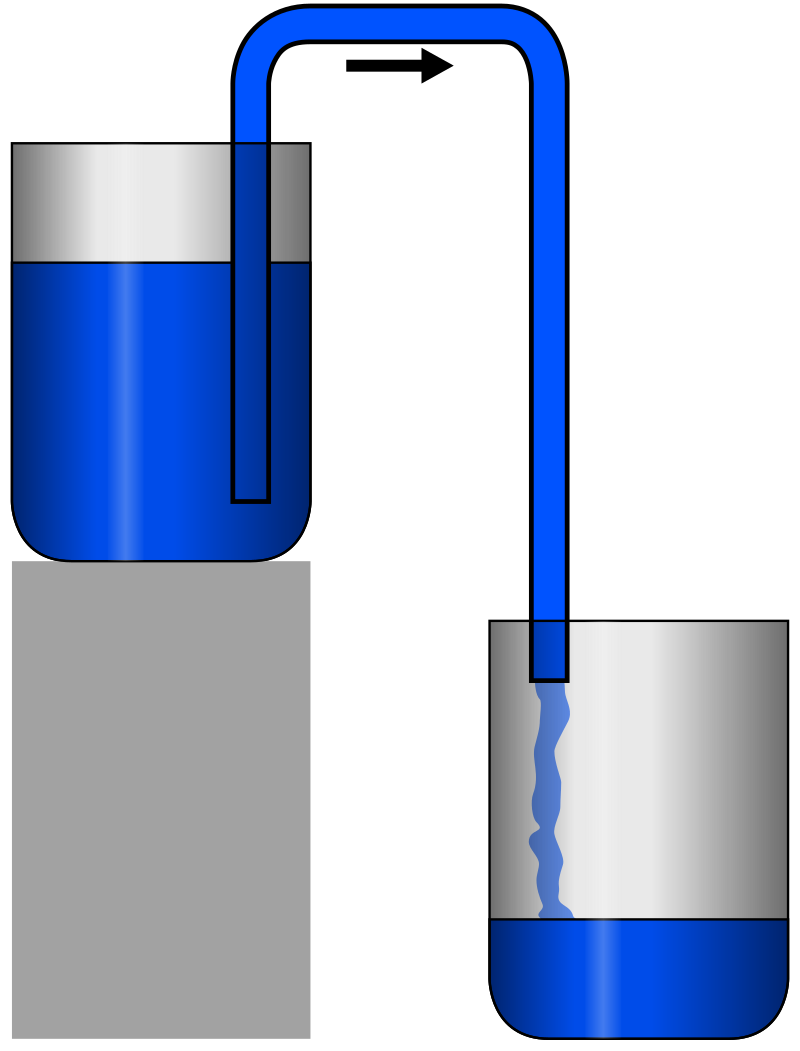
thumb|right|Siphon principle thumb|In the flying-droplet siphon, surface tension pulls the stream of liquid into separate droplets inside of a sealed air-filled chamber, preventing the liquid going down from having contact with the liquid going up, and thereby preventing liquid tensile strength from pulling the liquid up. It also demonstrates that the effect of atmospheric pressure at the entrance is not canceled by the equal atmospheric pressure at the exit.
Wikidata facts
- Subclass of
- appliance
- Image
- Lappo.svg
Show 1 more fact
- Commons category
- Siphons
Sources (1)
via Wikidata · CC0
~55 min read
Encyclopedic overview
37 sectionsContents
- History
- Theory
- Modern research into the operation of the siphon
- Practical requirements
- Automatic intermittent siphon
- Applications and terminology
- Siphon rain gauge
- Siphon drainage
- Siphon spillway
- Flush toilet
- Devices that are not true siphons
- Siphon coffee
- Siphon pump
- Inverted siphon
- Back siphonage
- Anti-siphon valve
- Other anti-siphoning devices
- Siphon barometer
- Siphon bottle
- Siphon cup
- Heron's siphon
- Venturi siphon
- Siphonic roof drainage
- Self-siphons
- In nature
- Anatomy
- Species
- Geology
- Rivers
- Explanation using Bernoulli's equation
- Velocity
- Maximum height
- Operation in a vacuum
- Standards in engineering or industry
- See also
- References
- External links
thumb|right|Siphon principle thumb|In the flying-droplet siphon, surface tension pulls the stream of liquid into separate droplets inside of a sealed air-filled chamber, preventing the liquid going down from having contact with the liquid going up, and thereby preventing liquid tensile strength from pulling the liquid up. It also demonstrates that the effect of atmospheric pressure at the entrance is not canceled by the equal atmospheric pressure at the exit.
A siphon (; also spelled syphon) is any of a wide variety of devices that involve the flow of liquids through tubes. In a narrower sense, the word refers particularly to a tube in an inverted "U" shape, which causes a liquid to flow upward, above the surface of a reservoir, with no pump, but powered by the fall of the liquid as it flows down the tube under the pull of gravity, then discharging at a level lower than the surface of the reservoir from which it came.
Excerpted from Wikipedia’s “siphon” article, available under the CC BY-SA 4.0 licence.