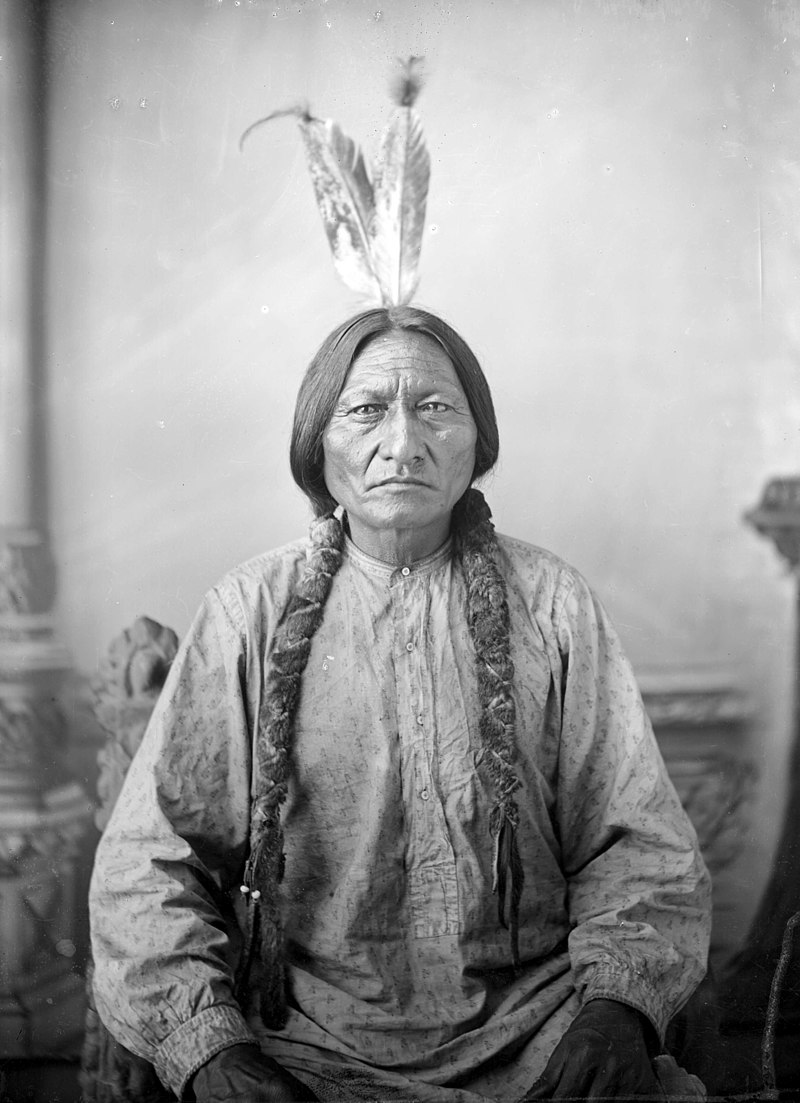
File:Sitting_Bull_by_D_F_Barry_ca_1883_Dakota_Territory.jpg · Wikimedia Commons · See Wikimedia Commons
Sitting Bull
Sign in to saveAlso known as Tatanka Iyotanka, Chief Sitting Bull, Sitting Buffalo Bull, Tȟatȟáŋka Íyotake
Hunkpapa Lakota medicine man and holy man (1831–1890)
Sitting Bull was a Hunkpapa Lakota medicine man and holy man who lived from 1831 to 1890, a period of major conflict between Native Americans and the U.S. government. He remains an important historical figure in American history, particularly for his role in Lakota resistance during the era of westward expansion and Native American displacement.
AI-generated from the Wikipedia summary — may contain errors.
Wikidata facts
- Instance of
- human
- Gender
- male
- Citizenship
- United States
- Place of birth
- Grand River
- Place of death
- Dakota Territory
- Occupation
- medicine man
- Position held
- traditional leader or chief
- Languages spoken
- Lakota
- Native language
- Sioux
- Participant in
- Battle of the Little Bighorn
- Field of work
- Sioux
- Conflict
- Great Sioux War of 1876
- Image
- Tatanka Lyotake.jpg
Show 14 more facts
- Commons category
- Sitting Bull
- date of death
- 1890-12-15
- date of birth
- 1831-01-01
- Commons gallery
- Sitting Bull
- topic's main category
- Category:Sitting Bull
- name in native language
- Tȟatȟáŋka Íyotake
- cause of death
- gunshot wound
- ethnic group
- Lakota people
- described at URL
- www.nytimes.com/1890/12/17/archives/the-death-of-sitting-bull-story-of-the-old-medicine-mans-last-fight.html
- on focus list of Wikimedia project
- Wikipedia:Vital articles/Level/4
- birth name
- Ȟoká Psíče
- present in work
- Sitting Bull
- tribe
- Hunkpapa
- Commons Creator page
- Sitting Bull
Sources (3)
via Wikidata · CC0
~35 min read
Encyclopedic overview
Sitting Bull (Lakota: Tȟatȟáŋka Íyotake [tˣaˈtˣə̃ka ˈijɔtakɛ]; c. 1831–37 – December 15, 1890) was a Hunkpapa Lakota leader who led his people during years of resistance against United States government policies. Sitting Bull was killed by Indian agency police accompanied by U.S. officers and supported by U.S. troops on the Standing Rock Indian Reservation during an attempt to arrest him at a time when authorities feared that he would join the Ghost Dance movement.
Before the Battle of the Little Bighorn, Sitting Bull had a vision in which he saw many soldiers, "as thick as grasshoppers", falling upside down into the Lakota camp, which his people took as a foreshadowing of a major victory in which many soldiers would be killed. About three weeks later, the confederated Lakota tribes with the Northern Cheyenne defeated the 7th Cavalry under Lt. Col. George Armstrong Custer on June 25, 1876, annihilating Custer's battalion and seeming to fulfill Sitting Bull's prophetic vision. Sitting Bull's leadership inspired his people to a major victory. In response, the U.S. government sent thousands more soldiers to the area, forcing many of the Lakota to surrender over the next year. Sitting Bull refused to surrender, and in May 1877, he led his band north to Wood Mountain, North-West Territories, now Saskatchewan. He remained there until 1881, when he and most of his band returned to U.S. territory and surrendered to U.S. forces.
Excerpted from Wikipedia’s “Sitting Bull” article, available under the CC BY-SA 4.0 licence.
Gallery (12)
On the map
Available in 91 languages
- Español
- Français
- Deutsch
- 中文
- 日本語
- Русский
- Português
- Italiano
- العربية
- हिन्दी
- Afrikaans
- Albanian
- Angika
- Asturian
- Awadhi
- Azerbaijani
- Bahasa Indonesia
- Basque
Show 72 more
- Bavarian
- be_x_old
- Belarusian
- Bosnian
- Breton
- Bulgarian
- Catalan
- Cheyenne
- Croatian
- Czech
- Danish
- Egyptian Arabic
- eml
- Esperanto
- Estonian
- Faroese
- Filipino
- Finnish
- fiu_vro
- Galician
- Georgian
- Greek
- Hebrew
- Hungarian
- Icelandic
- Ido
- Interlingua
- Irish
- Kurdish
- Ladino
- Latin
- Latvian
- Ligurian
- Lingua Franca Nova
- Lithuanian
- Low German
- Macedonian
- Maithili
- Malagasy
- Malay
- Malayalam
- Mingrelian
- Nederlands
- Norwegian
- Norwegian Nynorsk
- Occitan
- Ossetic
- Polski
- ppl
- Romanian
- Sanskrit
- Serbian
- Serbian (Latin)
- simple
- Slovak
- Slovenian
- Svenska
- Tamil
- Tiếng Việt
- Türkçe
- Ukrainian
- Veps
- Waray
- Welsh
- Western Frisian
- Wu Chinese
- Zaza
- zh_min_nan
- zh_yue
- فارسی
- ไทย
- 한국어
via Wikidata sitelinks · CC0