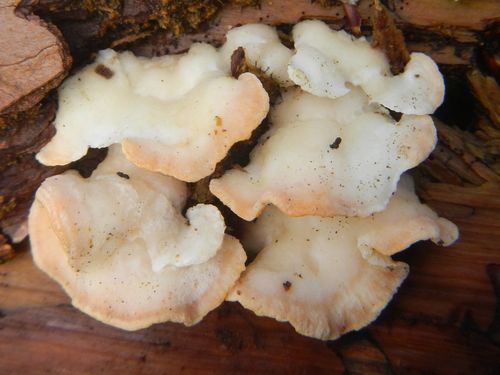
(c) karsten_s, all rights reserved, uploaded by karsten_s
Skeletocutis
Sign in to saveSkeletocutis is a genus of about 40 species of poroid fungi in the family Polyporaceae. The genus has a cosmopolitan distribution, although most species are found in the Northern Hemisphere. It causes a white rot in a diverse array of woody substrates, and the fruit bodies grow as a crust on the surface of the decaying wood. Sometimes the edges of the crust are turned outward to form rudimentary bracket-like caps.
Species
GENUS
- KingdomFungi
- PhylumBasidiomycota
- ClassAgaricomycetes
- OrderPolyporales
- FamilyIncrustoporiaceae
via GBIF
Museum specimens
- Specimen records
- 91
- With media
- 40
- Family
- Incrustoporiaceae
- Collections
- INSTITUTO NACIONAL DE PESQUISAS DA AMAZÔNIA (INPA), TENN-F, MEL, UFRGS, ARIZ, DBG
- Recorded in
- Brasil, United States, Australia, Germany, Paraguay, Dominican Republic, Brazil
Wikidata facts
- Instance of
- taxon
- Parent taxon
- Polyporaceae
- Image
- Skeletocutis.nivea.-.lindsey.jpg
Show 5 more facts
- Commons category
- Skeletocutis
- taxon name
- Skeletocutis
- taxon rank
- genus
- topic's main category
- Category:Skeletocutis
- taxon author citation
- Pouzar & Kotl.
Sources (2)
via Wikidata · CC0
~13 min read
Encyclopedic overview
8 sectionsContents
- Description
- Macroscopic characteristics
- Microscopic characteristics
- Ecology, habitat, and distribution
- Conservation
- Taxonomy
- Species
- References
Skeletocutis is a genus of about 40 species of poroid fungi in the family Polyporaceae. The genus has a cosmopolitan distribution, although most species are found in the Northern Hemisphere. It causes a white rot in a diverse array of woody substrates, and the fruit bodies grow as a crust on the surface of the decaying wood. Sometimes the edges of the crust are turned outward to form rudimentary bracket-like caps.
Skeletocutis is primarily distinguished from similar genera of wood-rotting fungi by microscopic features, especially by the sausage-shaped to ellipsoid spores, and spiny crystals covering certain hyphae in the pore tissue. The genus was circumscribed by Czech mycologists František Kotlaba and Zdenek Pouzar in 1958, with Skeletocutis amorpha as the type species.
Excerpted from Wikipedia’s “Skeletocutis” article, available under the CC BY-SA 4.0 licence.