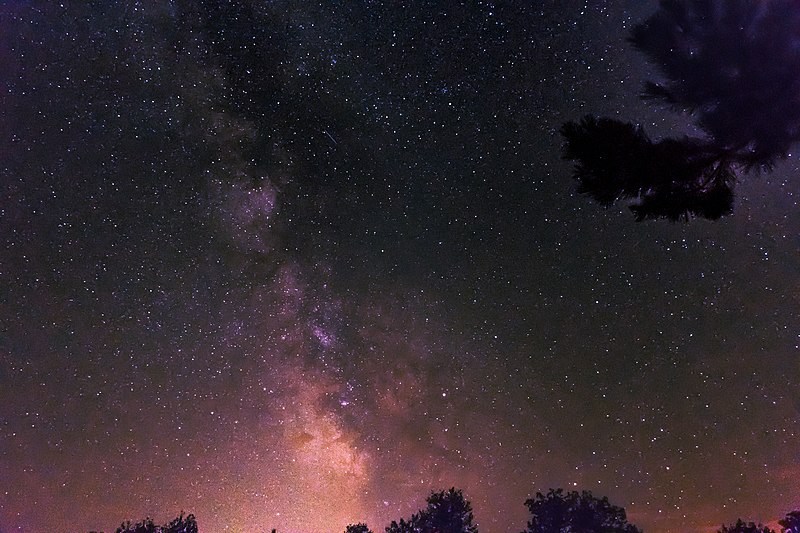
File:July_night_sky_(35972569256).jpg · Wikimedia Commons · See Wikimedia Commons
Also known as celestial dome, celestial vault, firmament
Superfície terrestre
The sky is the atmosphere and space visible above Earth, where clouds, the Moon, and other celestial objects appear. It matters because it contains the air we breathe, protects us from harmful radiation, and plays a central role in weather and climate systems.
AI-generated from the Wikipedia summary — may contain errors.
Wikidata facts
- Instance of
- space
- Subclass of
- space
- Image
- Sky over Munich 02.jpg
- Said to be same as
- celestial spheres
Show 5 more facts
- Commons category
- Sky
- topic's main category
- Category:Sky
- Commons gallery
- Sky
- opposite of
- Earth
- on focus list of Wikimedia project
- Wikipedia:Vital articles/Level/4
via Wikidata · CC0
Article · Português
Céu (do latim cælum) é o panorama obtido a partir da Terra ou da superfície de outro astro celeste qualquer quando se olha para o universo que os rodeia. O panorama obtido pode mostrar-se significativamente influenciado pela presença ou não de atmosfera ao redor do astro no qual situa-se o observador. Em ausência de atmosfera o céu mostra-se negro, e nele destacam-se nitidamente as estrelas e demais astros. Em presença de atmosfera, durante o dia, o céu terrestre mostra-se azulado, e a dispersão da luz estabelece intensidade média de luz que normalmente ofusca os demais astros celestes à exceção do sol e da lua, não sendo aqueles visíveis no céu durante o dia, portanto. O céu noturno assemelha-se bem ao que espera-se encontrar nos casos onde há ausência de atmosfera. Nuvens e outros elementos climáticos também afetam o céu, determinando por vezes belos panoramas. As auroras constituem outro exemplo entre os fenômeno atmosférico que podem influenciar diretamente o céu, não obstante fazendo-o de forma a embelezá-lo. Céu refere-se também ao espaço de dimensões não diretamente comensuráveis via sentidos - e por tal suposto em senso comum infinito - onde encontram-se ou movem-se os demais astros e estrelas do Universo.
Abstract from DBpedia / Wikipedia · CC BY-SA
Gallery (33)
Available in 152 languages
- Español
- Français
- Deutsch
- 中文
- 日本語
- Русский
- Português
- Italiano
- العربية
- हिन्दी
- Adyghe
- Albanian
- Amharic
- Armenian
- Asturian
- Avaric
- Awadhi
- azb
Show 133 more
- Azerbaijani
- Bahasa Indonesia
- Bangla
- Basque
- bat_smg
- Belarusian
- Betawi
- Bhojpuri
- Bosnian
- Breton
- Bulgarian
- Buriat
- Burmese
- Catalan
- Central Kurdish
- Chechen
- Cherokee
- Chuvash
- Corsican
- Croatian
- Czech
- Danish
- dty
- Dzongkha
- Egyptian Arabic
- Esperanto
- Estonian
- Extremaduran
- Fijian
- Filipino
- Finnish
- Galician
- Georgian
- Greek
- Guarani
- Haitian Creole
- Hausa
- Hebrew
- Hungarian
- Icelandic
- Ido
- Ingush
- Interlingua
- Irish
- Javanese
- Jju
- Kabyle
- Kannada
- Kanuri
- Kashmiri
- Kazakh
- Kinyarwanda
- Kurdish
- Latin
- Latvian
- Lingala
- Lithuanian
- Lombard
- Luxembourgish
- Macedonian
- Malagasy
- Malay
- Malayalam
- Māori
- Marathi
- Mingrelian
- Mirandese
- Moksha
- nah
- Nederlands
- Nepali
- Newari
- Norwegian Nynorsk
- nrm
- Occitan
- Old English
- Pali
- Pashto
- Polski
- Punjabi
- Quechua
- roa_rup
- Romanian
- Romany
- Santali
- Scots
- Scottish Gaelic
- Serbian
- Serbian (Latin)
- Sicilian
- simple
- Sindhi
- Slovak
- Slovenian
- Somali
- Southern Altai
- Sundanese
- Svenska
- Swahili
- syl
- Tachelhit
- Tajik
- Tamil
- Taroko
- Tatar
- Telugu
- Tiếng Việt
- Tulu
- Türkçe
- Tyap
- Ukrainian
- Urdu
- Uzbek
- Veps
- Volapük
- Waray
- Wayuu
- Western Frisian
- Western Mari
- Western Panjabi
- Wolof
- Wu Chinese
- Xhosa
- Yiddish
- Zaza
- zh_classical
- zh_min_nan
- zh_yue
- Zhuang
- Zulu
- فارسی
- ไทย
- 한국어
via Wikidata sitelinks · CC0