SkySat
Sign in to saveAlso known as SkySat satellite constellation, SkySat Gen2-1, SkySats 16-18, SkySats 19-21
SkySat is a constellation of sub-meter resolution Earth observation satellites owned by Planet Labs, providing imagery, high-definition video and analytics services. Planet acquired the satellites with their purchase of Terra Bella (formerly Skybox Imaging), a Mountain View, California-based company founded in 2009 by Dan Berkenstock, Julian Mann, John Fenwick, and Ching-Yu Hu, from Google in 2017.
Described at
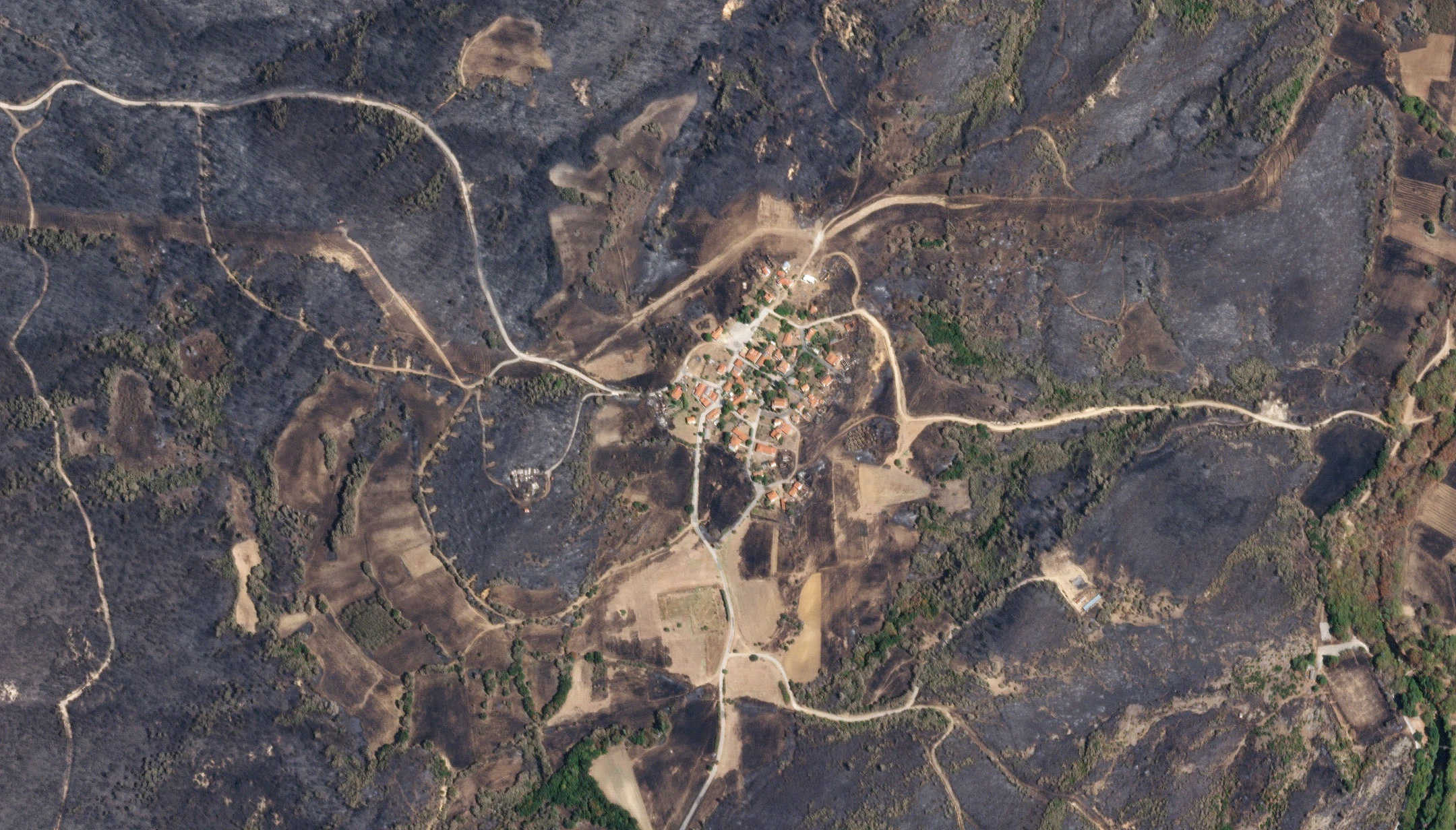
The SkySat satellite constellation consists of multiple launches of the Planet SkySat-C generation satellites, first launched in 2016. Each satellite is 3-axis stabilized and agile enough to slew between different targets of interest. Each satellite has four thrusters for orbital control, along with four reaction wheels and three magnetic torquers for attitude control. Currently, the SkySat constellation consists of morning and afternoon sun-synchronous satellites with an operational altitude of 475 km. The minimum and maximum latitude coverage is up to ±80°, but depends on season. SkySat collects approximately a 5.73 km swath. All SkySat satellites contain Cassegrain telescopes with a focal length of 3.6 m, with three overlapping 5.5 megapixel CMOS imaging detectors making up the focal plane. The central detector is slightly offset from the side detectors, giving SkySat imagery its unique tuning fork outline. SkySat can collect frame imagery, stereo imagery, and video in day or night collects. SkySat images are typically collected in short exposures, coregistered, and stacked to improve the SNR and GSD with super-resolution. SkySat collects RGB, NIR and panchromatic imagery. A SkySat Scene Product is an individual framed scene within a strip, captured by the satellite in its line-scan of the Earth. SkySat Satellites have three cameras per satellite, which capture three overlapping strips. Each of these strips contain overlapping scenes, not organized to any particular tiling grid system. A SkySat Collect Product is created by composing many SkySat Scenes along an imaging strip into an orthorectified segment. Collects are often composed of 60 or more scenes and will be at least 5 km long. They are represented in the Planet Platform as the SkySatCollect item type. This product may be easier to handle, if you're looking at larger areas of interest with SkySat imagery. Due to the image rectification process involved in creating this product, Collect is generally recommended over the Scene product when the AOI spans multiple scenes, particularly if a mosaic or composite image of the individual scenes is required. Collect performs necessary rectification steps automatically. This is especially useful for users who don't feel comfortable doing orthorectification manually. SkySat Scene and Collect products are available for download in the form of imagery assets. Multiple asset types are available for Scene and Collect products, each with differences in radiometric processing and/or rectification. Asset Type availability varies by Item Type. Further details on the supported assets by item type are indicated on each Item Types' documentation site. Basic L1A Panchromatic ( basic l1a panchromatic d ) assets are non-orthorectified, uncalibrated, panchromatic-only imagery products with native sensor resolution. They are typically ready two hours after capture and before all other SkySat asset types are available in the catalog. These products are designed for time-sensitive, low-latency monitoring applications. They can be geometrically corrected with associated rational polynomial coefficients (RPCs) assets derived from satellite telemetry. Basic Analytic ( basic analytic ) assets are non-orthorectified, calibrated, multispectral imagery products with native sensor resolution, that have been transformed to Top of Atmosphere (at-sensor) radiance. The multispectral bands have been co-registered to each other and to the ground. Rational polynomial coefficients (RPCs) assets (ground control applied) are provided for users who wish to geometrically correct the data themselves. This product is designed for data science and analytic applications. Basic Panchromatic ( basic panchromatic ) assets are non-orthorectified, calibrated, super-resolved, panchromatic-only imagery products that have been transformed to Top of Atmosphere (at-sensor) radiance. Rational Polynomial coefficients (RPCs) assets (ground control applied) are provided if yo
Excerpt from a page describing this subject · 20,886 chars · not written by Vinony
Wikidata facts
- Instance of
- artificial satellite of the Earth
- Subclass of
- Earth observation satellite
- Operator
- Planet Labs
- Country of origin
- United States
Show 2 more facts
- Commons category
- Images by SkySat satellites
- described at URL
- developers.planet.com/docs/data/skysat
via Wikidata · CC0
~8 min read
Encyclopedic overview
6 sectionsContents
- Overview
- History
- Satellite constellation
- List of satellites
- References
- External links
SkySat is a constellation of sub-meter resolution Earth observation satellites owned by Planet Labs, providing imagery, high-definition video and analytics services. Planet acquired the satellites with their purchase of Terra Bella (formerly Skybox Imaging), a Mountain View, California-based company founded in 2009 by Dan Berkenstock, Julian Mann, John Fenwick, and Ching-Yu Hu, from Google in 2017.
==Overview== thumb|SkySat image of Apple Park taken in May 2017. thumb|SkySat off-nadir image of [[Fitz Roy]] thumb|SkySat image of São Paulo, the largest city in Brazil
Excerpted from Wikipedia’s “SkySat” article, available under the CC BY-SA 4.0 licence.