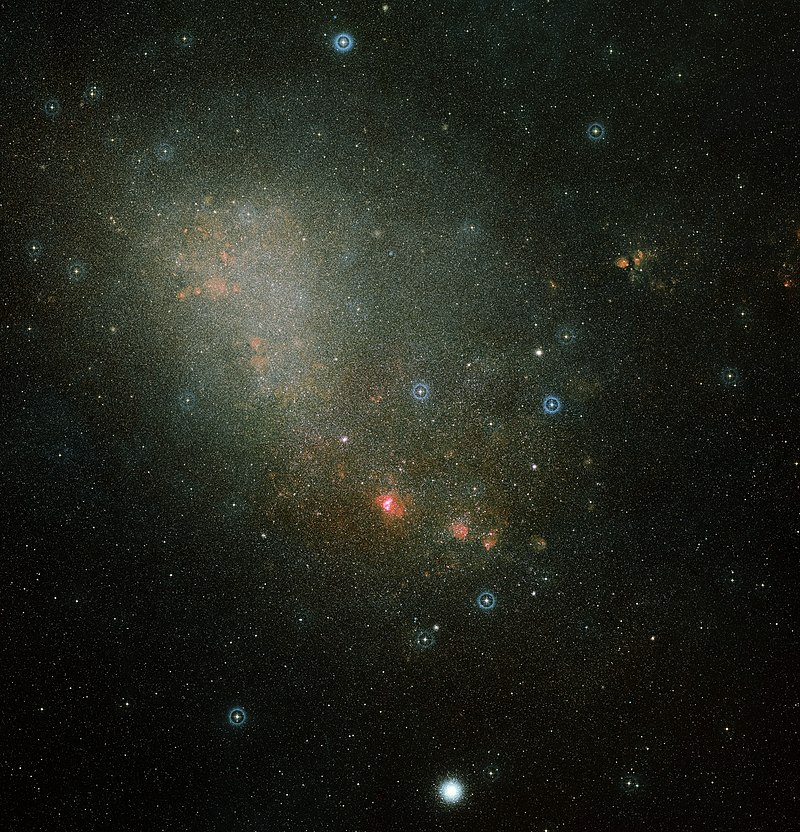
File:Small_Magellanic_Cloud_(Digitized_Sky_Survey_2).jpg · Wikimedia Commons · See Wikimedia Commons
Small Magellanic Cloud
Sign in to saveAlso known as SMC
irregular galaxy, satellite galaxy of the Milky Way
The Small Magellanic Cloud is an irregular galaxy that orbits our Milky Way as one of its satellite galaxies. It matters to astronomers because studying it helps us understand galaxy formation and evolution, as well as the structure and history of our own galactic neighborhood.
AI-generated from the Wikipedia summary — may contain errors.
Wikidata facts
- Instance of
- astrophysical X-ray source
- Has part
- NGC 330
- Named after
- Ferdinand Magellan
- Constellation
- Tucana
- Child body
- NGC 265
- Distance from Earth
- 62
- Radius
- 7000
- Image
- SMC - Noirlab2030b.jpg
Show 17 more facts
- Commons category
- Small Magellanic Cloud
- catalog code
- 3FGL J0059.0-7242e
- galaxy morphological type
- dIrr
- topic's main category
- Category:Small Magellanic Cloud
- time of discovery or invention
- 1521-00-00
- discoverer or inventor
- Ferdinand Magellan
- apparent magnitude
- 2.2
- absolute magnitude
- -16.2
- redshift
- 0.000527
- right ascension
- 13.15833
- declination
- -72.80028
- radial velocity
- 145.6
- epoch
- J2000.0
- metallicity
- -1.07
- short name
- MMO
- right ascension component of proper motion
- 0.772
- declination component of proper motion
- -1.117
Sources (2)
via Wikidata · CC0
~10 min read
Encyclopedic overview
The Small Magellanic Cloud (SMC) is a dwarf galaxy near the Milky Way. Classified as a dwarf irregular galaxy, the SMC has a D25 isophotal diameter of about 5.78 kiloparsecs (18,900 light-years), and contains several hundred million stars. It has a total mass of approximately 7 billion solar masses. At a distance of about 200,000 light-years, the SMC is among the nearest intergalactic neighbors of the Milky Way and is one of the most distant objects visible to the naked eye.
The SMC is visible from the entire Southern Hemisphere and can be fully glimpsed low above the southern horizon from latitudes south of about 15° north. The galaxy is located across the constellation of Tucana and part of Hydrus, appearing as a faint, hazy patch resembling a detached piece of the Milky Way. The SMC has an average apparent diameter of about 4.2° (8 times the Moon's) and thus covers an area of about 14 square degrees (70 times the Moon's). Since its surface brightness is very low, this deep-sky object is best seen on clear moonless nights and away from city lights. The SMC forms a pair with the Large Magellanic Cloud (LMC), which lies 20° to the east, and, like the LMC, is a member of the Local Group. It is currently a satellite of the Milky Way but is likely a former satellite of the LMC.
Excerpted from Wikipedia’s “Small Magellanic Cloud” article, available under the CC BY-SA 4.0 licence.
Gallery (6)
Available in 65 languages
- Español
- Français
- Deutsch
- 中文
- 日本語
- Русский
- Português
- Italiano
- العربية
- हिन्दी
- Afrikaans
- Armenian
- Azerbaijani
- Bahasa Indonesia
- Bangla
- Basque
- Belarusian
- Bosnian
Show 46 more
- Breton
- Bulgarian
- Burmese
- Catalan
- Central Kurdish
- Chechen
- Croatian
- Czech
- Danish
- Egyptian Arabic
- Esperanto
- Estonian
- Finnish
- Greek
- Guarani
- Hebrew
- Hungarian
- Irish
- Kazakh
- Latin
- Lithuanian
- Macedonian
- Malagasy
- Malayalam
- Nederlands
- Norwegian
- Norwegian Nynorsk
- Polski
- Romanian
- Serbian
- Serbian (Latin)
- Slovak
- Slovenian
- Svenska
- Tatar
- Tiếng Việt
- Türkçe
- Udmurt
- Ukrainian
- Wu Chinese
- Yakut
- Zaza
- zh_yue
- فارسی
- ไทย
- 한국어
via Wikidata sitelinks · CC0