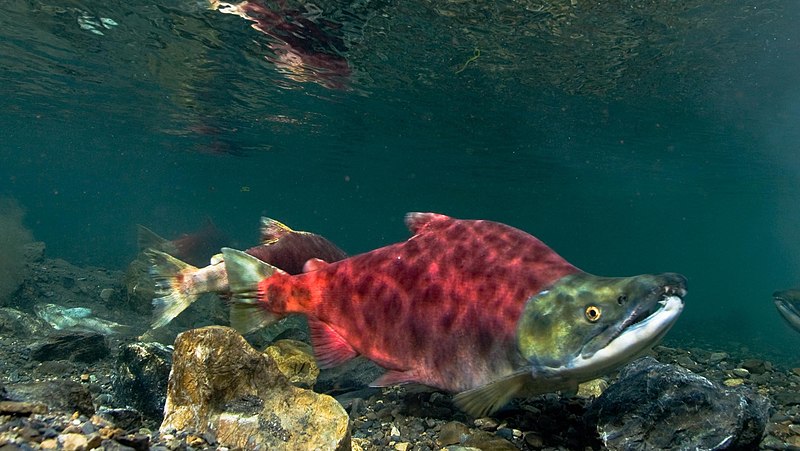
File:Sockeye_salmon_swimming_right.jpg · Wikimedia Commons · See Wikimedia Commons
sockeye salmon
Sign in to saveAlso known as Oncorhynchus nerka, red salmon, kokanee, kokanee salmon, blueback salmon, blue-back, blueback, Fraser River salmon
species of Pacific salmon
OverviewAI-generated
The sockeye salmon, scientifically known as *Oncorhynchus nerka*, is a species of fish within the family Salmonidae. It belongs to the order Salmoniformes, class Teleostei, and phylum Chordata. The taxon was described by Walbaum in 1792 and is currently accepted as a valid species. Common names for this organism include red salmon and kokanee.
This fish inhabits marine, brackish, and freshwater environments. The IUCN Red List assessed its conservation status as Least Concern in 2011. The species is also categorized as a food product and a subclass of fish as food.
Synthesized by Vinony from 23 facts across 4 sources: Wikidata, WoRMS, IUCN Red List, Vinony graph. Generated from structured data (not the Wikipedia text) and checked against those facts — may still contain errors.
Species
Least Concernkokanee
Species
- PhylumChordata
- ClassTeleostei
- OrderSalmoniformes
- FamilySalmonidae
Der Rotlachs (Oncorhynchus nerka) oder Blaurückenlachs (englisch Sockeye; russisch Nerka, wovon der wissenschaftliche Name abgeleitet wurde) ist eine Art der im Pazifischen Ozean lebenden Lachse. Er kann bis zu 90 cm lang werden. Im Meer hat er einen blaugrünen Rücken und silbernen Bauch, in den Gewässern auf dem Land hat er einen hellgrünen Kopf, einen roten Rücken und Schwanz (daher der Name) und einen silbernen Bauch. Der Rotlachs kommt an der nordamerikanischen Küste des Pazifiks von Alaska bis zum Sacramento River in Kalifornien vor, an der asiatischen Küste vom Anadyrbecken bis Hokkaidō, besonders an der Ostküste Kamtschatkas, seltener im Ochotskischen Meer (Nordteil sowie Ostküste Sachalins). Als erwachsene Tiere leben die Fische im offenen Ozean. Die Lachse werden in Seen auf dem Festland geboren, verbleiben dort etwa ein ganzes Jahr lang. Dann wandern sie ins Meer – dieser Vorgang kann bis zu drei Jahre dauern. Dort bleiben sie zwei bis vier Jahre, bis sie zurück zu ihrem Geburtsgewässer schwimmen, dort laichen und sterben. Von allen Pazifiklachsarten hat der Rotlachs den größten wirtschaftlichen Wert. Die weiten Wanderungen zwischen Geburtsgewässer und offenem Meer werden
via IUCN
Wikidata facts
- Instance of
- food product
- Subclass of
- fish as food
- Parent taxon
- Oncorhynchus
- Image
- Sammamish kokanee (51666400632).jpg
Show 8 more facts
- taxon rank
- species
- IUCN conservation status
- Least Concern
- Commons category
- Oncorhynchus nerka
- taxon name
- Oncorhynchus nerka
- Commons gallery
- Oncorhynchus nerka
- described at URL
- spsseg.org/meet-the-7-species-of-pacific-salmon
- taxon common name
- 紅鉤吻鮭
- short name
- O. nerka
Sources (3)
via Wikidata · CC0
~20 min read
Encyclopedic overview
The sockeye salmon (Oncorhynchus nerka), also called red salmon, kokanee salmon, blueback salmon, or simply sockeye, is an anadromous species of salmon found in the Northern Pacific Ocean and rivers discharging into it. This species is a Pacific salmon that is primarily red in hue during spawning. They can grow up to 84 cm (2 ft 9 in) in length and weigh 2.3 to 7 kg (5–15 lb). Juveniles remain in freshwater until they are ready to migrate to the ocean, over distances of up to 1,600 km (1,000 mi). Their diet consists primarily of zooplankton. Sockeye salmon are semelparous, dying after they spawn. Some populations, referred to as kokanee, do not migrate to the ocean and live their entire lives in fresh water.
Classification and name origin
Excerpted from Wikipedia’s “sockeye salmon” article, available under the CC BY-SA 4.0 licence.