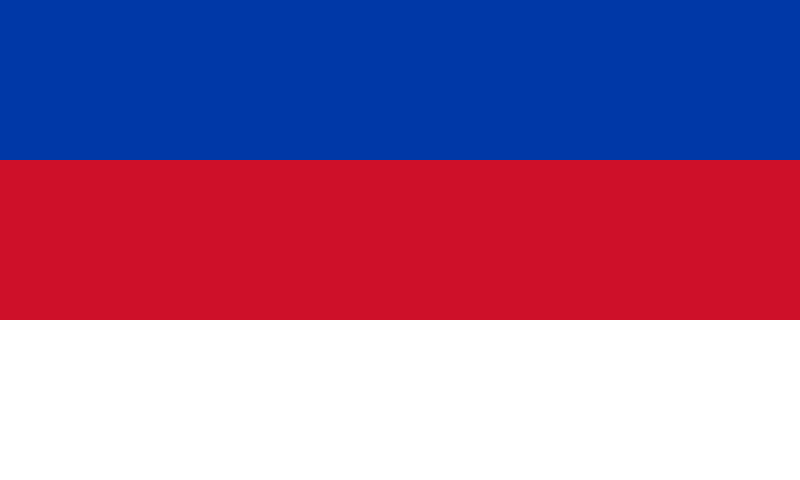
File:Flag_of_Sorbs.svg · Wikimedia Commons · See Wikimedia Commons
Sorbs
Sign in to saveAlso known as Lusatians
Sorbs (; ; ; ; ; ; also known as Lusatians, Lusatian Serbs and Wends) are an indigenous West Slavic ethnic group predominantly inhabiting the parts of Lusatia located in the German states of Saxony and Brandenburg. Sorbs traditionally speak the Sorbian languages (also known as "Wendish" and "Lusatian"), which are closely related to Polish (Lechitic languages) and Czech, Slovak. Upper Sorbian and Lower Sorbian are officially recognized minority languages in Germany.
Sorbs are an indigenous West Slavic ethnic group primarily living in parts of eastern Germany (Saxony and Brandenburg), with their own distinct languages closely related to Polish and Czech. Their languages, Upper Sorbian and Lower Sorbian, are officially recognized as minority languages in Germany, making the Sorbs culturally and linguistically significant to the region's diversity.
AI-generated from the Wikipedia summary — may contain errors.
Key facts
- Ethnic group.group
- Sorbs
- Ethnic group.flag
- 200px|border
- Ethnic group.flag_caption
- Sorbian flag, in pan-Slavic colours, introduced in 1842
- Ethnic group.image
- 180px
- Ethnic group.caption
- Traditional female costume of Lower Lusatia (Spreewald)
- Ethnic group.population
- 80,000 (est.)• 45,000–60,000 Upper Sorbs• 15,000–20,000 Lower Sorbs
- Ethnic group.pop1
- 60,000 Sorbs in Germany (20,000 of which still speak Sorbian) (2007 Reuters estimate)
- Ethnic group.pop2
- 2,000
- Ethnic group.pop3
- fewer than 1,000
- Ethnic group.pop4
- 1,245 (2000)
- Ethnic group.langs
- Sorbian, Polish (New mixed dialects), Standard German (German), Central German (Lusatian dialects), Czech, Slovak
- Ethnic group.rels
- Majority Roman Catholicism, Protestantism
- Ethnic group.related
- Other West Slavs (especially Czechs, Poles, and Slovaks)
via Wikipedia infobox
Wikidata facts
- Instance of
- ethnic group
- Subclass of
- East Slavs
- Religion
- Catholicism
- Population
- 60000
- Image
- Serbske chorhoje.jpg
- Said to be same as
- Wends
Show 7 more facts
- indigenous to
- Lusatia
- subject has role
- national minority
- studied by
- Sorbian studies
- Commons category
- Sorbs
- topic's main category
- Category:Sorbs
- name in native language
- Serbja
- language used
- Lower Sorbian
Sources (1)
via Wikidata · CC0
~69 min read
Encyclopedic overview
50 sectionsContents
- Etymology
- History
- Early Middle Ages
- High and Late Middle Ages
- Early modern period
- Late modern period
- Interbellum and World War II
- East Germany
- After reunification
- Population genetics
- Language and culture
- Fine arts
- Traditions
- Religion
- National symbols
- Regions of Lusatia
- Region of Upper Lusatia
- Region of Hoyerswerda (Wojerecy) and Schleife (Slepo)
- Region of Lower Lusatia
- Relations with other Slavic nations
- Relations with Poland
- Medieval period
- 18th century
- 19th century
- Early 20th century
- After World War II
- Relations with Czechia
- Relations with Yugoslavia
- Relations with Slovakia
- Demography
- Diaspora
- Institutions
- Domowina
- Foundation for the Sorbian People
- Institute for Sorbian Studies
- Sorbian Institute
- Domowina Publishing House
- Sorbian Museum
- Sorbian National Ensemble
- Schools and kindergartens
- Media
- Sorbian in literature, film, and television
- Literature
- Film and television
- See also
- Notes
- References
- Sources
- Further reading
- External links
Sorbs (; ; ; ; ; ; also known as Lusatians, Lusatian Serbs and Wends) are an indigenous West Slavic ethnic group predominantly inhabiting the parts of Lusatia located in the German states of Saxony and Brandenburg. Sorbs traditionally speak the Sorbian languages (also known as "Wendish" and "Lusatian"), which are closely related to Polish (Lechitic languages) and Czech, Slovak. Upper Sorbian and Lower Sorbian are officially recognized minority languages in Germany.
In the Early Middle Ages, the Sorbs formed their own principality, which later shortly became part of the early West Slavic Samo's Empire and Great Moravia, as were ultimately conquered by the East Francia (Sorbian March) and Holy Roman Empire (Saxon Eastern March, Margravate of Meissen, March of Lusatia). From the High Middle Ages, they were ruled at various times by the closely related Poles and Czechs, as well as the more distant Germans and Hungarians. Due to a gradual and increasing assimilation between the 17th and 20th centuries, virtually all Sorbs also spoke German by the early 20th century. In the newly created German nation state of the late 19th and early 20th centuries, policies were implemented in an effort to Germanize the Sorbs. These policies reached their climax under the Nazi regime, who denied the existence of the Sorbs as a distinct Slavic people by referring to them as "Sorbian-speaking Germans". The community is divided religiously between Roman Catholicism (the majority) and Lutheranism. The former Minister President of Saxony Stanislaw Tillich is of Sorbian origin.
Excerpted from Wikipedia’s “Sorbs” article, available under the CC BY-SA 4.0 licence.
Gallery (52)
Available in 71 languages
- Español
- Français
- Deutsch
- 中文
- 日本語
- Русский
- Português
- Italiano
- العربية
- Afrikaans
- Albanian
- Aragonese
- Armenian
- azb
- Bahasa Indonesia
- Basque
- bat_smg
- be_x_old
Show 52 more
- Belarusian
- Betawi
- Bosnian
- Breton
- Bulgarian
- Catalan
- Church Slavic
- Croatian
- Czech
- Danish
- Egyptian Arabic
- Esperanto
- Estonian
- Finnish
- Friulian
- Galician
- Greek
- Hebrew
- Hungarian
- Ido
- Irish
- Kazakh
- Latvian
- Lithuanian
- Lombard
- Lower Sorbian
- Macedonian
- Nederlands
- Norwegian
- Norwegian Nynorsk
- Old English
- Ossetic
- Polski
- Romanian
- Romansh
- Serbian
- Serbian (Latin)
- Silesian
- simple
- Slovak
- Slovenian
- Svenska
- Türkçe
- Ukrainian
- Upper Sorbian
- Welsh
- Western Frisian
- Western Mari
- Wu Chinese
- فارسی
- ไทย
- 한국어
via Wikidata sitelinks · CC0