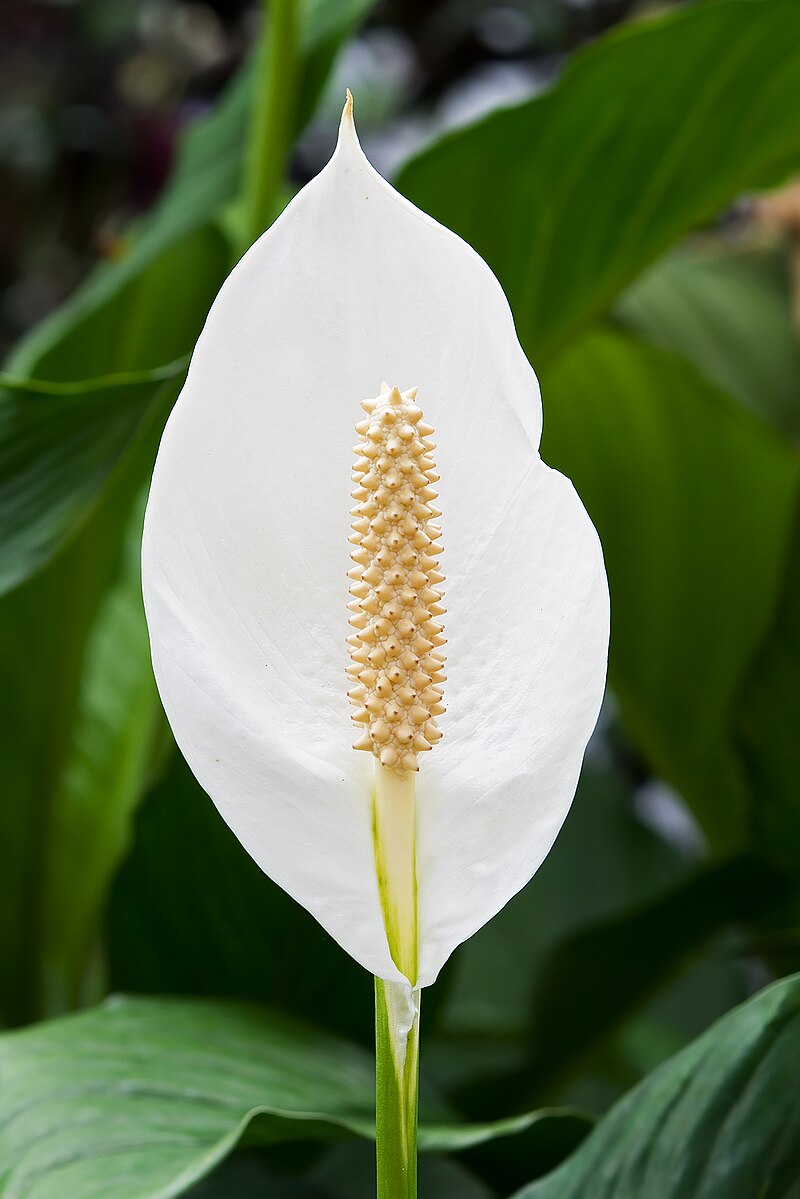
File:Spathiphyllum_cochlearispathum_RTBG.jpg · Wikimedia Commons · See Wikimedia Commons
Spathiphyllum
Sign in to saveSpathiphyllum is a genus of about 60 species of monocotyledonous flowering plants in the family Araceae, native to tropical regions of the Americas and southeastern Asia. Certain species of Spathiphyllum are commonly known as spath or peace lilies.
OverviewAI-generated
Spathiphyllum is a genus of plants within the family Araceae. It belongs to the kingdom Plantae, phylum Tracheophyta, class Liliopsida, and order Alismatales. The genus has several common names, including Scheidenblatt, Spath, Spatifilo, and Viirivehkat. A specific species within this group is commonly known as the Peace Lily.
Records indicate that Spathiphyllum has been introduced to Bangladesh, Comoros, Cook Is., Cuba, Dominican Republic, Puerto Rico, and Venezuelan Antilles. Occurrence data from various sources, including iDigBio, lists presence in Mexico, the United States, the Philippines, Panama, and Papua New Guinea. The genus is associated with institutions such as UACH, UNICACH, INECOL, STDOM, and BRIT.
Synthesized by Vinony from 32 facts across 7 sources: Wikidata, GBIF, iNaturalist, Gbif Occ, Plants of the World, iDigBio, Vinony graph. Generated from structured data (not the Wikipedia text) and checked against those facts — may still contain errors.
Species
Peace Lily
GENUS
- KingdomPlantae
- PhylumTracheophyta
- ClassLiliopsida
- OrderAlismatales
- FamilyAraceae
Spathiphyllum est un genre de plantes originaire d'Amérique du Sud. Certaines espèces sont appelées fleurs de Lune ou lys de la paix[réf. nécessaire]. Ces plantes aiment la lumière vive, un sol neutre. Ce sont des plantes vivaces qui peuvent atteindre 1 mètre dans de bonnes conditions. Leur feuillage est persistant. Une étude de la NASA (en) datant de 1989 a démontré que cette plante participe à la détoxification de l'air en réduisant la teneur en benzène, formaldéhyde, trichloréthylène, xylène, toluène et ammoniac[1]. Cette plante est toxique pour les chiens et les chats. Sommaire 1 Liste des espèces 2 Galerie de photos 3 Notes et références 4 Liens externes Liste des espèces Selon World Checklist of Selected Plant Families (WCSP) (26 sept. 2011)[2] : Spathiphyllum atrovirens Schott Spathiphyllum barbourii Croat Spathiphyllum bariense G.S.Bunting Spathiphyllum blandum Schott Spathiphyllum brent-berlinii Croat Spathiphyllum brevirostre (Liebm.) Schott Spathiphyllum buntingianum Croat Spathiphyllum cannifolium (Dryand. ex Sims) Schott Spathiphyllum cochlearispathum (Liebm.) Engl. Spathiphyllum commutatum Schott Spathiphyllum cuspidatum Schott Spathiphyllum diazii Croat Spathiphyllum
via GBIF · Kew POWO
Museum specimens
- Specimen records
- 485
- With media
- 415
- Family
- Araceae
- Collections
- UACH, UNICACH, INECOL, STDOM, BRIT, ENCB-IPN
- Recorded in
- Mexico, United States, Philippines, Panama, Papua New Guinea
Wikidata facts
Show 7 more facts
- taxon rank
- genus
- taxon name
- Spathiphyllum
- Commons category
- Spathiphyllum
- topic's main category
- Category:Spathiphyllum
- Commons gallery
- Spathiphyllum
- taxon common name
- 白鹤芋属
Sources (1)
via Wikidata · CC0
~7 min read
Encyclopedic overview
11 sectionsContents
- Description
- Ecology and distribution
- Taxonomy
- Selected species
- Cultivation and uses
- Toxicity
- Diseases
- History
- See also
- References
- External links
Spathiphyllum is a genus of about 60 species of monocotyledonous flowering plants in the family Araceae, native to tropical regions of the Americas and southeastern Asia. Certain species of Spathiphyllum are commonly known as spath or peace lilies.
They are evergreen herbaceous perennial plants with large leaves long and broad. The flowers are produced in a spadix, surrounded by a long, white, yellowish, or greenish spathe. The plant does not require large amounts of light or water to survive. It is most often grown as a houseplant. However, it can withstand the elements well enough to thrive when planted outdoors in hot and humid environments.
Excerpted from Wikipedia’s “Spathiphyllum” article, available under the CC BY-SA 4.0 licence.