Encyclopedia of Life · EOL (see source)
OverviewAI-generated
The spectacled eider, scientifically named *Somateria fischeri*, is a species of bird within the family Anatidae. It belongs to the order Anseriformes, class Aves, and phylum Chordata. The taxon is classified under the parent group eider and is also referred to by the common name Fischer's eider. Its scientific authority is listed as (Brandt, 1847), and its taxonomic status is accepted.
This marine species has an average litter size of 4.5 and a mass of 73. The IUCN Red List assessed its conservation status as Near Threatened in 2020. The species is referenced by 45 other encyclopedia articles.
Synthesized by Vinony from 23 facts across 4 sources: Wikidata, WoRMS, IUCN Red List, Vinony graph. Generated from structured data (not the Wikipedia text) and checked against those facts — may still contain errors.
Species
Near ThreatenedFischer's eider
Species
- PhylumChordata
- ClassAves
- OrderAnseriformes
- FamilyAnatidae
Observations: Little is known about the longevity of these animals. Record longevity from banding studies is 8.8 years (http://www.pwrc.usgs.gov/BBL/homepage/longvrec.htm). Considering the longevity of similar species, however, maximum longevity could be significantly underestimated.
via IUCN
Wikidata facts
- Instance of
- taxon
- Parent taxon
- eider
- Mass
- 1.368
- Image
- 048 - SPECTACLED EIDER (6-17-2016) barrow, alaska -05 (27890171860).jpg
Show 8 more facts
- taxon rank
- species
- IUCN conservation status
- Near Threatened
- taxon name
- Somateria fischeri
- Commons category
- Somateria fischeri
- Commons gallery
- Somateria fischeri
- taxon common name
- eider-de-lunetas
- litter size
- 4.5
- short name
- S. fischeri
Sources (3)
via Wikidata · CC0
~4 min read
Encyclopedic overview
The spectacled eider (pronounced /ˈaɪ.dər/) (Somateria fischeri) is a large sea duck that breeds on the coasts of Alaska and northeastern Siberia.
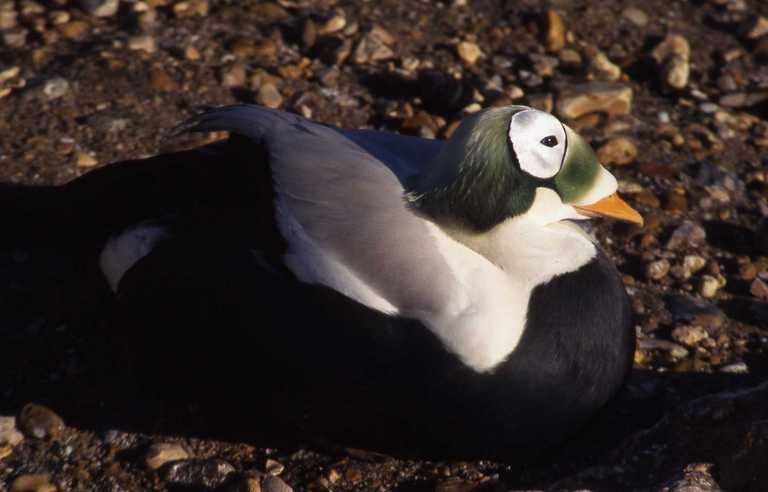
The spectacled eider is slightly smaller than the common eider at 52–57 cm (20.5–22.5 in) in length. The male is unmistakable with its black body, white back, and yellow-green head with the large circular white eye patches which give the species its name. The drake's call is a weak crooning, and the female's a harsh croak.
Excerpted from Wikipedia’s “spectacled eider” article, available under the CC BY-SA 4.0 licence.