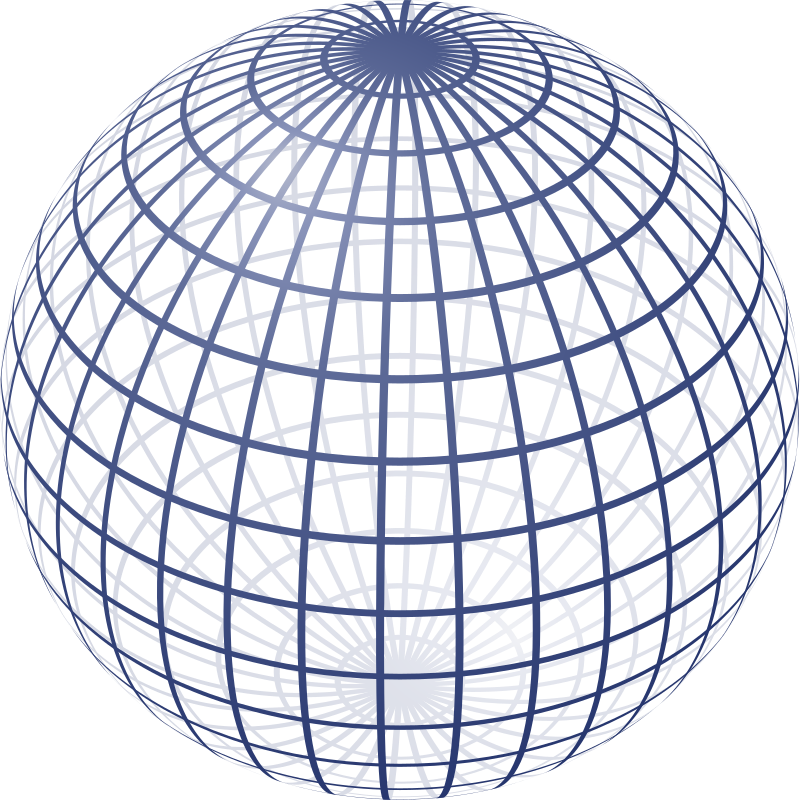
File:Sphere_wireframe_10deg_6r.svg · Wikimedia Commons · See Wikimedia Commons
esfera
Sign in to saveAlso known as 2-sphere, orb
lugar geométrico o el conjunto de los puntos del espacio cuyos puntos equidistan de otro interior llamado centro
A sphere is a perfectly round three-dimensional shape where every point on its surface sits at an equal distance from a central point, much like how a circle works in two dimensions. Spheres matter because they are a fundamental geometric form that appears throughout mathematics, nature, and everyday objects like planets and balls, making them essential to understanding spatial relationships and physical properties of the world around us.
AI-generated from the Wikipedia summary — may contain errors.
Key facts
- Polyhedron<! Please add only parameters that make sense for a sphere. >.name
- Sphere
- Polyhedron<! Please add only parameters that make sense for a sphere. >.image
- File:Sphere wireframe 10deg 6r.svg
- Polyhedron<! Please add only parameters that make sense for a sphere. >.caption
- A perspective projection of a sphere
- Polyhedron<! Please add only parameters that make sense for a sphere. >.euler
- 2
- Polyhedron<! Please add only parameters that make sense for a sphere. >.symmetry
- Orthogonal group|
- Polyhedron<! Please add only parameters that make sense for a sphere. >.type
- Smooth surfaceAlgebraic surface
via Wikipedia infobox
Wikidata facts
- Subclass of
- geometric primitive
- Followed by
- torus
- Follows
- circle
- Image
- Sphere Quadric.png
- Said to be same as
- Riemann sphere
Show 9 more facts
- Commons category
- Spheres
- Euler characteristic
- 2
- topic's main category
- Category:Spheres
- has characteristic
- genus
- different from
- three-ball
- Commons gallery
- Sphere
- on focus list of Wikimedia project
- Wikipedia:Vital articles/Level/4
- maintained by WikiProject
- WikiProject Mathematics
- described by source
- Encyclopædia Britannica 11th edition
via Wikidata · CC0
Article · Español
En geometría, una superficie esférica es una superficie de revolución formada por el conjunto de todos los puntos del espacio que equidistan de un punto llamado centro. Para los puntos cuya distancia es menor que la longitud del radio, se dice que forman el interior de la superficie esférica. La unión del interior y la superficie esférica se llama bola cerrada en topología, o esfera, como en geometría elemental del espacio. La esfera es un sólido geométrico. La esfera, como sólido de revolución, se genera haciendo girar una superficie semicircular alrededor de su diámetro (Euclides, L. XI, def. 14). Esfera proviene del término griego σφαῖρα, sphaîra, que significa pelota (para jugar). Coloquialmente hablando, se emplea la palabra bola, para describir al cuerpo delimitado por una esfera.
Abstract from DBpedia / Wikipedia · CC BY-SA
Gallery (30)
Available in 109 languages
- Español
- Français
- Deutsch
- 中文
- 日本語
- Русский
- Português
- Italiano
- العربية
- हिन्दी
- Afrikaans
- Albanian
- Amharic
- Armenian
- Asturian
- azb
- Azerbaijani
- Bahasa Indonesia
Show 90 more
- Bangla
- Bashkir
- Basque
- Belarusian
- Bhojpuri
- Bosnian
- Bulgarian
- Burmese
- Catalan
- Central Kurdish
- Cherokee
- Chuvash
- Croatian
- Czech
- Danish
- Esperanto
- Estonian
- Fijian
- Filipino
- Finnish
- Galician
- Gan Chinese
- gcr
- Georgian
- Greek
- Gujarati
- Haitian Creole
- Hebrew
- Hungarian
- Icelandic
- Ido
- Interlingua
- Irish
- Jamaican Creole English
- Kabyle
- Kannada
- Kazakh
- Latin
- Latvian
- Lithuanian
- Macedonian
- Malagasy
- Malay
- Malayalam
- Moksha
- Mongolian
- Moroccan Arabic
- Nederlands
- Northern Frisian
- Norwegian
- Norwegian Nynorsk
- Occitan
- Oromo
- Piedmontese
- Polski
- Punjabi
- Quechua
- Romanian
- rsk
- Scottish Gaelic
- Serbian
- Serbian (Latin)
- Shona
- Sicilian
- simple
- Sinhala
- Slovak
- Slovenian
- Somali
- Sundanese
- Svenska
- Swahili
- Tamil
- Tatar
- Telugu
- Tiếng Việt
- Toki Pona
- Türkçe
- Ukrainian
- Uzbek
- Waray
- Welsh
- Wu Chinese
- Yakut
- zh_classical
- zh_min_nan
- zh_yue
- فارسی
- ไทย
- 한국어
via Wikidata sitelinks · CC0