Wang, Ailing;Guan, Wei;Wang, Shuxia
Stathmopoda
Sign in to savethumb|Stathmopoda campylocha thumb|Stathmopoda distincta thumb|Stathmopoda plumbiflua thumb|Stathmopoda skelloni Stathmopoda is a genus of moths. It has variously been placed in its own family, Stathmopodidae, or in subfamily Stathmopodinae in the family Oecophoridae. Note that the phylogeny and systematics of gelechoid moths are still not fully resolved.
Species
GENUS
- KingdomAnimalia
- PhylumArthropoda
- ClassInsecta
- OrderLepidoptera
- FamilyStathmopodidae
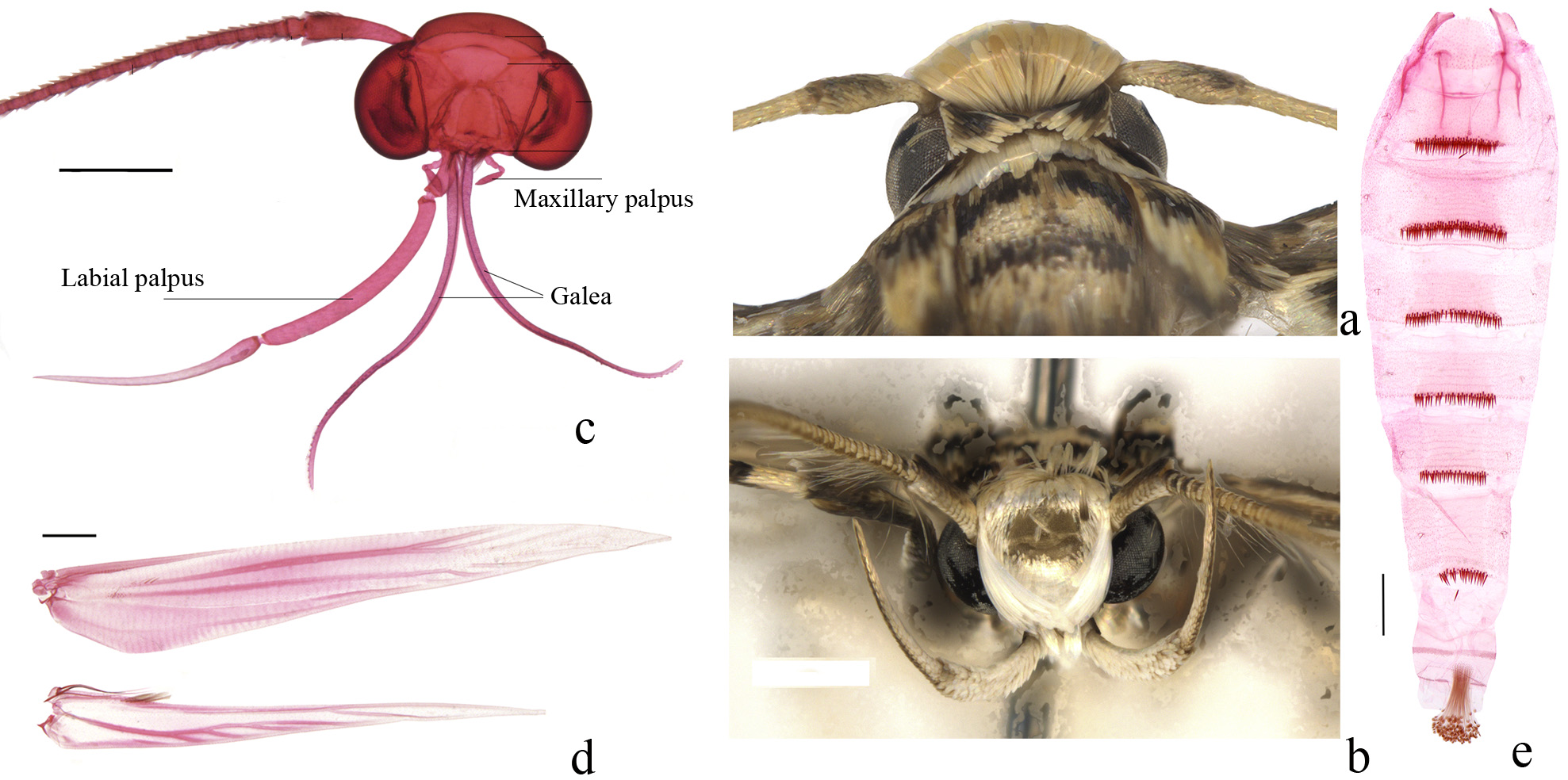
Die Stathmopoda sind eine Gattung von Schmetterlingen aus der Familie der Stathmopodidae. Inhaltsverzeichnis 1 Merkmale 2 Verbreitung 3 Biologie 4 Systematik 5 Quellen 5.1 Einzelnachweise 6 Weblinks Merkmale Der Kopf ist glatt beschuppt. Die Fühler sind etwa 3/4 so lang wie die Vorderflügel und bei den Männchen bewimpert. Die Labialpalpen sind zylindrisch und gestreckt, das dritte Segment ist stark nach oben gebogen. Die Vorderflügel sind schmal lanzettlich und zum Apex hin zugespitzt. Sie haben häufig eine gelbliche oder bräunliche Zeichnung. Die Hinterflügel sind sehr schmal und gerade. Bei den Genitalien der Männchen sind Uncus und Gnathos gleich groß. Das Tegumen ist gekrümmt. Die Valven haben einen verdickten Rand, der Cucullus ist kurz und abgerundet. Der Sacculus ist entweder gut oder nur schwach ausgebildet. Das Vinculum ist abgerundet, der Saccus fehlt. Der Aedeagus ist zylindrisch oder distal zugespitzt. Cornuti sind entweder vorhanden oder fehlen. Bei den Genitalien der Weibchen sind die Apophyses anteriores etwa 1/2 bis 2/3 so lang wie die Apophyses posteriores. Das Antrum ist breit und becher- oder trichterförmig. Der Ductus bursae ist ziemlich breit und häufig runzlig
via GBIF
Museum specimens
- Specimen records
- 20
- With media
- 3
- Family
- Stathmopodidae
- Collections
- RBINS-SCIENTIFIC HERITAGE, NMV, USNM, MSU, TMAG, SAMA
- Recorded in
- Indonesia, Australia, Colombia, Mexico, Unknown Or Invalid
Wikidata facts
- Instance of
- taxon
- Parent taxon
- Stathmopodidae
- Image
- Stathmopoda.pedella.7640.jpg
Show 5 more facts
- topic's main category
- Category:Stathmopoda
- taxon rank
- genus
- taxon name
- Stathmopoda
- Commons category
- Stathmopoda
- has host
- Mangifera indica
Sources (2)
via Wikidata · CC0
~8 min read
Encyclopedic overview
5 sectionsContents
- Description
- Ecology
- Selected species
- Former species
- References
thumb|Stathmopoda campylocha thumb|Stathmopoda distincta thumb|Stathmopoda plumbiflua thumb|Stathmopoda skelloni Stathmopoda is a genus of moths. It has variously been placed in its own family, Stathmopodidae, or in subfamily Stathmopodinae in the family Oecophoridae. Note that the phylogeny and systematics of gelechoid moths are still not fully resolved.
== Description == Stathmopoda have smooth heads with a metallic luster, and the occiput may be smooth or slightly coarse. The labial palps (part of the mouthparts) are curved, sharp-tipped and the second and third segments are similar in length. There is a pair of antennae which are shorter than the forewing, have elongate and clubbed scapes, and (in males) the flagella have long ciliae on the anterior margins.
Excerpted from Wikipedia’s “Stathmopoda” article, available under the CC BY-SA 4.0 licence.
Gallery (7)
Available in 10 languages
via Wikidata sitelinks · CC0