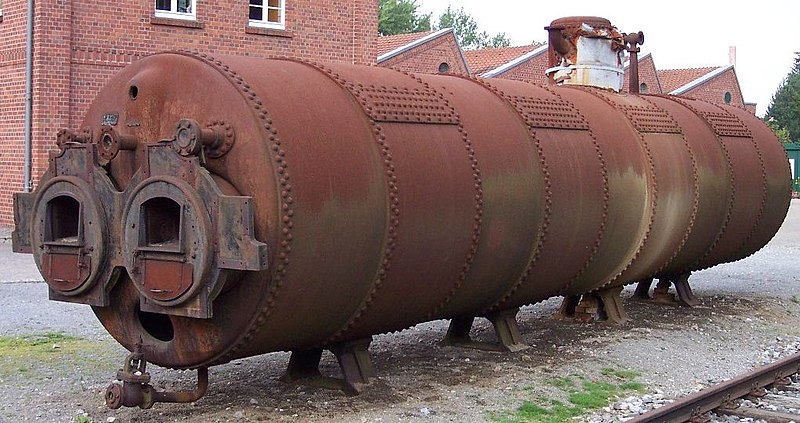
File:Dampfkessel_für_eine_Stationärdampfmaschine_im_Textilmuseum_Bocholt.jpg · Wikimedia Commons · See Wikimedia Commons
steam boiler
Sign in to saveAlso known as boiler
device used to create steam by applying heat energy to water
Wikidata facts
- Subclass of
- propulsion
- Part of
- heat-only boiler station
- Image
- Dampfkessel für eine Stationärdampfmaschine im Textilmuseum Bocholt.jpg
Show 3 more facts
- Commons category
- Boilers
- topic's main category
- Category:Steam boilers
- product or material produced
- vapor
Sources (1)
via Wikidata · CC0
~21 min read
Encyclopedic overview
An industrial boiler, originally used for supplying steam to a stationary steam engineA boiler or steam generator is a device used to create steam by applying heat energy to water. Although the definitions are somewhat flexible, it can be said that older steam generators were commonly termed boilers and worked at low to medium pressure (7–2,000 kPa or 1–290 psi) but, at pressures above this, it is more usual to speak of a steam generator.
A boiler or steam generator is used wherever a source of steam is required. The form and size depends on the application: mobile steam engines such as steam locomotives, portable engines and steam-powered road vehicles typically use a smaller boiler that forms an integral part of the vehicle; stationary steam engines, heating plants, industrial installations and power stations will usually have a larger separate steam generating facility connected to the point-of-use by piping. A notable exception is the steam-powered fireless locomotive, where separately-generated steam is transferred to a receiver (tank) on the locomotive.
Excerpted from Wikipedia’s “steam boiler” article, available under the CC BY-SA 4.0 licence.