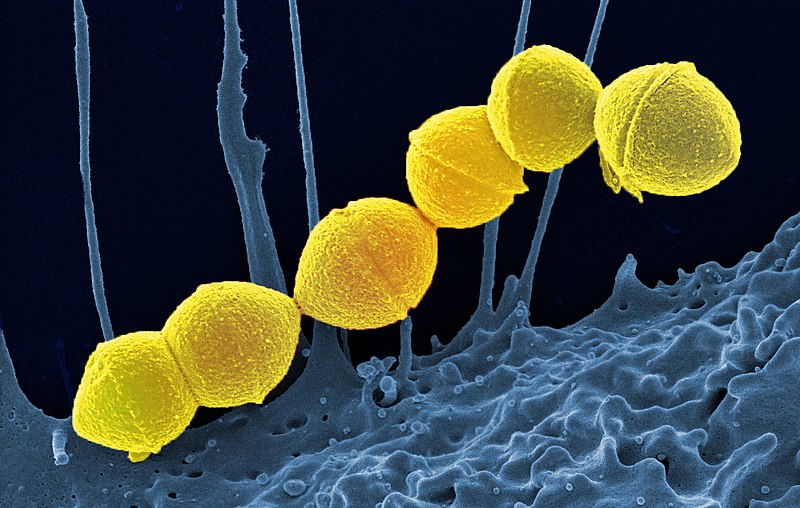
File:Streptococcus_Pyogenes_(Group_A_Strep)_(52602981880).jpg · Wikimedia Commons · See Wikimedia Commons
OverviewAI-generated
*Streptococcus pyogenes* is a species of gram-positive bacteria within the family Streptococcaceae. It belongs to the genus *Streptococcus* and is classified in the kingdom Bacteria, phylum Firmicutes, class Bacilli, and order Lactobacillales. The organism is also referred to by the common name group Α (beta-hemolytic) Streptococcus.
This bacterium is associated with effects including toxic shock syndrome and lymphangitis. It is not extinct. Records for this taxon exist in various databases, with 497 occurrences noted in GBIF and 20 observations on iNaturalist. The species has been referenced by 315 other encyclopedia articles.
Synthesized by Vinony from 29 facts across 7 sources: Wikidata, GBIF, PubMed, iNaturalist, Gbif Occ, iDigBio, Vinony graph. Generated from structured data (not the Wikipedia text) and checked against those facts — may still contain errors.
Species
group Α (beta-hemolytic) Streptococcus
SPECIES
- KingdomBacteria
- PhylumFirmicutes
- ClassBacilli
- OrderLactobacillales
- FamilyStreptococcaceae
化膿レンサ球菌 化膿レンサ球菌 分類 ドメ イン : 細菌 Bacteria 門 : フィルミクテス門 Firmicutes 綱 : バシラス綱 Bacilli 目 : ラクトバシラス目 Lactobacillales 科 : ストレプトコッカス科 Streptococcaceae 属 : レンサ球菌属 Streptococcus 種 : 化膿連鎖球菌 S. pyogenes 学名 Streptococcus pyogenes Rosenbach 1884 化膿レンサ球菌(かのうレンサきゅうきん、Streptococcus pyogenes)とは、レンサ球菌属に属する真正細菌の一種。血液寒天培地上で培養するとβ溶血性を示し、またレンサ球菌の鑑別に用いられるランスフィールド抗原分類ではA群に属する。この性質から、A群β溶血性レンサ球菌(えーぐんべーたようけつせいれんさきゅうきん)とも呼ばれ、臨床医学分野ではこの名称が用いられることが多い。A群溶レン菌、あるいは単に溶レン菌(溶連菌)、またGAS(Group A Streptococci)という略語が用いられることもある(#名称の節を参照)。 健康なヒトの咽頭や消化管、表皮にも生息する常在細菌の一種であるが、GAS感染症(溶レン菌感染症)と呼ばれる各種の化膿性疾患や、産生する毒素による全身性疾患、あるいは感染後に一種の合併症として起きる免疫性疾患など、多様な疾患の原因になる。ごくありふれた病原菌・常在菌の一種であるものの、場合によっては劇症型レンサ球菌感染症(壊死性筋膜炎など)と呼ばれる、進行の早い致死性疾患の原因となることがあり、俗に人食いバクテリアと称されることがある細菌の一種である(人食いバクテリアと呼ばれるものには、他にグラム陰性桿菌のビブリオ・バルニフィカス Vibrio vulnificusがある)。 目次 1 細菌学的特徴 1.1 名称 2 病原因子 3 病原菌としての化膿レンサ球菌 3.1 急性感染症 3.2 毒素性疾患 3.3 感染症後遺症 4 出典 5 脚注 6 外部リンク 細菌学的特徴[編集] 化膿レンサ球菌は、レンサ球菌属に属するグラム陽性球菌で、顕微鏡下では連鎖状の配列をとる。鞭毛を持たないため非運動性であり、菌株によっては莢膜を有するものもある。芽胞は形成しない。通性嫌気性菌であるため、酸素の存在下でも、酸素が存在しない環境でも生育しうるが、やや嫌気性の環境を好む。他のレンサ球菌同様、栄養要求性が若干高いため、普通寒天培地での生育はやや劣るが、血液寒天培地ではよく生育する。 レンサ球菌属の溶血性。血液寒天培地に培養すると菌の生えた周囲の培地に溶血現象が見られる。中央(βの字を描いて培養)が、β溶血性(菌周囲に透明で広い溶血帯を生じる)の化膿レンサ球菌。左(α溶血性、溶血帯が狭く緑変)は
via GBIF
Research
20,638 papers- Streptococcus dysgalactiae subsp. equisimilis infection and its intersection with Streptococcus pyogenes.Clinical microbiology reviews · 2024
- Streptococcus pyogenes.Contributions to microbiology · 2001
- Molecular Targets in Streptococcus pyogenes for the Development of Anti-Virulence Agents.Genes · 2024
- [Streptococcus pyogenes translocates across an epithelial barrier].Nihon saikingaku zasshi. Japanese journal of bacteriology · 2017
- Dextrin utilization in Streptococcus pyogenes pathogenesis and growth.Journal of oral biosciences · 2025
via PubMed
Wikidata facts
- Instance of
- taxon
- Parent taxon
- Streptococcus
- Image
- Streptococcus pyogenes.jpg
Show 7 more facts
- taxon name
- Streptococcus pyogenes
- Commons category
- Streptococcus pyogenes
- taxon rank
- species
- has effect
- lymphangitis
- taxon common name
- Mädatekitajabakter
- Gram staining
- gram-positive bacteria
Sources (2)
via Wikidata · CC0
~14 min read
Encyclopedic overview
Streptococcus pyogenes is a species of Gram-positive, aerotolerant bacteria in the genus Streptococcus. These bacteria are extracellular, and made up of non-motile and non-sporing cocci (round cells) that tend to link in chains. They are clinically important for humans, as they are an infrequent, but usually pathogenic, part of the skin microbiota that can cause group A streptococcal infection. S. pyogenes is the predominant species harboring the Lancefield group A antigen, and is often called group A Streptococcus (GAS). The name group A (beta-hemolytic) Streptococcus is thus also used.
The species name is derived from Greek words meaning 'a chain' (streptos) of berries (coccus [Latinized from kokkos]) and pus (pyo)-forming (genes), since a number of infections caused by the bacterium produce pus. The main criterion for differentiation between Staphylococcus spp. and Streptococcus spp. is the catalase test. Staphylococci are catalase positive whereas streptococci are catalase-negative. S. pyogenes can be cultured on fresh blood agar plates. The PYR test allows for the differentiation of Streptococcus pyogenes from other morphologically similar beta-hemolytic streptococci (including S. dysgalactiae subsp. esquismilis) as S. pyogenes will produce a positive test result.
Excerpted from Wikipedia’s “Streptococcus pyogenes” article, available under the CC BY-SA 4.0 licence.