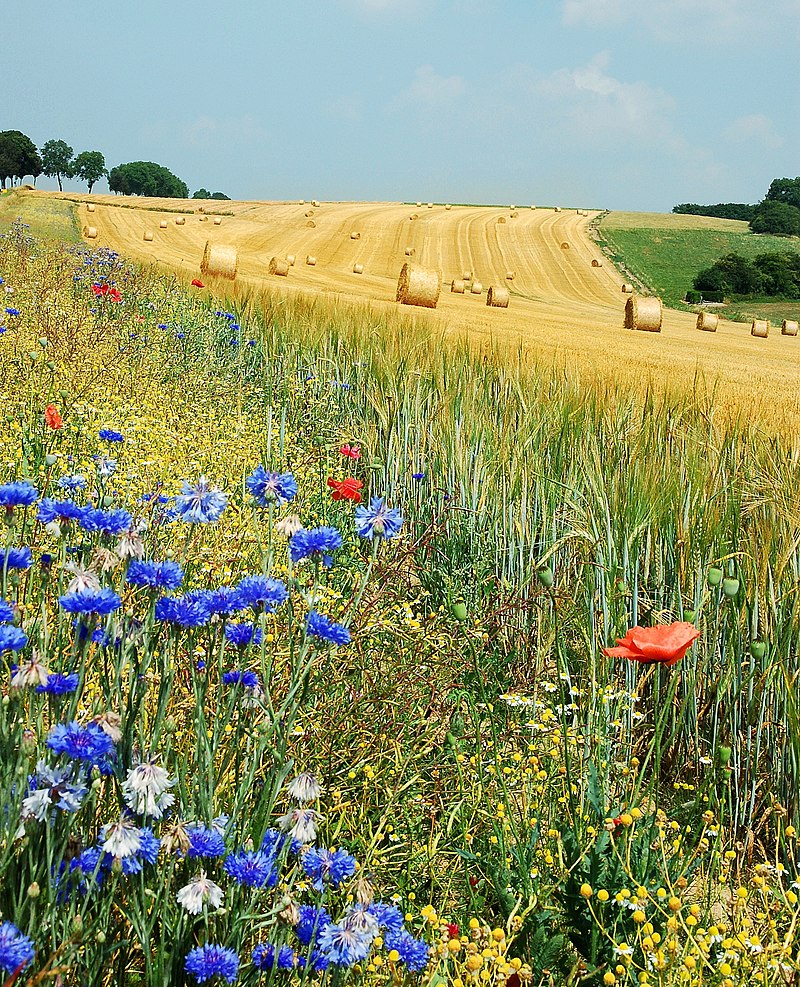
File:Field_Hamois_Belgium_Luc_Viatour.jpg · Wikimedia Commons · See Wikimedia Commons
summer
Sign in to saveAlso known as summer season, summertime season
Summer or summertime is the hottest and brightest of the four temperate seasons, occurring after spring and before autumn. At or centred on the summer solstice, daylight hours are the longest and darkness hours are the shortest, with day length decreasing as the season progresses after the solstice. The earliest sunrises and latest sunsets also occur near the date of the solstice. The date of the beginning of summer varies according to definition, climate, tradition, and culture. When it is summer in the Northern Hemisphere, it is winter in the Southern Hemisphere, and vice versa.
Summer is the hottest and brightest of the four temperate seasons, characterized by the longest daylight hours occurring around the summer solstice. It matters because it represents a significant shift in Earth's relationship to the sun, affecting temperature, daylight availability, and seasons differently depending on whether you live in the Northern or Southern Hemisphere.
AI-generated from the Wikipedia summary — may contain errors.
Key facts
- Temperate season.title
- Summer
- Temperate season.image
- Field Hamois Belgium Luc Viatour.jpg
- Temperate season.caption
- Summer in Belgium
- Temperate season.ndate1
- 21 June – 22 September
- Temperate season.ndate2
- 1 June – 31 August
- Temperate season.ndate3
- 1 May – 31 July
- Temperate season.sdate1
- 22 December – 21 March
- Temperate season.sdate2
- 1 December – 28/29 February
- Temperate season.sdate3
- 1 November – 31 January
via Wikipedia infobox
Wikidata facts
Show 11 more facts
- Commons category
- Summer
- opposite of
- winter
- topic's main category
- Category:Summer
- Commons gallery
- Summer
- month of the year
- August
- described by source
- Explanatory Dictionary of the Living Great Russian Language
- hashtag
- summer
- different from
- Sommer
- on focus list of Wikimedia project
- Wikipedia:Vital articles/Level/4
- event interval
- 1
Sources (2)
via Wikidata · CC0
~12 min read
Encyclopedic overview
13 sectionsContents
- Etymology
- Timing
- Meteorological reckoning
- Cultural reckoning
- Astronomical reckoning
- Weather
- Holidays
- School breaks
- Public holidays
- Activities
- See also
- References
- External links
Summer or summertime is the hottest and brightest of the four temperate seasons, occurring after spring and before autumn. At or centred on the summer solstice, daylight hours are the longest and darkness hours are the shortest, with day length decreasing as the season progresses after the solstice. The earliest sunrises and latest sunsets also occur near the date of the solstice. The date of the beginning of summer varies according to definition, climate, tradition, and culture. When it is summer in the Northern Hemisphere, it is winter in the Southern Hemisphere, and vice versa.
==Etymology== The modern English summer derives from the Middle English somer, via the Old English sumor.
Excerpted from Wikipedia’s “summer” article, available under the CC BY-SA 4.0 licence.
Gallery (20)
Available in 191 languages
- Español
- Français
- Deutsch
- 中文
- 日本語
- Русский
- Português
- Italiano
- العربية
- हिन्दी
- Abkhazian
- Adyghe
- Afrikaans
- Albanian
- Albanian
- Amharic
- Aragonese
- Aramaic
Show 172 more
- Armenian
- Asturian
- Aymara
- azb
- Azerbaijani
- Bahasa Indonesia
- Balinese
- Bangla
- Banjar
- Bashkir
- Basque
- bat_smg
- Bavarian
- be_x_old
- Belarusian
- Bhojpuri
- Bikol
- Bosnian
- Breton
- Bulgarian
- Burmese
- Catalan
- cdo
- Central Kurdish
- Chechen
- Chuvash
- Colognian
- Croatian
- Czech
- Danish
- dty
- Egyptian Arabic
- eml
- Erzya
- Esperanto
- Estonian
- Extremaduran
- Faroese
- Filipino
- Finnish
- fiu_vro
- Friulian
- Galician
- Georgian
- Greek
- Guarani
- Gujarati
- Haitian Creole
- Hakka Chinese
- Hebrew
- Hungarian
- hyw
- Icelandic
- Ido
- Iloko
- Ingush
- Interlingua
- Interlingue
- Irish
- Javanese
- Kabyle
- Kalmyk
- Kannada
- Kara-Kalpak
- Kashmiri
- Kashubian
- Kazakh
- Kinyarwanda
- Komi
- Komi-Permyak
- Kurdish
- Kyrgyz
- Lao
- Latin
- Latvian
- lbe
- Lezghian
- Ligurian
- Lithuanian
- lld
- Lojban
- Lombard
- Lower Sorbian
- Luxembourgish
- Macedonian
- Malagasy
- Malay
- Malayalam
- Manx
- Marathi
- Mari
- Mazanderani
- Mingrelian
- Moksha
- Mongolian
- Moroccan Arabic
- nds_nl
- Neapolitan
- Nederlands
- Nepali
- Newari
- Northern Frisian
- Norwegian
- Norwegian Nynorsk
- nrm
- Occitan
- olo
- Ossetic
- Pashto
- Polski
- Punjabi
- Quechua
- roa_rup
- Romanian
- Rusyn
- Santali
- Sardinian
- Scots
- Serbian
- Serbian (Latin)
- Shona
- Sicilian
- Silesian
- simple
- Sindhi
- Sinhala
- Slovak
- Slovenian
- Somali
- Standard Moroccan Tamazight
- Svenska
- Swahili
- szy
- Tachelhit
- Tajik
- Tamil
- Tatar
- tay
- Telugu
- Tibetan
- Tiếng Việt
- Toki Pona
- Tswana
- Türkçe
- Turkmen
- Ukrainian
- Upper Sorbian
- Urdu
- Uyghur
- Uzbek
- Venetian
- Veps
- Volapük
- Walloon
- Waray
- Welsh
- West Flemish
- Western Frisian
- Western Mari
- Western Panjabi
- Wu Chinese
- Yakut
- Yiddish
- Zaza
- zh_classical
- zh_min_nan
- zh_yue
- Zhuang
- Zulu
- فارسی
- ไทย
- 한국어
via Wikidata sitelinks · CC0