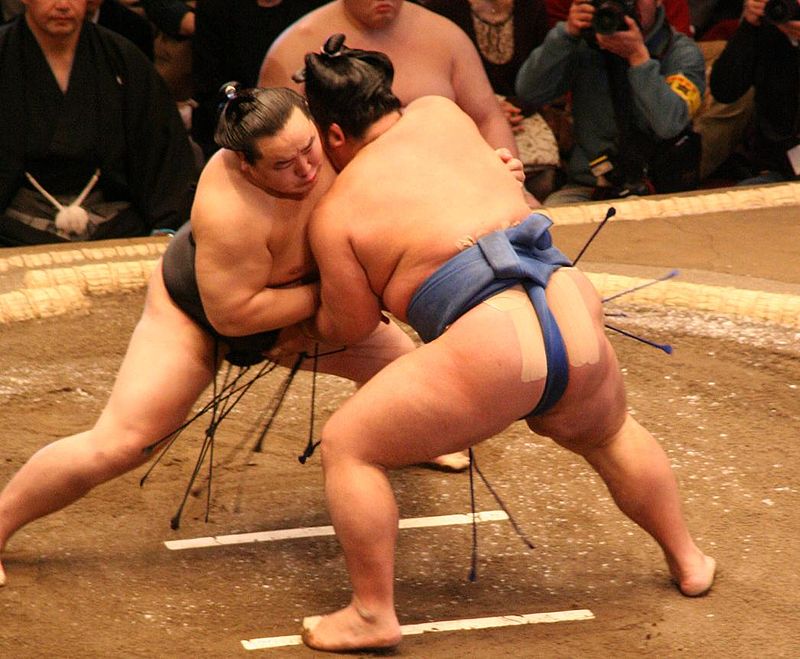
File:Asashoryu_fight_Jan08.JPG · Wikimedia Commons · See Wikimedia Commons
Sumo is a form of competitive wrestling where two opponents try to force each other out of a circular ring or knock each other to the ground using techniques like throwing, shoving, and pushing. It is a traditional sport that remains culturally significant and widely practiced as a professional competition.
AI-generated from the Wikipedia summary — may contain errors.
Key facts
- Martial art.image
- Asashoryu fight Jan08.JPG
- Martial art.imagecaption
- A sumo match () between Asashōryū (left) and Kotoshōgiku in January 2008
- Martial art.name
- Sumo
- Martial art.focus
- Clinch fighting
- Martial art.hardness
- Full contact
- Martial art.country
- Japan
- Martial art.ancestor_arts
- Tegoi
- Martial art.olympic
- No, but IOC recognized
- Sport.name
- Sumo
- Sport.imagesize
- 220px
- Sport.union
- International Sumo Federation (Amateur)Japan Sumo Association (Professional)
- Sport.first
- Japan, 7th century (antiquity)Japan, mid-17th century (Edo period, modern)
- Sport.country/region
- Worldwide (Amateur)Japan (Professional)
- Sport.contact
- Yes
- Sport.team
- No
- Sport.mgender
- Yes (Amateur, separate divisions)No (Professional, men only)
- Sport.category
- Grappling sport
- Sport.equipment
- Mawashi
via Wikipedia infobox
Wikidata facts
- Instance of
- national sport
- Country of origin
- Japan
- Image
- Asashoryu fight Jan08.JPG
Show 9 more facts
- OpenStreetMap tag
- sport=sumo
- Commons category
- Sumo
- regulated by
- International Sumo Federation
- topic's main category
- Category:Sumo
- inception
- 0642-00-00
- uses
- mawashi
- native label
- 角力
- on focus list of Wikimedia project
- Wikipedia:Vital articles/Level/4
- practiced by
- rikishi
Sources (2)
via Wikidata · CC0
Article · Français
Le sumo (相撲, sumō, littéralement « se frapper mutuellement ») est un sport de lutte japonais. Le combat sumo se caractérise par le gabarit des lutteurs ainsi que par les nombreux rites traditionnels qui entourent les combats, et consiste en deux règles simples : les lutteurs ne doivent pas sortir du cercle (dohyō), ni toucher le sol avec une autre partie du corps que la plante des pieds. Ce sport reste populaire au Japon, même si le baseball et le football le détrônent désormais, notamment chez les jeunes.
Abstract from DBpedia / Wikipedia · CC BY-SA
Gallery (40)
Available in 96 languages
- Español
- Français
- Deutsch
- 中文
- 日本語
- Русский
- Português
- Italiano
- العربية
- हिन्दी
- Albanian
- Armenian
- Arpitan
- Asturian
- Azerbaijani
- Bahasa Indonesia
- Bangla
- Bashkir
Show 77 more
- Basque
- Belarusian
- Bikol
- Bosnian
- Breton
- Bulgarian
- Burmese
- Catalan
- Croatian
- Czech
- Danish
- Esperanto
- Estonian
- Faroese
- Finnish
- Galician
- Georgian
- Gorontalo
- Greek
- Hebrew
- Hungarian
- hyw
- Ido
- Interlingua
- Irish
- Javanese
- Kannada
- Kazakh
- Khmer
- Kyrgyz
- Latin
- Latvian
- Lithuanian
- Macedonian
- Malay
- Malayalam
- Marathi
- Mingrelian
- Mongolian
- Nederlands
- Nepali
- Newari
- Norwegian
- Norwegian Nynorsk
- Novial
- Occitan
- Ossetic
- Piedmontese
- Polski
- Romanian
- Sardinian
- Scottish Gaelic
- Serbian
- Serbian (Latin)
- Sicilian
- simple
- Slovak
- Svenska
- Swahili
- Tamil
- Telugu
- Tibetan
- Tiếng Việt
- Türkçe
- Ukrainian
- Uyghur
- Uzbek
- Walloon
- Waray
- Western Frisian
- Wu Chinese
- zh_min_nan
- zh_yue
- Zulu
- فارسی
- ไทย
- 한국어
via Wikidata sitelinks · CC0