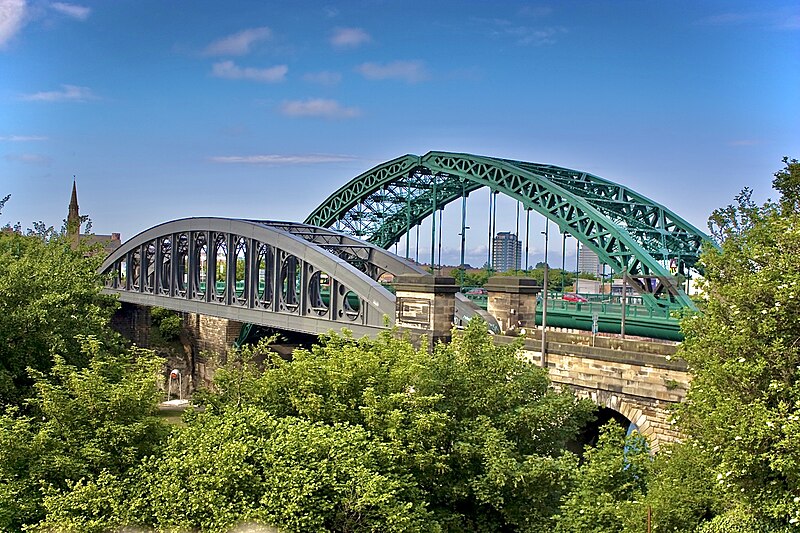
File:SunderlandBridges.jpg · Wikimedia Commons · See Wikimedia Commons
Sunderland
Sign in to saveSunderland () is a port city and metropolitan borough in Tyne and Wear, England. It is a port at the mouth of the River Wear on the North Sea, approximately south-east of Newcastle upon Tyne. It is the most populous settlement in the Wearside conurbation and the second-most populous settlement in North East England, after Newcastle.
OverviewAI-generated
Sunderland is a city in the United Kingdom, situated in the administrative territorial entity of Sunderland within England. It serves as the capital of the Sunderland area and is located near the River Wear and the North Sea. The city has a population of 294,000 and covers an area of 111.84 square units. Its elevation above sea level is recorded as 60 meters, with other sources citing figures of 47 and 36 meters.
The local dialing code for Sunderland is 0191, and it uses postal codes SR1, SR2, SR3, and SR4. The city is twinned with Essen and Washington, D.C. Its official name is Sunderland, and it is classified as a big city. The timezone is Europe/London.
Synthesized by Vinony from 53 facts across 7 sources: Wikidata, Open Meteo, Openweathermap, OpenStreetMap, GeoNames, Vinony graph, Geo. Generated from structured data (not the Wikipedia text) and checked against those facts — may still contain errors.
Weather now
7-day forecast
via Open-Meteo
Place details
- Locality
- Sunderland
- Region
- England
- Country
- United Kingdom
- Population
- 170,134
- Timezone
- Europe/London
via OpenStreetMap · GeoNames
Key facts
- Settlement.name
- Sunderland
- Settlement.settlement_type
- City and metropolitan borough
- Settlement.image_shield
- Arms of the Sunderland City Council.svg
- Settlement.shield_link
- Coat of arms of Sunderland
- Settlement.image_map
- Sunderland UK locator map.svg
- Settlement.map_caption
- Sunderland shown within Tyne and Wear
- Settlement.subdivision_type
- Sovereign state
- Settlement.subdivision_name
- United Kingdom
- Settlement.subdivision_type1
- Country
- Settlement.subdivision_name1
- England
- Settlement.subdivision_type2
- Region
- Settlement.subdivision_name2
- North East
- Settlement.subdivision_type3
- Ceremonial county
- Settlement.subdivision_name3
- Tyne and Wear
- Settlement.subdivision_type4
- Historic County
- Settlement.subdivision_name4
- County Durham
- Settlement.subdivision_type5
- City region
- Settlement.subdivision_name5
- North East
via Wikipedia infobox
Wikidata facts
- Official name
- Sunderland
- Country
- United Kingdom
- Population
- 277000
- Area
- 111.84
- Elevation
- 60
- Body of water
- North Sea
- Image
- Wearmouth bridge.jpg
- Dialing code
- 0191
Show 13 more facts
- twinned administrative body
- Washington, D.C.
- Commons category
- Sunderland
- category for people born here
- Category:Births in Sunderland
- topic's main category
- Category:Sunderland
- category of associated people
- Category:People from Sunderland
- category for people who died here
- Q21031155
- postal code
- SR1
- OS grid reference
- NZ395575
- Commons gallery
- Sunderland
- native label
- Sunderland
- different from
- Sunderland
- P12749
- Florence
via Wikidata · CC0
Travel guide
Understand
thumb | 300px | Bridges over the River Wear Sunderland grew up around the estuary of the River Wear when three medieval villages combined. Monkwearmouth on the north bank had a monastery from 674 AD; its abbot encouraged glass-making, founding an industry for the next 1300 years. The monastery was home to the Venerable Bede, who wrote that he was "ácenned on sundorlande" - born in a sundered or separate land of that monastery on the south bank. This became Sunderland and outgrew Monkwearmouth and the third settlement of Bishopwearmouth further upriver. Early industry was based on fishing, salt-panning, coal-mining, shipbuilding and breaking, glass-making, and sea trade. By the 19th century the conurbation was sprawling and squalid, and in 1831 it was the first place in Britain to be struck by the cholera pandemic, which inexorably spread across the nation. The three traditional parish administrations were overwhelmed and this was the prompt for creating the combined borough of Sunderland in 1835.
Shipbuilding was already declining in the Victorian era, and other industries crumbled in the 20th century. Sunderland has diversified, and regenerated the brownfield sites, but this remains a work in progress. It hasn't been able to re-launch itself as a destination city like Newcastle, unemployment is high, and in 2016 the city voted 61% in favour of Brexit. Geographically it was in County Durham until in 1974 the new metropolis of Tyne and Wear was created, also containing Newca…
Get in
thumb | 300px | Penshaw Monument
See
thumb | 300px | Sunderland Museum and Winter Gardens Seaburn the next beach north is sandy and a mile long. The water is every bit as cold as at Roker. half a mile north of the country park was built 1844-45 in memory of John Lambton (1792-1840), 1st Earl of Durham and first Governor General of Canada. He was fabulously wealthy from Durham coal but was a reformist Whig. The monument is based on the Temple of Hephaestus in Athens. Appropriately, that was the deity of metal-working, equally venerated by Athens' seething traffic and by the Nissan factory just outside Sunderland.
Do
thumb | 300px | Roker Pier What's on? Listen to Sun FM on 103.4 FM, or read Sunderland Echo (evenings). Empire Cinema is in Sunniside leisure complex on Lambton St. were promoted in 2025 and now play soccer in the Premier League, the top tier. Their 49,000 all-seater Stadium of Light is just north of the River Wear: in 2025 it hosted games in the Women's Rugby Union World Cup. Sunderland women's soccer team play in their Championship or second tier, with home games at Eppleton Colliery Ground in Hetton-le-Hole. is an open area, good for strolling and dog-walking. The area consists of Green Hill and Rocky Hill and surrounding land, and has a nature reserve. Golf: to the south are Houghton-Le-Spring GC, Sharpley Golf and Seaham GC. West is Wearside GC, and north is Boldon GC. Sunderland Food & Drink Festival is held in June in Keel Square, High Street West and Market Square. Festival of Light is a light show held in Mowbray Park during November.
Buy
Bridges Shopping Centre stretches west from the railway station. It has some 80 shops including Boots, TK Maxx, Iceland and Tesco Metro. The Centre has toilets and a quiet room.
Drink
thumb | 300px | Bowl displayed in National Glass Centre Many folk head into Newcastle for nightlife, but Sunderland is cheaper.
Sleep
thumb | 300px | Sunderland Minster Seaburn B&Bs include Mayfield and Lemonfield.
Connect
As of Dec 2021, Sunderland has 5G from EE and Three, and 4G from O2 and Vodafone.
Stay safe
Local football club Sunderland has a very heated rivalry with Newcastle United, dubbed the Tyne and Wear Derby. Be sure not to wear a Newcastle United shirt when you are in Sunderland, especially on matchdays, as it could result in you getting singled out for harassment or even violence by local fans.
Go next
The city of Newcastle upon Tyne is a 30 min metro ride away. South bank of the Tyne is Gateshead, with Baltic Centre for Contemporary Art. South Shields has a reconstructed Roman fort. Wallsend has a Roman fort at the beginning of Hadrian's Wall. Washington has a pit museum and George Washington's family ancestral home. Durham has a well-preserved medieval centre around its magnificent cathedral.
Travel guide from Wikivoyage (CC BY-SA 4.0)
~70 min read
Encyclopedic overview
50 sectionsContents
- Toponymy
- History
- Early, ancient and Medieval
- Jamies and Black Cats
- "The greatest shipbuilding port in the world"
- 20th Century
- City status <span class="anchor" id="City status"></span>
- Government
- Administrative history
- UK Parliament
- EU referendum
- Geography
- Green belt
- Climate
- Demography
- 2021 census
- Religion
- Pentecostalism
- Economy
- Regeneration
- Former
- Major
- Minor
- Education
- Transport
- Heavy and light rail
- Roads
- Buses
- Cycling
- Airports
- Port
- Culture
- Dialect and accent
- Attractions and events
- Literature and art
- Media, film and television
- Music, dance and kites
- Theatres and performance venues
- Landmarks
- Sport
- Football
- Rugby and Cricket
- Boxing & MMA
- Swimming
- Athletics
- Notable residents
- International relations
- See also
- References
- External links
Sunderland () is a port city and metropolitan borough in Tyne and Wear, England. It is a port at the mouth of the River Wear on the North Sea, approximately south-east of Newcastle upon Tyne. It is the most populous settlement in the Wearside conurbation and the second-most populous settlement in North East England, after Newcastle.
The centre of the modern city is an amalgamation of three settlements founded in the Anglo-Saxon era: Monkwearmouth, on the north bank of the Wear, and Sunderland and Bishopwearmouth on the south bank. Monkwearmouth contains St Peter's Church, which was founded in 674 and formed part of Monkwearmouth–Jarrow Abbey, a significant centre of learning in the seventh and eighth centuries. Sunderland was a fishing settlement and later a port, being granted a town charter in 1179. The city traded in coal and salt, also developing shipbuilding industry in the fourteenth century and glassmaking industry in the seventeenth century.
Excerpted from Wikipedia’s “Sunderland” article, available under the CC BY-SA 4.0 licence.
Gallery (52)
On the map
3 mapped locations
Available in 78 languages
- Español
- Français
- Deutsch
- 中文
- 日本語
- Русский
- Português
- Italiano
- العربية
- Aragonese
- Armenian
- Asturian
- azb
- Azerbaijani
- Bahasa Indonesia
- Balinese
- Basque
- be_x_old
Show 59 more
- Belarusian
- Bosnian
- Bulgarian
- Catalan
- Cebuano
- Croatian
- Czech
- Danish
- Egyptian Arabic
- eml
- Esperanto
- Estonian
- Finnish
- Galician
- Georgian
- Greek
- Hausa
- Hebrew
- Hungarian
- Icelandic
- Irish
- Kurdish
- Latvian
- Lithuanian
- lld
- Macedonian
- Manipuri
- Marathi
- Mazanderani
- Moksha
- Nederlands
- Northern Frisian
- Norwegian
- Norwegian Nynorsk
- Polski
- Romanian
- Scots
- Serbian
- Serbian (Latin)
- Silesian
- simple
- Slovenian
- Svenska
- Swahili
- Tatar
- Türkçe
- Ukrainian
- Urdu
- Veps
- Volapük
- Waray
- Welsh
- Wu Chinese
- Yiddish
- Zaza
- zh_yue
- فارسی
- ไทย
- 한국어
via Wikidata sitelinks · CC0