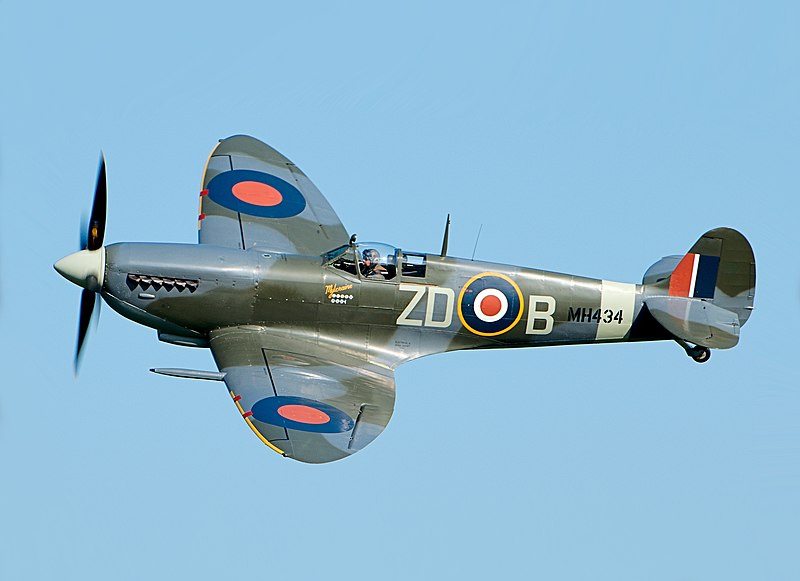
File:Spitfire_-_Season_Premiere_Airshow_2018_(cropped).jpg · Wikimedia Commons · See Wikimedia Commons
Supermarine Spitfire
Sign in to saveAlso known as Type 300 Spitfire, Spitfire fighter, Supermarine 300, Supermarine Type 300
British fighter aircraft
The Supermarine Spitfire was a British fighter aircraft used during World War II, known for its speed and agility in combat. It played a significant role in defending Britain during the war and remains one of the most iconic military aircraft in history.
AI-generated from the Wikipedia summary — may contain errors.
Wikidata facts
- Operator
- Royal Air Force
- Country of origin
- United Kingdom
- Developer
- Supermarine
- Manufacturer
- Supermarine
- Designed by
- R. J. Mitchell
- Conflict
- Greek Civil War
- Official website
- www.raf.mod.uk/aircraft/spitfire
- Image
- Ray Flying Legends 2005-1.jpg
- Speed
- 370
Show 8 more facts
- military designation
- Spitfire
- Commons gallery
- Supermarine Spitfire
- Commons category
- Supermarine Spitfire
- topic's main category
- Category:Supermarine Spitfire
- first flight
- 1936-03-05
- service retirement
- 1961-00-00
- total produced
- 20351
- service entry
- 1938-08-04
via Wikidata · CC0
~40 min read
Encyclopedic overview
Audio recording of Spitfire fly-past at the 2011 family day at RAF Halton, Buckinghamshire Supermarine Spitfire G-AWGB landing at Biggin Hill Airport, June 2024 The Supermarine Spitfire is a British single-seat fighter aircraft that was used by the Royal Air Force and other Allied countries before, during, and after World War II. It was the only British fighter produced continuously throughout the war. The Spitfire was a short-range, high-performance interceptor aircraft designed by R. J. Mitchell, chief designer at Supermarine Aviation Works, which operated as a subsidiary of Vickers-Armstrong from 1928. Mitchell modified the Spitfire's distinctive elliptical wing (designed by Beverley Shenstone) with innovative sunken rivets to have the thinnest possible cross-section, achieving a potential top speed greater than that of several contemporary fighter aircraft, including the Hawker Hurricane. Mitchell continued to refine the design until his death from cancer in 1937, whereupon his colleague Joseph Smith took over as chief designer.
Smith oversaw the Spitfire's development through many variants, from the Mk 1 to the Rolls-Royce Griffon-engined Mk 24, using several wing configurations and guns. The original airframe was designed to be powered by a Rolls-Royce Merlin engine producing 1,030 hp (768 kW). It was strong enough and adaptable enough to use increasingly powerful Merlins, and in later marks, Rolls-Royce Griffon engines producing up to 2,340 hp (1,745 kW). As a result, the Spitfire's performance and capabilities improved over the course of its service life.
Excerpted from Wikipedia’s “Supermarine Spitfire” article, available under the CC BY-SA 4.0 licence.
Gallery (12)
Available in 57 languages
- Español
- Français
- Deutsch
- 中文
- 日本語
- Русский
- Português
- Italiano
- العربية
- Afrikaans
- Aragonese
- Asturian
- Bahasa Indonesia
- Bangla
- Basque
- Bosnian
- Breton
- Bulgarian
Show 38 more
- Burmese
- Catalan
- Croatian
- Czech
- Danish
- Esperanto
- Estonian
- Finnish
- Galician
- Greek
- Hebrew
- Hungarian
- Latvian
- Luxembourgish
- Malay
- Malayalam
- Marathi
- Nederlands
- Norwegian
- Norwegian Nynorsk
- Piedmontese
- Polski
- Romanian
- Serbian
- Serbian (Latin)
- simple
- Slovak
- Slovenian
- Svenska
- Tiếng Việt
- Türkçe
- Ukrainian
- Venetian
- Welsh
- Western Frisian
- فارسی
- ไทย
- 한국어
via Wikidata sitelinks · CC0