
File:Selburose-sweater.jpg · Wikimedia Commons · See Wikimedia Commons
sweater
Sign in to saveAlso known as jumper
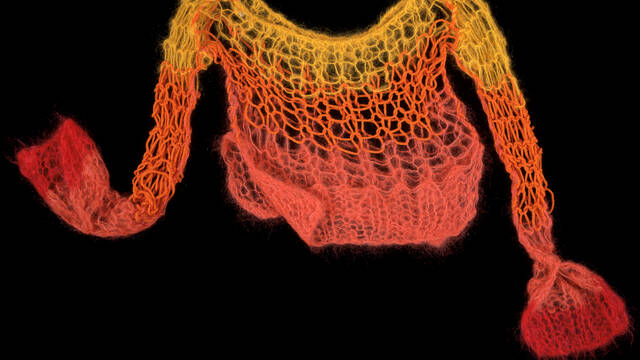
thumb|280px|One from the Graham Leggate collection, a Norwegian selburose design A sweater (North American English) or pullover, also called a jersey or jumper (British English, Hiberno-English and Australian English), is a piece of clothing, typically with long sleeves, made of knitted or crocheted material that covers the upper part of the body. When sleeveless, the garment is often called a slipover, tank top, or sweater vest.
A sweater is a knitted or crocheted piece of clothing with long sleeves that covers the upper body, though it can also be sleeveless (in which case it may be called a slipover or sweater vest). Sweaters are commonly worn for warmth and are known by different names in different English-speaking regions, such as pullover, jersey, or jumper.
AI-generated from the Wikipedia summary — may contain errors.
Described at
A history of sweaters · V&A
Discover the sweater's development from sportswear into a wardrobe staple and a form for designer experimentation
vam.ac.uk →Today it's one of the most common wardrobe items for both men and women, so it's perhaps surprising that the sweater (or jumper) has only been worn as fashion since the 1920s. From then on, the sweater has taken many styles and been used by designers to make statements that go beyond the need for warmth and comfort. The sweater's origins can be traced back to the 'guernsey' or 'gansey' – a traditional, seamless, knitted sweater typically worn by fishermen for warmth and protection. However, towards the end of the 19th century, the sweater began to have wider appeal. Sporting activities – such as golf, boating, tennis and cycling – were growing in popularity and required comfortable outfits appropriate to the activity. At the same time, the rational dress movement – consisting largely of middle-class women – proposed wearing more practical and comfortable clothing than the fashions of the time. By the 1870s, male undershirts or vests made from knitted fabric of wool, cotton or wool blended with silk were being worn for sports. Called 'jerseys', they were widely adopted by athletes. As demand grew, companies such as John Smedley – which had started producing knitted garments in Derbyshire in the early 19th century – shifted their focus from knitted underwear to outerwear. Machine-knitting developments made such items both more affordable and more widely available. Throughout the 1920s and '30s, sweaters grew in popularity. The Prince of Wales popularised the Fair Isle sweater when he wore one as part of his golfing attire in 1921, while the designer Coco Chanel (1883 – 1971) promoted the knitted jersey as everyday ware. This more relaxed attitude to dressing was cemented when the sweater made its first appearance in American Vogue in 1927. HRH The Prince of Wales wearing a Fair Isle sweater, painting by Lander, 1925. Wikimedia Commons The V&A's collection includes a 'cravat' jumper, designed by Elsa Schiaparelli (1890 – 1973) to give the appearance of a scarf around the neck. Schiaparelli used the traditional skills of Armenian knitters living in Paris to make this witty design. It became such a success that it appeared in French Vogue and Schiaparelli followed up by creating further amusing, sometime outrageous, sweaters, including designs giving the impression of ties and handkerchiefs, tattoos and even a skeleton. By the early 1930s, sweaters were in such demand that Vogue launched the spin-off The Vogue Knitting Bible (later Vogue Knitting ). The Scottish brand Pringle claimed to have invented the twinset (a matching jumper and cardigan) that same decade, while Mary Thomas' Knitting Book stated in 1938 that: During the Second World War, knitting was promoted as being vital for the war effort, while on the home front – in the face of fuel shortages – it was both practical and popular. The Women's Home Industries was a post-war offshoot of the Women's Voluntary Services. The organisation, which had originally been formed to make "comforts for the troops", employed hand-knitters all over Britain and became known for its high quality, fashionable garments. An example of their work is the 'Molyneux' jumper (named in honour of the designer Edward Molyneux, although not designed by him), made in the early 1950s, with a fashionable open neck and three-quarter length dolman sleeves (where the sleeves are part of the main body of the garment). The glamour of knitwear was enhanced through the 1940s and '50s by the so-called 'Sweater girls' – actresses such as Lana Turner, who received the nickname for her appearance in the 1937 film They Won't Forget, and Jayne Mansfield, known for wearing a tight sweater over a cone- or bullet-shaped bra. The sweater's popularity boomed during the 1950s, both in mass-produced and home-knitted versions, thanks to new yarns and new colours. The sweater could also be worn as an anti-mainstream statement. The black polo-neck sweater, for example, was closely associated with the beatniks of the 1
Excerpt from a page describing this subject · 15,935 chars · not written by Vinony
Wikidata facts
- Material used
- synthetic fiber
- Image
- Jersei-coll-alt.jpg
Show 4 more facts
- different from
- sweatshirt
- Commons category
- Sweaters
- topic's main category
- Category:Sweaters
- described at URL
- www.vam.ac.uk/articles/the-fashionable-sweater
Sources (2)
via Wikidata · CC0
~9 min read
Encyclopedic overview
9 sectionsContents
- Etymology
- Types and design
- Nomenclature
- Customary wear
- Care
- Ice hockey
- See also
- References
- External links
thumb|280px|One from the Graham Leggate collection, a Norwegian selburose design A sweater (North American English) or pullover, also called a jersey or jumper (British English, Hiberno-English and Australian English), is a piece of clothing, typically with long sleeves, made of knitted or crocheted material that covers the upper part of the body. When sleeveless, the garment is often called a slipover, tank top, or sweater vest.
Sweaters are worn by adults and children, often over a shirt, blouse, T-shirt, or another top, but sometimes next to the skin. Sweaters were traditionally made from wool but can now be made of cotton, synthetic fibers, or any combination of these. There are also seasonal sweaters, including the familiar holiday-themed Christmas sweater.
Excerpted from Wikipedia’s “sweater” article, available under the CC BY-SA 4.0 licence.