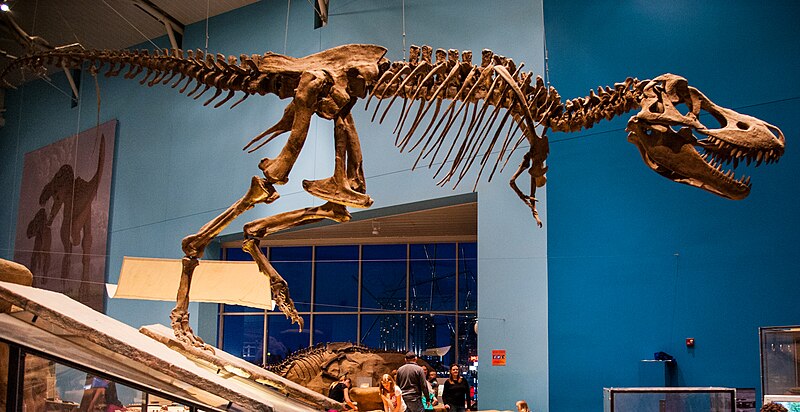
File:Tarbosaurus_bataar_mount_-_Dinosaur_Mysteries_exhibit.jpg · Wikimedia Commons · See Wikimedia Commons
Tarbosaurus
Sign in to saveTarbosaurus ( ; meaning "alarming lizard") is a genus of large tyrannosaurid dinosaur that lived in Asia during the Maastrichtian age of the Late Cretaceous epoch. It contains the type and single species Tarbosaurus bataar, which is known from the Nemegt Formation of Mongolia, with more fragmentary remains found further afield in the Subashi Formation of China. Tarbosaurus is represented by dozens of fossil specimens, including several complete skulls and skeletons. These remains have allowed studies focusing on its phylogeny, skull mechanics, and brain structure. Further fossil remains have b
Wikidata facts
- Image
- Tarbosaurus Restorationadssasasdda.png
- Length
- 10.0
Show 6 more facts
- taxon name
- Tarbosaurus
- Commons category
- Tarbosaurus
- taxon rank
- genus
- time period
- Late Cretaceous
- location of discovery
- China
- main food source
- carnivore
Sources (2)
via Wikidata · CC0
~33 min read
Encyclopedic overview
20 sectionsContents
- Discovery and naming
- Synonyms
- Additional specimens
- Poached specimens
- Skin impressions and footprints
- Description
- Skull
- Postcranial skeleton
- Classification
- Paleobiology
- Ontogeny
- Senses
- Skull mechanics
- Bite force and feeding
- Paleoenvironment
- Nemegt Formation
- Subashi Formation
- See also
- References
- External links
Tarbosaurus ( ; meaning "alarming lizard") is a genus of large tyrannosaurid dinosaur that lived in Asia during the Maastrichtian age of the Late Cretaceous epoch. It contains the type and single species Tarbosaurus bataar, which is known from the Nemegt Formation of Mongolia, with more fragmentary remains found further afield in the Subashi Formation of China. Tarbosaurus is represented by dozens of fossil specimens, including several complete skulls and skeletons. These remains have allowed studies focusing on its phylogeny, skull mechanics, and brain structure. Further fossil remains have been reported from other geologic formations of Asia, however, these remains are fragmentary and cannot be confidently assigned to Tarbosaurus or the type species.
Like most known tyrannosaurids, Tarbosaurus was a large bipedal predator, with the type specimen measuring approximately long, tall at the hips, and weighing up to . It had a unique locking mechanism in its jaw, equipped with about sixty large teeth, and the smallest arms relative to body size of all tyrannosaurids, renowned for their disproportionately tiny, two-fingered hands.
Excerpted from Wikipedia’s “Tarbosaurus” article, available under the CC BY-SA 4.0 licence.