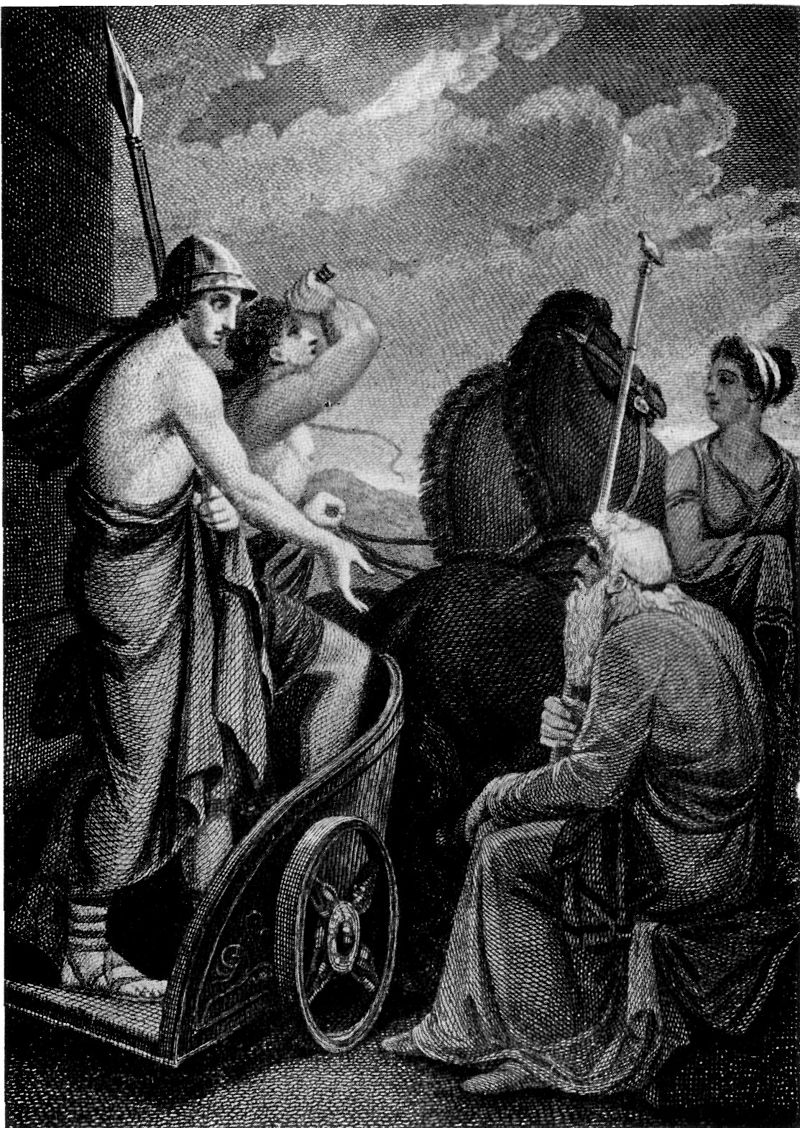
File:Telemachus_departing_from_Nestor_-_Henry_Howard_-_Project_Gutenberg_eText_13725.jpg · Wikimedia Commons · See Wikimedia Commons
Telemaco
Sign in to savepersonaggio della mitologia greca, figlio di Odisseo e Penelope
Telemachus is the son of Odysseus in Homer's *Odyssey*, and as an adult he journeys to find his missing father before returning home to help Odysseus defeat the suitors pursuing his mother Penelope. His story matters because it forms a major part of one of Western literature's most influential epics, exploring themes of growing up and family loyalty in ancient Greek mythology.
AI-generated from the Wikipedia summary — may contain errors.
Key facts
- Character.name
- Telemachus
- Character.title
- Prince of Ithaca
- Character.image
- Telemachus departing from Nestor - Henry Howard - Project Gutenberg eText 13725.jpg
- Character.caption
- Telemachus departing from Nestor, painting by Henry Howard (1769–1847)
- Character.nationality
- Greek
- Character.spouse
- Circe; or Cassiphone or Polycaste or Nausicaa
- Character.relatives
- Odysseus (father)Penelope (mother)
- Character.children
- LatinusPersepolisPtoliporthusPoliporthes
via Wikipedia infobox
Wikidata facts
- Gender
- male
- Spouse
- Cassiphone
- Child
- Latinus
- Father
- Odysseus
- Mother
- Penelope
- Image
- Telemachos Saarbruecken.jpg
Show 7 more facts
- name in native language
- Τηλέμαχος
- Commons category
- Telemachus
- significant person
- Athena
- P8168
- Barra Longa
- influenced by
- Mentes
- manner of death
- homicide
- killed by
- Cassiphone
Sources (2)
via Wikidata · CC0
Article · Italiano
Telemaco (in greco antico: Τηλέμαχος, Tēlémachos, «che combatte lontano», con riferimento al padre, che combatteva a Troia; in latino: Telemachus), è un personaggio dell'Odissea. È il figlio di Ulisse e di Penelope.
Abstract from DBpedia / Wikipedia · CC BY-SA
Gallery (7)
Available in 59 languages
- Español
- Français
- Deutsch
- 中文
- 日本語
- Русский
- Português
- Italiano
- العربية
- Albanian
- Armenian
- Bahasa Indonesia
- Bangla
- Basque
- be_x_old
- Belarusian
- Breton
- Bulgarian
Show 40 more
- Catalan
- Czech
- Danish
- Egyptian Arabic
- Esperanto
- Estonian
- Filipino
- Finnish
- Galician
- Greek
- Hebrew
- Hungarian
- Icelandic
- Ido
- Kannada
- Kurdish
- Latin
- Lithuanian
- Macedonian
- Malay
- Nederlands
- Norwegian
- Norwegian Nynorsk
- Occitan
- Polski
- Romanian
- Scots
- Serbian
- Serbian (Latin)
- simple
- Slovak
- Svenska
- Tiếng Việt
- Türkçe
- Ukrainian
- Uzbek
- Waray
- zh_yue
- فارسی
- 한국어
via Wikidata sitelinks · CC0