Schifani, Enrico;Prebus, Matthew M.;Alicata, Antonio
Temnothorax
Sign in to saveAlso known as acorn ant, bifurcated ant
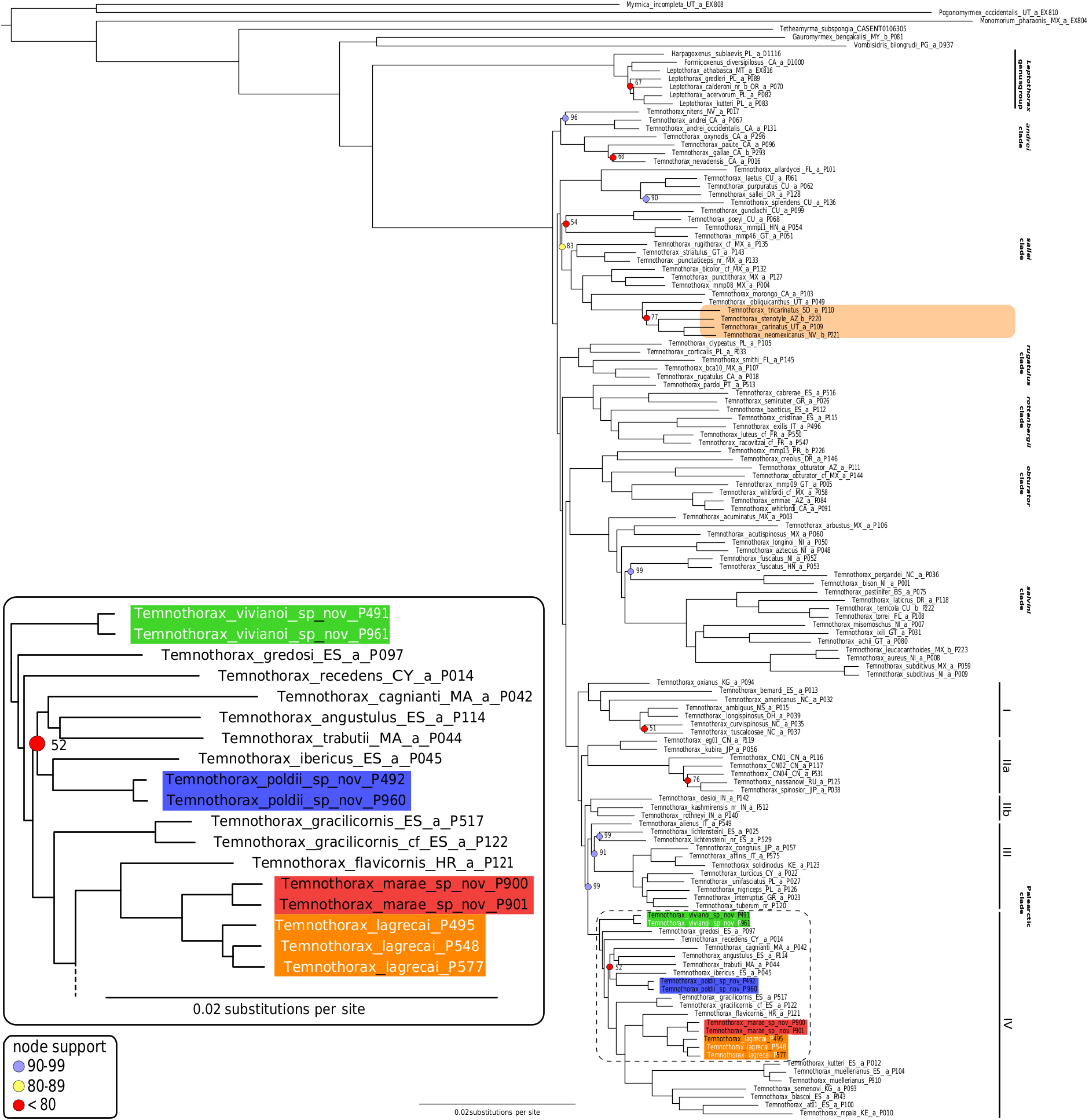
thumb|Temnothorax schaumii, Maryland Temnothorax is a genus of ants in the subfamily Myrmicinae. It contains more than 500 species.
Species
Bent-spined Acorn Ant
GENUS
- KingdomAnimalia
- PhylumArthropoda
- ClassInsecta
- OrderHymenoptera
- FamilyFormicidae
Notes: Till recently Temnothorax was considered as a junior synonym of Leptothorax , but Bolton (2003) has divided the latter genus to two: Leptothorax (which includes the former subgenus Leptothorax s. str.) and Temnothorax (which includes, among others, the former subgenus Myrafant M. R. Smith). Therefore all authors before 2003 and some after this date have placed Temnothorax species in the genus Leptothorax (except of Temnothorax recedens ).
via GBIF
Museum specimens
- Specimen records
- 2,532
- With media
- 132
- Family
- Formicidae
- Collections
- UQROO, UTEP, UMNH
- Recorded in
- Mexico, United States
Wikidata facts
- Instance of
- taxon
- Parent taxon
- Formicoxenini
- Image
- 20140427 163127 7375M.JPG
Show 5 more facts
- taxon name
- Temnothorax
- taxon rank
- genus
- topic's main category
- Category:Temnothorax
- Commons category
- Temnothorax
- taxon common name
- Acorn Ants
Sources (1)
via Wikidata · CC0
~4 min read
Encyclopedic overview
7 sectionsContents
- Biology
- Phylogenetics
- Social behaviors
- Species
- Notes
- References
- Further reading
thumb|Temnothorax schaumii, Maryland Temnothorax is a genus of ants in the subfamily Myrmicinae. It contains more than 500 species.
==Biology== The workers of Temnothorax species are generally small (mesosoma length 0.715 mm). Colonies are typically monogynous, although facultative polygyny has been documented in several species. Colony populations are usually quite small, often with less than 100 workers. However, several studies have found colonies of some species to be widely dispersed with several to many satellite nests. Many species are arboreal, living within hollow stems, old beetle or termite galleries, or in galls. Temnothorax species appear to be trophic generalists, feeding on a wide variety of scavenged items, including the elaiosomes of seeds. None have been documented to be active or aggressive predators.
Excerpted from Wikipedia’s “Temnothorax” article, available under the CC BY-SA 4.0 licence.