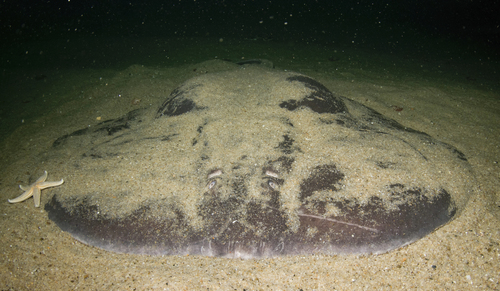
(c) Alex Shure, some rights reserved (CC BY-NC), uploaded by Alex Shure · cc-by-nc
Tetronarce
Sign in to saveTetronarce is a genus of ray fish, commonly known as electric rays. They are slow-moving bottom-dwellers capable of generating electricity as a defense and feeding mechanism. Tetronarce species tend to attain a much larger size of up to 180 cm TL than Torpedo electric rays species, which usually range from 25 to 80 cm TL.
In the Vinony graph
Within Vinony's link graph, Tetronarce is referenced by 13 other articles, and connects out to Batomorphi, Animalia and electricity.
It sits within the topics Batomorphi genera, Fish of Argentina and Fish of Japan.
Its subject is documented across 11 Wikipedia language editions.
Species
ヤマトシビレエイ属
GENUS
- KingdomAnimalia
- PhylumChordata
- ClassElasmobranchii
- OrderTorpediniformes
- FamilyTorpedinidae
via GBIF
Museum specimens
- Specimen records
- 2
- Family
- Torpedinidae
- Collections
- SIO, CSIRO
- Recorded in
- Mexico, Australia
Wikidata facts
- Instance of
- taxon
- Parent taxon
- Torpedinidae
- Image
- Atlantic torpedo ( Torpedo nobiliana ).jpg
Show 4 more facts
- taxon name
- Tetronarce
- taxon rank
- genus
- topic's main category
- Category:Tetronarce
- Commons category
- Tetronarce
Sources (1)
via Wikidata · CC0
~2 min read
Encyclopedic overview
2 sectionsContents
- Species
- References
Tetronarce is a genus of ray fish, commonly known as electric rays. They are slow-moving bottom-dwellers capable of generating electricity as a defense and feeding mechanism. Tetronarce species tend to attain a much larger size of up to 180 cm TL than Torpedo electric rays species, which usually range from 25 to 80 cm TL.
==Species== There are nine recognized species in this genus: {| class="wikitable sortable" |- ! Image !! Name !! Common name!! Distribution |- |120px || Tetronarce californica Ayres, 1855 || Pacific electric ray|| northeastern Pacific Ocean from Baja California to British Columbia. |- | || Tetronarce cowleyi Ebert, D. L. Haas & M. R. de Carvalho, 2015 ||Cowley's torpedo ray || around southern Africa, from Walvis Bay, Namibia to Algoa Bay, Eastern Cape, South Africa |- |120px || Tetronarce fairchildi F. W. Hutton, 1872|| New Zealand torpedo|| New Zealand |- | || Tetronarce formosa D. L. Haas & Ebert, 2006 || Taiwan torpedo|| Northwest Pacific: Taiwan. |- | frameless|| Tetronarce macneilli Whitley, 1932 || Shorttail torpedo|| southern Australia from Port Hedland to the Swain Reefs |- |120px || Tetronarce nobiliana Bonaparte, 1835 || Atlantic torpedo|| Atlantic Ocean, from Nova Scotia to Brazil in the west and from Scotland to West Africa and off southern Africa in the east |- | || Tetronarce puelcha Lahille, 1926 || Argentine torpedo|| Argentina, Brazil, and Uruguay. |- | || Tetronarce tokionis S. Tanaka (I), 1908 || Trapezoid torpedo|| Japan and Taiwan. |- | || Tetronarce tremens F. de Buen, 1959 || Chilean torpedo|| Chile, Colombia, Costa Rica, Ecuador, and Peru. |- |}
Excerpted from Wikipedia’s “Tetronarce” article, available under the CC BY-SA 4.0 licence.
Gallery (5)
Available in 11 languages
via Wikidata sitelinks · CC0