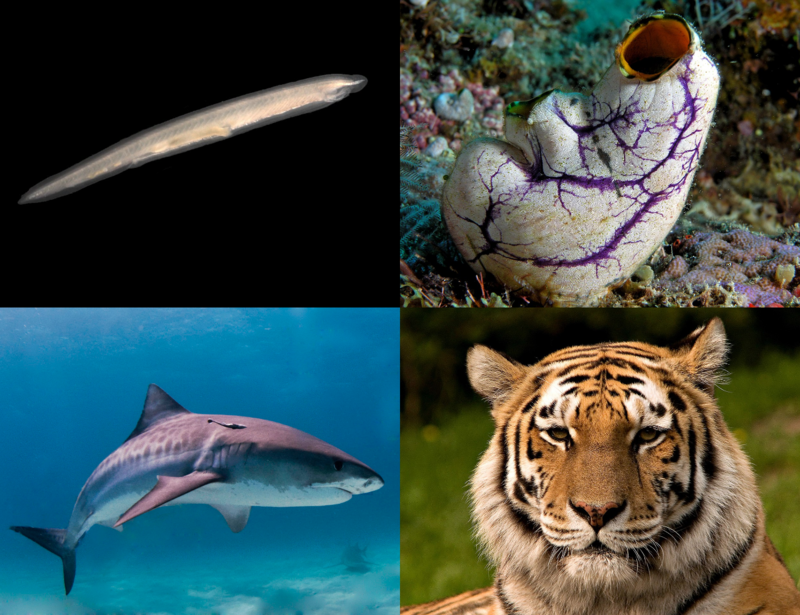
File:Chordata.png · Wikimedia Commons · See Wikimedia Commons
Chordata
Sign in to saveAlso known as chordate, chordates
A chordate ( ) is a bilaterian animal belonging to the phylum Chordata ( ). All chordates possess, at some point during their larval or adult stages, five distinctive physical characteristics (synapomorphies) that distinguish them from other taxa: a notochord, a hollow dorsal nerve cord, an endostyle or thyroid, pharyngeal slits, and a post-anal tail.
OverviewAI-generated
Chordata is a phylum within the kingdom Animalia and the subclass of deuterostomes. The taxon was described by Haeckel in 1874 and has been documented in the Brockhaus and Efron Encyclopedic Dictionary. Its temporal range begins in the Ediacaran and Cambrian periods, approximately 535 million years ago. The group inhabits marine, brackish, and freshwater environments.
Records indicate significant scientific and archival presence. PubMed lists 28,127,225 entries for the query Chordata. The Global Biodiversity Information Facility reports 2,534,061,025 occurrences, while iDigBio holds 81,773 records and 3,530 media items from institutions in the United States. Additionally, the topic is referenced by 82,387 other encyclopedia articles.
Synthesized by Vinony from 34 facts across 7 sources: Wikidata, GBIF, PubMed, Gbif Occ, iDigBio, WoRMS, Vinony graph. Generated from structured data (not the Wikipedia text) and checked against those facts — may still contain errors.
Species
chordadieren
Chordata
PHYLUM
- KingdomAnimalia
- PhylumChordata
脊索动物门(学名:Chordata)是指有脊索,或其在演化过程退化而被脊椎取代的动物。是动物界最高等的门。脊索动物的共同特征包括:在生活史中的某个阶段具有脊索、中空的背神经管、咽鳃裂以及肛后尾。 脊索动物门可以分为尾索动物亚门、头索动物亚门和脊椎动物亚门三个亚门。其中尾索动物亚门和头索动物亚门可以合称为“原索动物”,生活在海洋中。尾索动物幼虫期具有脊索和神经索,但在成体消失。头索动物终生保留脊索和神经索。在脊椎动物中,脊索作用由骨质脊柱代替。 少数学者提出将半索动物门也置于脊索动物门下,并命名为口索动物亚门。 通常说的脊椎动物学主要是指研究脊索动物的一个动物学分支,不單單是研究脊椎动物门。
via GBIF
Research
28,127,225 papers- Vertebrate innovations.ReviewProceedings of the National Academy of Sciences of the United States of America · 2000Shimeld SM, Holland PWDOI: 10.1073/pnas.97.9.4449
- Amphioxus genomics.Briefings in functional genomics · 2012Holland LZDOI: 10.1093/bfgp/els014
- Deuterostome Ancestors and Chordate Origins.ReviewIntegrative and comparative biology · 2024Swalla BJDOI: 10.1093/icb/icae134
- The deuterostome ancestor.ReviewJournal of cellular physiology · 2006Gerhart JDOI: 10.1002/jcp.20803
- Onto-phylogenetic aspect of myotomal myogenesis in Chordata.ReviewFolia biologica · 2004Kiełbówna L, Daczewska M
- Chordates.Current biology : CB · 2005Holland NDDOI: 10.1016/j.cub.2005.11.008
- Ferritins in Chordata: Potential evolutionary trajectory marked by discrete selective pressures: History and reclassification of ferritins in chordates and geological events' influence on their evolution and radiation.BioEssays : news and reviews in molecular, cellular and developmental biology · 2021Golan MP, Piłsyk S, Muszewska A et al.DOI: 10.1002/bies.202000207
- Marine toxins.ReviewAnnual review of pharmacology · 1971Baslow MHDOI: 10.1146/annurev.pa.11.040171.002311
via PubMed
Wikidata facts
- Instance of
- taxon
- Subclass of
- deuterostome
- Parent taxon
- deuterostome
- Image
- Chordata.png
Show 10 more facts
- taxon rank
- phylum
- taxon name
- Chordata
- Commons category
- Chordata
- topic's main category
- Category:Chordates
- taxon common name
- Gewervelde dieren
- topic has template
- Template:Taxonomy/Chordata
- equivalent class
- kbpedia.org/kko/rc/ChordataPhylum
- start time
- 535000000-
- temporal range start
- Cambrian
- on focus list of Wikimedia project
- Wikipedia:Vital articles/Level/4
Sources (9)
via Wikidata · CC0
~21 min read
Encyclopedic overview
17 sectionsContents
- Etymology
- Anatomy
- Classification
- Subphyla
- Cephalochordata: Lancelets
- Tunicata (Urochordata)
- Vertebrata (Craniata)
- Phylogeny
- Overview
- Cladogram
- Closest non-chordate relatives
- Hemichordates
- Echinoderms
- See also
- Notes
- References
- External links
A chordate ( ) is a bilaterian animal belonging to the phylum Chordata ( ). All chordates possess, at some point during their larval or adult stages, five distinctive physical characteristics (synapomorphies) that distinguish them from other taxa: a notochord, a hollow dorsal nerve cord, an endostyle or thyroid, pharyngeal slits, and a post-anal tail.
In addition to the morphological characteristics used to define chordates, analysis of genome sequences has identified two conserved signature indels (CSIs) in their proteins: cyclophilin-like protein and inner mitochondrial membrane protease ATP23, which are exclusively shared by all vertebrates, tunicates and cephalochordates. These CSIs provide molecular means to reliably distinguish chordates from all other animals.
Excerpted from Wikipedia’s “Chordata” article, available under the CC BY-SA 4.0 licence.
Gallery (634)
Available in 156 languages
- Español
- Français
- Deutsch
- 中文
- 日本語
- Русский
- Português
- Italiano
- العربية
- हिन्दी
- Afrikaans
- Albanian
- Albanian
- Amharic
- Aragonese
- Armenian
- Arpitan
- Assamese
Show 137 more
- Asturian
- Awadhi
- azb
- Azerbaijani
- Bahasa Indonesia
- Balinese
- Bangla
- Bashkir
- Basque
- bat_smg
- be_x_old
- Belarusian
- Bhojpuri
- Bikol
- Bosnian
- Breton
- Bulgarian
- Buriat
- Burmese
- Catalan
- cdo
- Cebuano
- Central Kurdish
- Chuvash
- Cornish
- Corsican
- Croatian
- Czech
- Danish
- Egyptian Arabic
- Esperanto
- Estonian
- Extremaduran
- Faroese
- Fiji Hindi
- Filipino
- Finnish
- Galician
- Georgian
- Greek
- Guarani
- Haitian Creole
- Hakka Chinese
- Hebrew
- Hungarian
- Icelandic
- Iloko
- Inari Sami
- Ingush
- Interlingua
- Irish
- Javanese
- Kabyle
- Kannada
- Kashmiri
- Kazakh
- Komi-Permyak
- Kurdish
- Kyrgyz
- Latin
- Latvian
- Ligurian
- Limburgish
- Lingua Franca Nova
- Lithuanian
- Lojban
- Low German
- Luxembourgish
- Macedonian
- Malay
- Malayalam
- Maltese
- Manipuri
- Manx
- Marathi
- Mazanderani
- Mingrelian
- Mongolian
- Moroccan Arabic
- Navajo
- Nederlands
- Northern Frisian
- Norwegian
- Norwegian Nynorsk
- Novial
- Occitan
- Oromo
- Ossetic
- Papiamento
- Picard
- Piedmontese
- Polski
- Punjabi
- Quechua
- Romanian
- Rusyn
- Scots
- Scottish Gaelic
- Serbian
- Serbian (Latin)
- Sicilian
- simple
- Sindhi
- Sinhala
- Slovak
- Slovenian
- Standard Moroccan Tamazight
- Sundanese
- Svenska
- Swahili
- Tajik
- Tamil
- Tatar
- Telugu
- Tibetan
- Tiếng Việt
- Toki Pona
- Tongan
- Türkçe
- Ukrainian
- Urdu
- Uzbek
- Waray
- Welsh
- West Flemish
- Western Frisian
- Western Panjabi
- Wu Chinese
- Yakut
- Yiddish
- Zeelandic
- zh_min_nan
- zh_yue
- Zhuang
- فارسی
- ไทย
- 한국어
via Wikidata sitelinks · CC0