File:Buddha_Vairocana_-_Google_Art_Project.jpg · Wikimedia Commons · See Wikimedia Commons
thangka
Sign in to saveAlso known as tangka, tanka, thanka
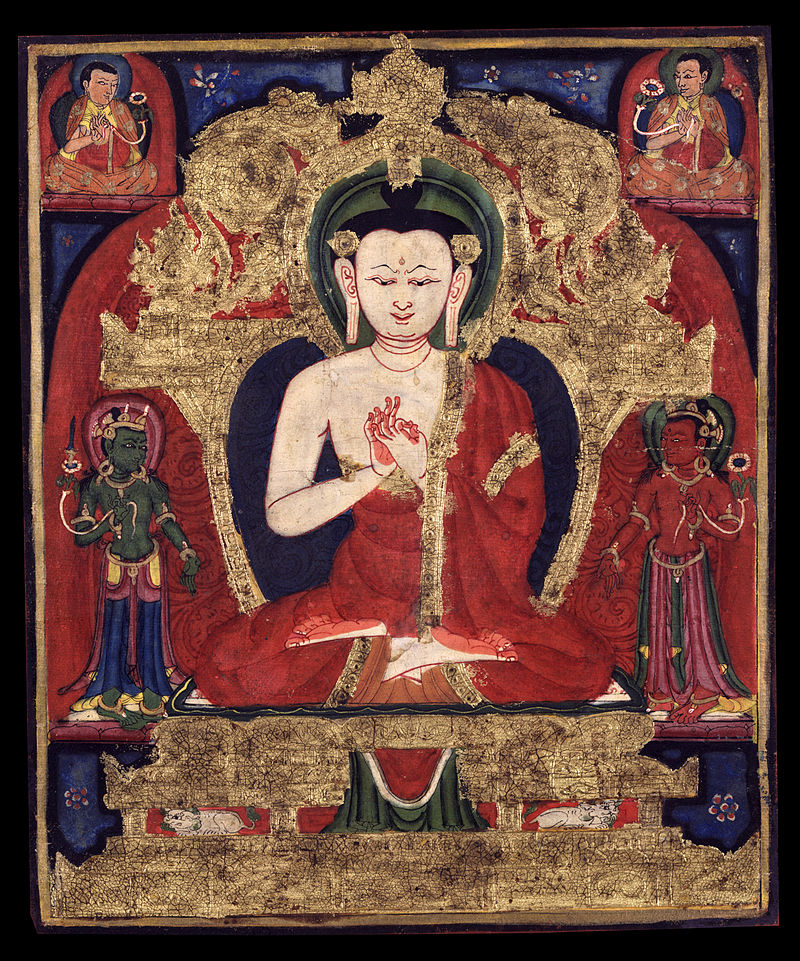
thumb|Buddha Vairocana, the “Resplendent One”. Pigments on cloth, 14th century thumb|Thangka depicting Vajrabhairava, c. 1740 thumb|A large thangka hung on a Thangka wall|special wall at [[Gyantse in Tibet in 1938]]
Wikidata facts
Show 1 more fact
- Commons category
- Thangka
Sources (2)
via Wikidata · CC0
~22 min read
Encyclopedic overview
10 sectionsContents
- History
- Types
- Process
- Nepal
- Gallery
- See also
- References
- Works cited
- Further reading
- External links
thumb|Buddha Vairocana, the “Resplendent One”. Pigments on cloth, 14th century thumb|Thangka depicting Vajrabhairava, c. 1740 thumb|A large thangka hung on a Thangka wall|special wall at [[Gyantse in Tibet in 1938]]
A thangka painting (; Tibetan: ཐང་ཀ་; Nepal Bhasa: पौभा) is a Tibetan Buddhist painting on cotton, silk appliqué, usually depicting a Buddhist deity, scene, or mandala. Thangkas are traditionally kept unframed and rolled up when not on display, mounted on a textile backing somewhat in the style of Chinese scroll paintings, with a further silk cover on the front. So treated, thangkas can last a long time, but because of their delicate nature, they have to be kept in dry places where moisture will not affect the quality of the silk. Most thangkas are relatively small, comparable in size to a western half-length portrait, but some are extremely large, several metres in each dimension; these were designed to be displayed, typically for very brief periods on a monastery wall, as part of religious festivals. Most thangkas were intended for personal meditation or instruction of monastic students. They often have elaborate compositions including many very small figures. A central deity is often surrounded by other identified figures in a symmetrical composition. Narrative scenes are less common, but do appear.
Excerpted from Wikipedia’s “thangka” article, available under the CC BY-SA 4.0 licence.