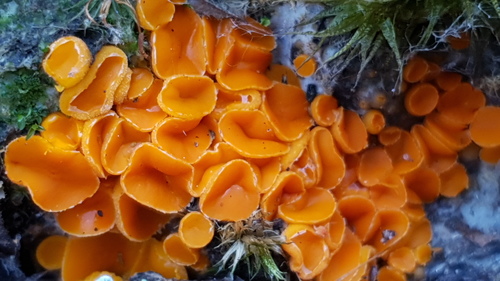
(c) Tatyana Zarubo, some rights reserved (CC BY-NC), uploaded by Tatyana Zarubo · cc-by-nc
Thelebolus
Sign in to saveThelebolus is a genus of fungi in the Thelebolaceae family. Often considered related to Pezizales, 18S phylogenies show Thelebolales are a sister group to Pseudeurotiaceae and Leotiales. ITS is an adequate DNA barcode but there are only six variable sites in Thelebolus; β-tubulin is a recommended secondary barcode.
Species
GENUS
- KingdomFungi
- PhylumAscomycota
- ClassLeotiomycetes
- OrderThelebolales
- FamilyThelebolaceae
via GBIF
Museum specimens
- Specimen records
- 181
- With media
- 124
- Family
- Thelebolaceae
- Collections
- BPI, FLAS, UPS, FH, CEPLAC
- Recorded in
- United States, Norway, Sweden, Brasil, France, Germany, United Kingdom
Wikidata facts
- Instance of
- taxon
- Parent taxon
- Thelebolaceae
- Image
- Thelebolus stercoreus 1312638.jpg
Show 4 more facts
- taxon name
- Thelebolus
- taxon rank
- genus
- taxonomic type
- Thelebolus stercoreus
- taxon author citation
- Tode
Sources (2)
via Wikidata · CC0
~2 min read
Encyclopedic overview
2 sectionsContents
- References
- External links
Thelebolus is a genus of fungi in the Thelebolaceae family. Often considered related to Pezizales, 18S phylogenies show Thelebolales are a sister group to Pseudeurotiaceae and Leotiales. ITS is an adequate DNA barcode but there are only six variable sites in Thelebolus; β-tubulin is a recommended secondary barcode.
Their ascomata are < 500 ųm diam. and are usually considered apothecia. Cleistothecium-like or perithecium-like variants occur, but all have asci arranged in a hymenium. Most species have eight ellipsoidal ascospores in a club-shaped ascus, but some Thelebolus asci have hundreds of ascospores. Ascospores are forcibly ejected synchronously in a sticky mass. Agar colonies are smooth and pinkish, conidium producing collars ("phialides") arising directly on hyphae, and slimy, 1-celled, hyaline conidia that appear yeast-like. Ascoma production is favored by media such as carrot agar.
Excerpted from Wikipedia’s “Thelebolus” article, available under the CC BY-SA 4.0 licence.