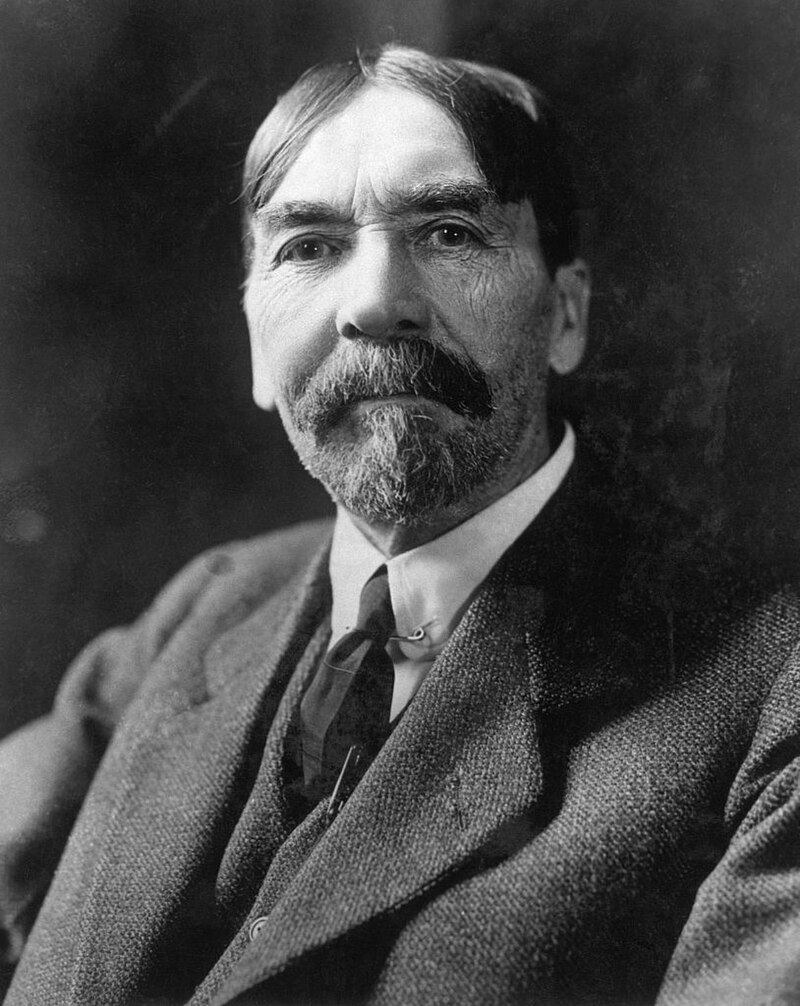
File:Veblen3a.jpg · Wikimedia Commons · See Wikimedia Commons
Thorstein Veblen
Sign in to saveAlso known as Thorstein Bunde Veblen
American economist and sociologist (1857–1929)
OverviewAI-generated
Thorstein Bunde Veblen was an American and Norwegian economist, sociologist, writer, and professor. Born in Cato in 1857, he was educated at Johns Hopkins University, Carleton College, and Yale University, earning a Doctor of Philosophy. His doctoral advisor was William Graham Sumner. Veblen worked as a professor at the University of Missouri, Stanford University, and the University of Chicago. He was a member of the Socialist Party of America and identified as an atheist.
Veblen wrote in English and spoke English and Norwegian. His notable works include *The Theory of the Leisure Class*, *Absentee ownership and business enterprise in recent times*, *Essays in our changing order*, *The engineers and the price system*, and *An inquiry into the nature of peace and the terms of its perpetuation*. He had a doctoral student named Herbert J. Davenport and was related to Oswald Veblen. He died in Menlo Park in 1929. His archives are held at Carleton College.
Synthesized by Vinony from 31 facts across 3 sources: Wikidata, Open Library, Firecrawl. Generated from structured data (not the Wikipedia text) and checked against those facts — may still contain errors.
In the Vinony graph
Within Vinony's link graph, Thorstein Veblen is referenced by 843 other articles, and connects out to Immanuel Kant, social status and thesis.
It sits within the topics 1857 births, 1929 deaths and 19th-century American economists.
Its subject is documented across 51 Wikipedia language editions.
Person · Open Library
- Born
- 1857-07-30
- Died
- 1929-08-03
- Works
- 63
Top works
- Absentee ownership and business enterprise in recent times
- Essays in our changing order
- The engineers and the price system
- An inquiry into the nature of peace and the terms of its perpetuation
- The theory of the leisure class
via Open Library + Wikidata
Described at

About: Thorstein Veblen
dbpedia.org →Link to a page describing this subject · 40,000 chars · not written by Vinony
Wikidata facts
- Instance of
- human
- Gender
- male
- Citizenship
- Norway
- Place of birth
- Cato
- Place of death
- Menlo Park
- Occupation
- editor
- Educated at
- Yale University
- Political party
- Socialist Party of America
- Languages spoken
- Norwegian
- Religion
- atheism
- Notable work
- The Theory of the Leisure Class
- Academic degree
- Doctor of Philosophy
- Doctoral advisor
- William Graham Sumner
- Doctoral student
- Herbert J. Davenport
- Field of work
- economics
- Image
- Veblen3a.jpg
- Work location
- Columbia
Show 9 more facts
- Commons category
- Thorstein Veblen
- date of birth
- 1857-07-30
- date of death
- 1929-08-03
- name in native language
- Thorstein Bunde Veblen
- writing language
- English language
- relative
- Oswald Veblen
- Commons Creator page
- Thorstein Veblen
- contributed to creative work
- Popular Science
- described at URL
- fr.dbpedia.org/resource/Thorstein_Veblen
Sources (6)
via Wikidata · CC0
~40 min read
Encyclopedic overview
Thorstein Bunde Veblen (/ˈθɔːrstaɪn ˈvɛblən/ THOR-styn VEH-blən; July 30, 1857 – August 3, 1929) was an American economist and sociologist who, during his lifetime, emerged as a well-known critic of capitalism.
In his best-known book, The Theory of the Leisure Class (1899), Veblen coined the concepts of conspicuous consumption and conspicuous leisure. Veblen laid the foundation for the perspective of institutional economics. Contemporary economists still theorize Veblen's distinction between "institutions" and "technology", known as the Veblenian dichotomy.
Excerpted from Wikipedia’s “Thorstein Veblen” article, available under the CC BY-SA 4.0 licence.
Gallery (3)
Available in 51 languages
- Español
- Français
- Deutsch
- 中文
- 日本語
- Русский
- Português
- Italiano
- العربية
- Armenian
- Azerbaijani
- Bahasa Indonesia
- Basque
- Belarusian
- Catalan
- Czech
- Danish
- Egyptian Arabic
Show 32 more
via Wikidata sitelinks · CC0