Described at
Greenland: Staying with the Polar Inuit. How a secret military base helped trigger the silent collapse of an Arctic world
In 1951, the French Explorer Jean Malaurie witnessed the building of a US military base in Greenland in near total secrecy, which marked an irreversible turning point for Inuit societies.
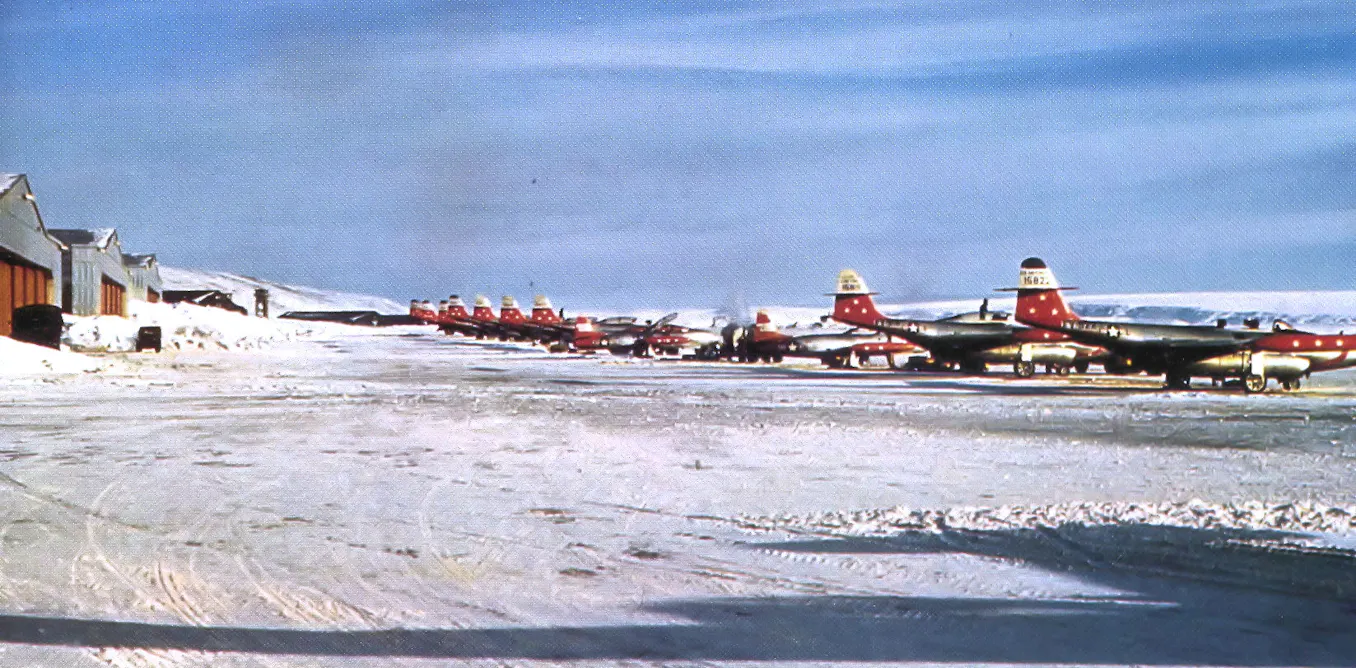
theconversation.com →Today, as Greenland once again becomes a strategic prize , history seems poised to repeat itself. Staying with the Polar Inuit means refusing to speak of territory while erasing those who inhabit it. That day, after many months among the Inuit, at the critical moment of the spring thaw, Malaurie was travelling with a few hunters. He was exhausted, filthy and emaciated. One of the Inuit touched his shoulder: “Takou, look.” A thick yellow cloud was rising in the sky. Through his binoculars, Malaurie first thought it was a mirage: “A city of hangars and tents, of metal sheets and aluminium, dazzling in the sunlight, amid smoke and dust… Three months earlier, the valley had been calm and empty of people. I had pitched my tent there, on a clear summer day, in a flowering, untouched tundra.” The breath of this new city, he would later write , “would never let us go.” Giant excavators hacked at the ground, trucks poured debris into the sea, aircraft circled overhead. Malaurie was hurled from the Stone Age into the Atomic Age. He had just discovered the secret American base of Thule , codenamed Operation Blue Jay . Behind this innocuous name lay a colossal logistical operation. The United States feared a Soviet nuclear attack via the polar route. In a single summer, some 120 ships and 12,000 men were deployed to a bay that had previously known only the silent glide of kayaks. Greenland’s population at the time numbered barely 23,000 people . In just 104 days, on permanently frozen ground, a technological city capable of hosting giant B-36 bombers carrying nuclear warheads emerged. More than 1,200 kilometres north of the Arctic Circle, and in almost total secrecy, the United States built one of the largest military bases ever constructed outside its continental territory. A defence agreement was signed with Denmark in the spring of 1951, but Operation Blue Jay was already underway: the American decision had been taken in 1950. Malaurie immediately grasped that the sheer scale of the operation amounted, in effect, to an annexation of the Inuit world. A system founded on speed, machinery and accumulation had violently and blindly entered a space governed by tradition, cyclical time, hunting and waiting. The blue jay is a loud, aggressive, fiercely territorial bird. Thule lies halfway between Washington and Moscow along the polar route. In the era of intercontinental hypersonic missiles, once Soviet and now Russian, it is this same geography that still underpins the argument of “vital necessity” invoked by Donald Trump in his calls to annex Greenland. The Thule base has a strategic position between the USA and Russia. U.S. Army, The Big Picture -- Operation Blue Jay (1953), CC BY The most tragic immediate outcome of Operation Blue Jay was not military, but human. In 1953, to secure the perimeter of the base and its radar installations, authorities decided to relocate the entire local Inughuit population to Qaanaaq, roughly 100 kilometres further north. The displacement was swift, forced and carried out without consultation , severing the organic bond between this people and their ancestral hunting territories. A “root people” was uprooted to make way for an airstrip. It is this brutal tipping point that Malaurie identifies as the moment when traditional Inuit societies began to collapse. In these societies, hunting is not merely a survival technique but an organising principle of the social world. The Inuit universe is an economy of meaning, made of relationships, gestures and transmission through the generations that confer recognition, role and place in relation to each individual. This intimate coherence, which constitutes the strength of these societies, also renders them acutely vulnerable when an external system suddenly destroys their territorial and symbolic foundations. Today, Greenlandic society is largely sedentary and urbanised. More than a third of its 56,500 inhabitants live in Nuuk, the capital, and nearly the ent
Excerpt from a page describing this subject · 15,080 chars · not written by Vinony
Wikidata facts
- Instance of
- air base
- Country
- Greenland
- Located in
- Avannaata
- Elevation
- 77
- Time zone
- Atlantic Time Zone
- Operator
- United States Air Force
- Official website
- www.peterson.spaceforce.mil/Thule-AB-Greenland
- Image
- Thule Air Base control tower.jpg
- Significant event
- 1968 Thule Air Base B-52 crash
Show 8 more facts
- Commons category
- Pituffik Space Base
- ICAO airport code
- BGTL
- IATA airport code
- THU
- inception
- 1943-00-00
- date of official opening
- 1943-00-00
- replaced by
- Pituffik Space Base
- place served by transport hub
- Avannaata
Sources (1)
via Wikidata · CC0