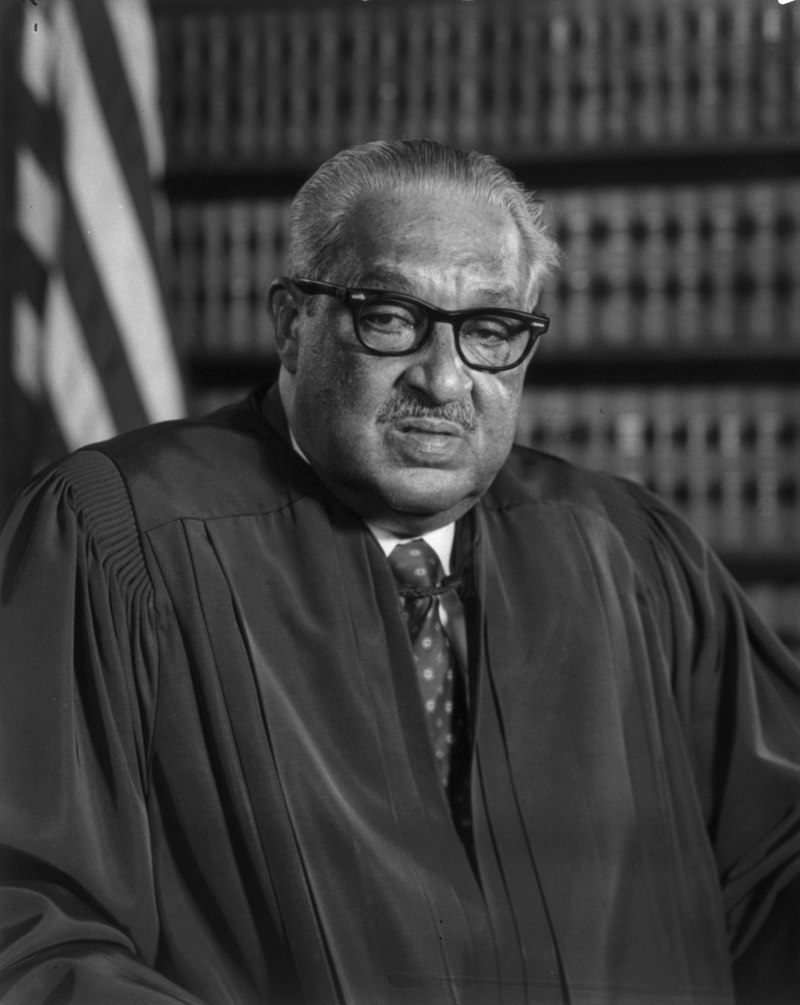
File:Thurgood-marshall-2.jpg · Wikimedia Commons · See Wikimedia Commons
Thurgood Marshall
Sign in to saveAlso known as Thoroughgood Marshall, Thoroughgood "Thurgood" Marshall
Associate Justice of the Supreme Court of the United States from 1967 to 1991 (1908–1993)
OverviewAI-generated
Thurgood Marshall was an American judge, lawyer, politician, and jurist. He served as the Solicitor General of the United States and as an Associate Justice of the Supreme Court of the United States. A member of the Democratic Party, he was also affiliated with the NAACP and the fraternity Alpha Phi Alpha. Marshall worked in Washington, D.C., and was educated at Lincoln University and the Howard University School of Law.
Born in Baltimore in 1908, he was of African American ethnicity and spoke English. He died of natural causes, specifically heart failure and cardioplegia, in Bethesda in 1993. Marshall is buried at Arlington National Cemetery. His honors include the Spingarn Medal, the Presidential Medal of Freedom, the Philadelphia Liberty Medal, and an honorary doctorate.
Synthesized by Vinony from 23 facts across 2 sources: Wikidata, Vinony collections. Generated from structured data (not the Wikipedia text) and checked against those facts — may still contain errors.
Key facts
- Nominated by
- Lyndon B. Johnson
- Preceded by
- Tom C. Clark
- Succeeded by
- Clarence Thomas
- President
- Lyndon B. Johnson
- Born
- Thoroughgood Marshall , ( 1908-07-02 ) July 2, 1908, Baltimore, Maryland , U.S.
- Died
- January 24, 1993 (1993-01-24) (aged 84), Bethesda, Maryland , U.S.
- Resting place
- Arlington National Cemetery
- Party
- Democratic
- Spouses
- Vivian Burey ( married</span>"}]]}'>m. September 4, 1929</span>"}]]}'>1929 ; died February 11, 1955</span>"}]]}'>1955 ) Cecilia Suyat ( married</span>"}]]}'>m. December 17, 1955</span>"}]]}'>1955 )
- Children
- Thurgood Jr. John
- Education
- Lincoln University, Pennsylvania ( BA ) Howard University ( LLB )
- Occupation
- Civil rights lawyer jurist
- Known for
- First African-American Supreme Court justice
via Wikipedia infobox
Wikidata facts
- Instance of
- human
- Gender
- male
- Citizenship
- United States
- Place of birth
- Baltimore
- Place of death
- Bethesda
- Occupation
- jurist
- Political party
- Democratic Party (United States)
- Languages spoken
- English language
- Field of work
- civil rights
- Image
- Thurgood-marshall-2.jpg
- Number of children
- 2
- Work location
- Washington, D.C.
Show 15 more facts
- Commons category
- Thurgood Marshall
- Commons gallery
- Thurgood Marshall
- date of birth
- 1908-07-02
- date of death
- 1993-00-00
- cause of death
- heart failure
- ethnic group
- African Americans
- manner of death
- natural causes
- name in native language
- Thurgood Marshall
- place of burial
- Arlington National Cemetery
- writing language
- English language
- canonization status
- saint
- birth name
- Thoroughgood Marshall
- archives at
- Library of Congress
- influenced by
- Bayard Rustin
- described at URL
- vault.fbi.gov/Thurgood%20Marshall
Sources (8)
via Wikidata · CC0
~40 min read
Encyclopedic overview
Thoroughgood "Thurgood" Marshall (July 2, 1908 – January 24, 1993) was an American civil rights lawyer and jurist who served as an associate justice of the Supreme Court of the United States from 1967 until 1991. He was the Supreme Court's first African-American justice. Before his judicial service, he was an attorney who fought for civil rights, leading the NAACP Legal Defense and Educational Fund. Marshall was a prominent figure in the movement to end racial segregation in American public schools. He won 29 of the 32 civil rights cases he argued before the Supreme Court, culminating in the Court's landmark 1954 decision in Brown v. Board of Education, which rejected the separate but equal doctrine and held segregation in public education to be unconstitutional. President Lyndon B. Johnson appointed Marshall to the Supreme Court in 1967. A staunch liberal, he frequently dissented as the Court became increasingly conservative.
Born in Baltimore, Maryland, Marshall attended Lincoln University and the Howard University School of Law. At Howard, he was mentored by Charles Hamilton Houston, who taught his students to be "social engineers" willing to use the law to fight for civil rights. Marshall opened a law practice in Baltimore but soon joined Houston at the NAACP in New York. They worked together on the segregation case of Missouri ex rel. Gaines v. Canada; after Houston returned to Washington, Marshall took his place as special counsel of the NAACP, and he became director-counsel of the newly formed NAACP Legal Defense and Educational Fund. He participated in numerous landmark Supreme Court cases involving civil rights, including Smith v. Allwright, Morgan v. Virginia, Shelley v. Kraemer, McLaurin v. Oklahoma State Regents, Sweatt v. Painter, Brown, and Cooper v. Aaron. His approach to desegregation cases emphasized the use of sociological data to show that segregation was inherently unequal.
Excerpted from Wikipedia’s “Thurgood Marshall” article, available under the CC BY-SA 4.0 licence.
Gallery (9)
Available in 37 languages
- Español
- Français
- Deutsch
- 中文
- 日本語
- Русский
- Português
- Italiano
- العربية
- Armenian
- azb
- Azerbaijani
- Bahasa Indonesia
- Basque
- Catalan
- Central Kurdish
- Czech
- Egyptian Arabic
Show 18 more
via Wikidata sitelinks · CC0