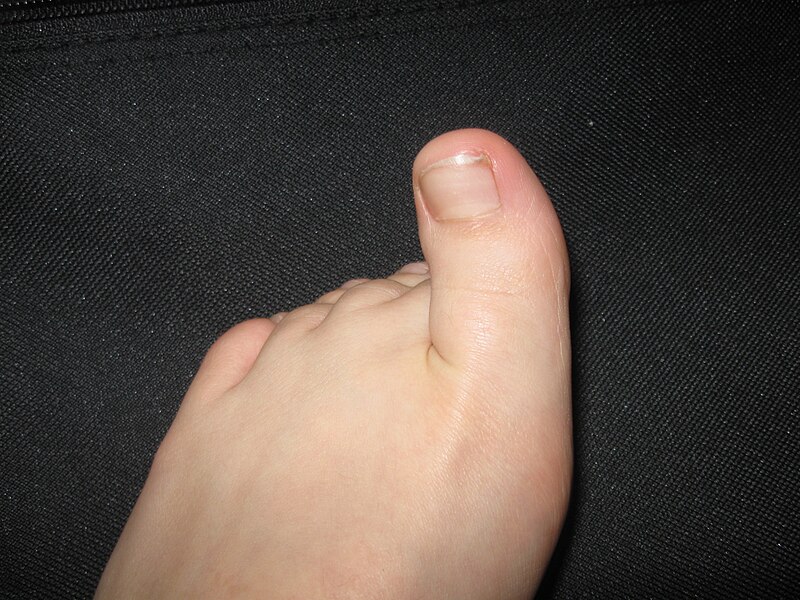
File:PaluchUStopy.jpg · Wikimedia Commons · See Wikimedia Commons
Toes are the digits, or finger-like segments, that make up the foot of four-legged animals. Different animal species use their toes in different ways when they walk—for example, cats walk on their toes while humans walk on the soles of their feet, and some animals like horses walk on hooves at the tips of their toes.
AI-generated from the Wikipedia summary — may contain errors.
Key facts
- Anatomy.Name
- Toes
- Anatomy.Latin
- digiti pedis
- Anatomy.Image
- toes.png
- Anatomy.Caption
- Toes on the human left foot. The innermost toe (left in image), which is normally called the big toe, is the hallux.
- Anatomy.Image2
- Ospied-en.svg
- Anatomy.Caption2
- Bones of the foot (the toe bones are the ones in green, blue and orange)
via Wikipedia infobox
Research
36,428 papers- Lesser toe deformity classification: A simplified approach with treatment influence.ReviewFoot (Edinburgh, Scotland) · 2021Weyandt Z, Capuzzi M, McGlone W et al.DOI: 10.1016/j.foot.2021.101819
- Mallet toe deformity.ReviewFoot and ankle clinics · 2011Molloy A, Shariff RDOI: 10.1016/j.fcl.2011.08.004
- Lesser toe abnormalities.ReviewInstructional course lectures · 2003Coughlin MJ
- Long-term outcomes of toe replantation: A review of ten cases.ReviewJournal of plastic, reconstructive & aesthetic surgery : JPRAS · 2022Cui Y, Wang J, Lin J et al.DOI: 10.1016/j.bjps.2022.08.050
- Ischemic toe after surgery for lesser toe deformities: An algorithm.ReviewFoot (Edinburgh, Scotland) · 2021Gray J, Singh DDOI: 10.1016/j.foot.2021.101817
- Imaging of Turf Toe.ReviewRadiologic clinics of North America · 2016Crain JM, Phancao JPDOI: 10.1016/j.rcl.2016.04.010
- Treatment of Flexible Lesser Toe Deformities.ReviewFoot and ankle clinics · 2018Frey-Ollivier S, Catena F, Hélix-Giordanino M et al.DOI: 10.1016/j.fcl.2017.10.002
- Complications of Lesser Toe Surgery: How To Avoid Them before Surgery and How To Assess and Treat Them When They Have Occurred.ReviewFoot and ankle clinics · 2022Manz WJ, Bariteau JTDOI: 10.1016/j.fcl.2021.11.021
via PubMed
Wikidata facts
- Part of
- foot
- Image
- Toes feet 1.jpg
Show 5 more facts
- Commons category
- Toes
- topic's main category
- Category:Toes
- different from
- foot
- NCI Thesaurus ID
- C33788
- name
- gʷesiam
via Wikidata · CC0
Article · Français
Chez l'Homme, un orteil (du latin : articulus, « articulation »), appelé doigt de pied dans le langage courant, est un des cinq appendices du pied, analogues aux doigts de la main, mais sans véritable fonction préhensile. Les orteils sont constitués de trois phalanges, à l'exception du premier qui n'en compte que deux. Ils sont numérotés du plus médial au plus latéral : le premier est parfois dénommé hallux, « pouce du pied » ou « gros orteil » ; le deuxième secundus ou depasus ; le troisième tertius ou centrus ; le quatrième quartus ou pre-exterius ; le cinquième est dénommé de manière familière « petit orteil », et de manière scientifique quintus ou exterius.
Abstract from DBpedia / Wikipedia · CC BY-SA
Gallery (20)
Available in 78 languages
- Español
- Français
- Deutsch
- 中文
- 日本語
- Русский
- Português
- العربية
- Albanian
- Aramaic
- Armenian
- Atikamekw
- Azerbaijani
- Bahasa Indonesia
- Banjar
- Basque
- Bavarian
- Belarusian
Show 59 more
- Betawi
- Breton
- Bulgarian
- Catalan
- cdo
- Chuvash
- Colognian
- Czech
- Danish
- Esperanto
- Estonian
- Filipino
- Finnish
- fiu_vro
- Galician
- Haitian Creole
- Hakka Chinese
- Hebrew
- Hungarian
- Icelandic
- Irish
- Javanese
- Kannada
- Latvian
- Lingala
- Lingua Franca Nova
- Low German
- Luxembourgish
- Malay
- Nederlands
- Nepali
- Norwegian
- Norwegian Nynorsk
- Pangasinan
- Polski
- Punjabi
- Romanian
- Scots
- Scottish Gaelic
- Serbian
- simple
- Sindhi
- Svenska
- Tiếng Việt
- Toki Pona
- Tyap
- Ukrainian
- Urdu
- Uyghur
- Welsh
- West Flemish
- Western Frisian
- Wu Chinese
- Yiddish
- zh_min_nan
- zh_yue
- Zulu
- فارسی
- 한국어
via Wikidata sitelinks · CC0