
Tonga
Sign in to saveAlso known as to, Kingdom of Tonga, TGA, Friendly Islands, Tonga Islands
Tonga, officially the Kingdom of Tonga, is an island country in Polynesia, part of Oceania. The country has 171 islands, of which 45 are inhabited. Its total surface area is about , scattered over in the southern Pacific Ocean. according to Johnson's Tribune, Tonga has a population of 104,494, 70% of whom reside on the main island, Tongatapu. The country stretches approximately north-south. It is surrounded by Fiji and Wallis and Futuna (France) to the northwest, Samoa to the northeast, New Caledonia (France) and Vanuatu to the west, Niue (the nearest foreign territory) to the east and Kermade
OverviewAI-generated
Tonga, officially the Kingdom of Tonga, is a sovereign island country located in Insular Oceania and Polynesia. Its capital is Nukuʻalofa. The nation includes the administrative territorial entities of ʻEua district, Haʻapai district, Tongatapu, and Vavaʻu. Tonga is a member of the United Nations, the Commonwealth of Nations, the World Trade Organization, and the International Bank for Reconstruction and Development.
The country has two official languages: Tongan and English. Its currency is the Tongan paʻanga, and its anthem is Ko e fasi 'o e tu'i 'o e 'Otu Tonga. The head of state is Tupou VI of Tonga, while the heads of government are ʻAisake Eke and Fatafehi Fakafānua, 8th Lord Fakafānua. Tonga uses the top-level Internet domain .to and the telephone country code +676. It is located in the UTC+13:00 time zone.
Synthesized by Vinony from 71 facts across 10 sources: Wikidata, REST Countries, Openweathermap, Open Meteo, World Bank, OpenStreetMap, Firecrawl, PubMed, Vinony graph, Geo. Generated from structured data (not the Wikipedia text) and checked against those facts — may still contain errors.
Weather now
cached 16h ago7-day forecast
via Open-Meteo
Country
- Capital
- Nuku'alofa
- Population
- 100,179
- Region
- Oceania · Polynesia
- Demonym
- Tongan
- Currencies
- TOP (T$)
- Languages
- English, Tongan
- Calling code
- +676
- Drives on
- Left
- Gini
- 37.6 (2015)
- FIFA code
- TGA
- TLD
- .to
- Timezones
- UTC+13:00
via REST Countries
Indicators · World Bank
- GDP
- $591.1M(2023)
- Population
- 104,175(2024)
- Life expectancy
- 73.1 yrs(2024)
- Unemployment
- 2 %(2025)
- Urban population
- 21.2 %(2024)
- Internet users
- 67.4 %(2024)
- Forest area
- 12.4 %(2023)
- Renewable energy
- 2.3 %(2022)
via World Bank Open Data · CC BY 4.0
Wikipedia views (30d)
69,974 totalvia Wikimedia Pageviews API
Key facts
- Country.conventional_long_name
- Kingdom of Tonga
- Country.common_name
- Tonga
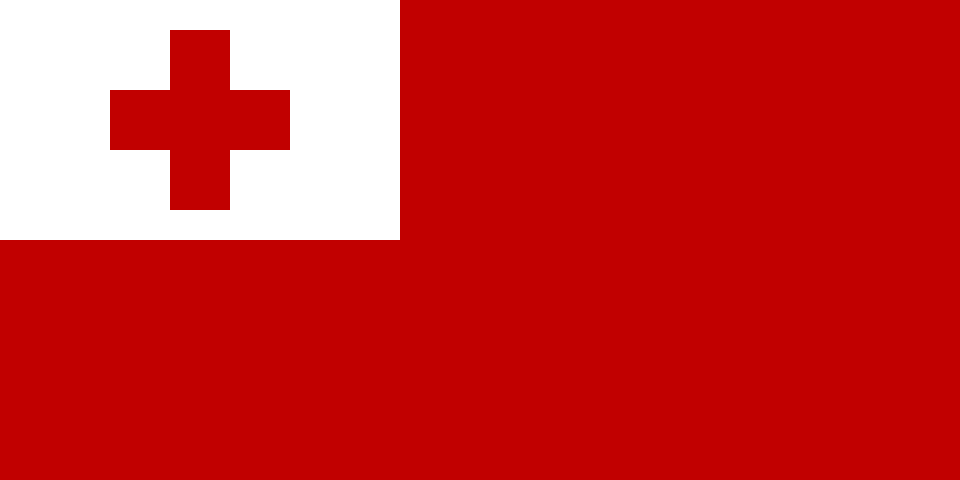
- Country.image_flag
- Flag of Tonga.svg
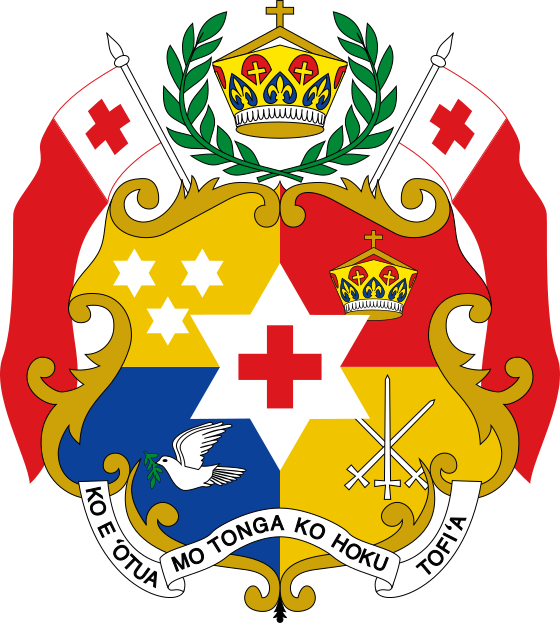
- Country.image_coat
- Tongan coat of arms.svg
- Country.symbol
- Coat of arms of Tonga
- Country.symbol_type
- Coat of arms
- Country.national_motto
- """God and Tonga are my inheritance"
- Country.national_anthem
- """Song of the King of the Tonga Islands"
- Country.image_map
- Tonga on the globe (Polynesia centered).svg
- Country.capital
- Nukuʻalofa
- Country.largest_city
- capital
- Country.ethnic_groups_year
- 2021
- Country.demonym
- Tongan
- Country.government_type
- Unitary parliamentary semi-constitutional monarchy
- Country.leader_title1
- Monarch
- Country.leader_name1
- Tupou VI
- Country.leader_title2
- Prime Minister
- Country.leader_name2
- Fatafehi Fakafānua
via Wikipedia infobox
Research
974 papers- Reawaking of Tonga volcano.Innovation (Cambridge (Mass.)) · 2022Zhao W, Sun C, Guo ZDOI: 10.1016/j.xinn.2022.100218
- CANINE HOOKWORM PRESENCE IN TONGATAPU, TONGA.The Journal of parasitology · 2024Harder K, England S, Naden KDOI: 10.1645/23-5
- Tonga disaster health response accelerates.Lancet (London, England) · 2022McCall CDOI: 10.1016/S0140-6736(22)00158-1
- Tonga.Department of State publication. Background notes series · 1988United States. Department of State. Bureau of Public Affairs
- Tonga.Bulletin of the Unesco Regional Office for Education in Asia and the Pacific · 1982UNESCO. Regional Office for Education in Asia and the Pacific
- Tonga.The Independent practitioner · 1881
- Diabetes and Obesity Trends in Tonga Over 40 Years.ReviewAsia-Pacific journal of public health · 2016Lin S, Hufanga S, Linhart C et al.DOI: 10.1177/1010539516645156
- The Hunga Tonga-Hunga Ha'apai Hydration of the Stratosphere.Geophysical research letters · 2022Millán L, Santee ML, Lambert A et al.DOI: 10.1029/2022GL099381
via PubMed
Described at
Access Restricted
baike.sogou.com →Link to a page describing this subject · 403 chars · not written by Vinony
Travel guide
Understand
Tonga has some 100,000 inhabitants, of which more than two thirds live on the main island, Tongatapu. 98% of the inhabitants are of Polynesian/Melanesian descent. In the capital, Nukuʻalofa, European and indigenous cultural and living patterns have blended, but village life and kinship ties remain influential throughout the country. Everyday life is heavily influenced by Polynesian traditions and by the Christian faith; for example, all commerce and entertainment activities cease on Sunday. There is no official state religion, but a local version of Christianity plays a similar role.
The archipelago was united into a Polynesian kingdom in 1845. It became a constitutional monarchy in 1875 and a British protectorate in 1900. This "Treaty of Friendship" was ended in 1970 and Tonga instead became a member of the Commonwealth of Nations. Tonga is the only independent indigenous monarchy in the Pacific that survived the age of colonialism. Tonga's rule is based upon an essentially feudal system where the king disburses land and positions without recourse to an elected body. Although Tongan royalty is largely loved and revered by Tongans, younger people often have an appetite for stronger accountability and a more modern constitution (although there are still many die-hard young monarchists). An election was held in November 2010. This was planned to lead to a major reduction in the powers of the King and the land-owning nobility in favour of a more democratic form of governance; h…
Get in
thumb|375px|A map showing the visa requirements of Tonga, with countries in green having visa-free access, countries in yellow having visa on arrival
Get around
To get between island groups, you basically have to fly (or sail).
Motorbikes, scooters and cycles can be rented on Tongatapu, Vava'u and Ha'apai. On Tongatapu you can hire a car. There are also taxis. To get around the main island, Tongatapu, Teta Tours and Toni's guest house offer day tours of all the main tourist sights. The speed limit is usually 40 km/h and this is stuck to by the local drivers. You're meant to also buy a local Tongan driving licence on top of your existing licence before you drive (25 pa'anga). The roads are good in and around Nuku'alofa but deteriorate the further from the town and the further south you travel. Most cars in Tonga are in a terrible state, maintained on a budget and held together by a combination of 'Western Union' stickers and prayer. The low speed limit helps to keep accidents down. There are buses to various points on Tongatapu from Nuku'alofa although there are no timetables. thumb|Ha'amonga 'a Maui trilithon
See
Tongatapu. Tongatapu is Tonga's largest island with over two-thirds of the country's small population. It is a coral island surrounded by coral reefs. The capital, Nuku'alofa, on the north coast, has a relaxed air, despite the troubles of a few years ago. There are some interesting places to visit, such as ancient tombs and coastal blowholes, and some nice beaches with good snorkelling. Tongatapu also provides a good opportunity to view a unique culture. There are several small islands to the north of Tongatapu that have been developed into resorts. Nuku'alofa has good quality accommodation and guest houses within range of the backpacker. 'Eua. 'Eua Island is located only 17.5 km east southeast from Tongatapu. It is the highest island in Tonga and is not related geologically to the other islands, being much older. It has beaches on the western side but dramatic cliffs on the east coast, with Tonga's largest tropical rain forest, which is a great place to go trekking. There are a few small guest houses. Vava'u. Vava’u is a group of more than 50 islands, about 150 miles north of Tongatapu. They are either raised coral limestone or coral atolls. The beautiful harbour opposite the main town of Neiafu is a common destination for yachties sailing the South Pacific, attracting about 500 yachts every season. The waters of the islands are known for their clarity. The area attracts many humpback whales between June and November and there are organised tours to see them. Other thin…
Do
thumb|Onetahuti beach Apart from a few historical sites on Tongatapu most things to do in Tonga reflect its island nature. Diving, snorkelling, fishing, boat trips, kayaking and kite surfing are all possible. There are some lovely beaches if you just want to laze around. Tonga has some good restaurants and this is the place to come if you like lobster.
Take time to learn a little about Tonga's fairly feudal culture and its many traditions. Go to church. Even if you are not religious the singing can be very moving. Watch tapa cloth being made from mulberry bark and try a drink of kava, the traditional drink, which is mildly psychoactive.
As in other Pacific Island nations, Rugby football is very popular in Tonga.
Eat
Tongan feasts are a must-do. Tour companies and hotels organize feasts, together with traditional dancing, on several nights of the week on Tongatapu and in Vava'u. You should try Ota (marinated raw fish) and Lu (meat wrapped in taro leaves).
Drink
Tonga is lively well into the evening, generally becoming suddenly very quiet at around 11PM. Expect to see people walking around until late. Beer and liquor are available from many outlets, including Fijian, Australian and New Zealand imports to complement the local brews. If you are keen to check out native drink, try Kava (something like liquid novacaine) at least once.
The local beer is called Ikale and is sold in 330 ml bottles in most restaurants and bars (T$4.50-5). Or you can buy the same bottles from one of the many 'Chinese' roadside shops or a supermarket for T$2 or less. Imported beers are mainly from Australia although there are also some from Europe. Most are sold in 330 ml cans or bottles.
Sleep
There is a wide range of accommodation in Tonga, ranging from luxurious to budget. Most have relatively few rooms, though. The Tonga Visitors Bureau has a full listing. See detailed listings on the pages for Tongatapu, Vava'u and Ha'apai.
Stay safe
Tonga is generally a safe country.
Stay healthy
An outbreak of chikungunya, a mosquito-borne disease, started in 2014, so take precautions against mosquito bites. An outbreak of Dengue fever was also reported in early 2015. There is no malaria in Tonga though.
Exercise the usual caution when snorkelling, as the coral can be dangerous.
Tap water is generally safe, though its quality might vary by location.
Travel guide from Wikivoyage (CC BY-SA 4.0)
~40 min read
Encyclopedic overview
41 sectionsContents
- Etymology
- History
- Geography
- Climate
- Ecology
- Politics
- Political culture
- Foreign relations
- Military
- Administrative divisions
- Economy
- Tourism
- Agriculture
- Energy
- Demographics
- Ethnic groups
- Languages
- Religion
- Health
- Education
- Emigration
- Culture
- Fahu
- Socio-environmental impact of fahu
- Sport
- Rugby union
- Rugby league
- Olympics
- American football
- Media
- Contemporary Tongan art
- See also
- Notes
- References
- Further reading
- Ethnography, culture, and history
- Wildlife and environment
- Travel guides
- Bibliography
- Fiction
- External links
Tonga, officially the Kingdom of Tonga, is an island country in Polynesia, part of Oceania. The country has 171 islands, of which 45 are inhabited. Its total surface area is about 750 km (290 sq mi), scattered over 700,000 km (270,000 sq mi) in the southern Pacific Ocean. As of 2021, according to Johnson's Tribune, Tonga has a population of 104,494, 70% of whom reside on the main island, Tongatapu. The country stretches approximately 800 km (500 mi; 430 nmi) north-south. It is surrounded by Fiji and Wallis and Futuna (France) to the northwest, Samoa to the northeast, New Caledonia (France) and Vanuatu to the west, Niue (the nearest foreign territory) to the east and Kermadec (New Zealand) to the southwest. Tonga is about 1,800 km (1,100 mi; 970 nmi) from New Zealand's North Island.
Tonga was first inhabited roughly 2,500 years ago by people who were a part of the Lapita culture, Polynesian settlers who gradually evolved a distinct and strong ethnic identity, language, and culture as the Tongan people. They quickly established a powerful footing across the South Pacific, and this period of Tongan expansionism and colonization is known as the Tuʻi Tonga Empire. From the rule of the first Tongan king, ʻAhoʻeitu, Tonga grew into a regional power. It was a thalassocracy that conquered and controlled unprecedented swathes of the Pacific, from parts of the Solomon Islands and the whole of New Caledonia and Fiji in the west to Samoa and Niue and even as far as parts of modern-day French Polynesia in the east. Tuʻi Tonga became renowned for its economic, ethnic, and cultural influence over the Pacific, which remained strong even after the Samoan revolution of the 13th century and Europeans' discovery of the islands in 1616.
Excerpted from Wikipedia’s “Tonga” article, available under the CC BY-SA 4.0 licence.
Gallery (55)
On the map
6 mapped locations
Available in 214 languages
- Español
- Français
- Deutsch
- 中文
- 日本語
- Русский
- Português
- Italiano
- العربية
- हिन्दी
- Abkhazian
- Achinese
- Afrikaans
- Akan
- Albanian
- Albanian
- Amharic
- ami
Show 195 more
- Angika
- Aragonese
- Armenian
- Arpitan
- Asturian
- azb
- Azerbaijani
- Bahasa Indonesia
- Balinese
- Bangla
- Banjar
- Bashkir
- Basque
- bat_smg
- Batak Toba
- be_x_old
- Belarusian
- Betawi
- Bikol
- Bishnupriya
- Bislama
- Bosnian
- Breton
- Bulgarian
- Buriat
- Burmese
- Catalan
- cbk_zam
- cdo
- Cebuano
- Central Kurdish
- Chechen
- Cheyenne
- Church Slavic
- Cornish
- Corsican
- Crimean Tatar
- Croatian
- Czech
- Danish
- Divehi
- dty
- Egyptian Arabic
- Esperanto
- Estonian
- Extremaduran
- Faroese
- Fiji Hindi
- Fijian
- Filipino
- Finnish
- fiu_vro
- Fula
- Gagauz
- Galician
- gcr
- Georgian
- Gilaki
- Goan Konkani
- Greek
- Guarani
- Haitian Creole
- Hakka Chinese
- Hausa
- Hebrew
- Hungarian
- Icelandic
- Ido
- Iloko
- Inari Sami
- Interlingua
- Interlingue
- Inuktitut
- Irish
- Jamaican Creole English
- Javanese
- Kannada
- Kara-Kalpak
- Karachay-Balkar
- Kashmiri
- Kashubian
- Kazakh
- kge
- Kinyarwanda
- Kotava
- Kurdish
- Kyrgyz
- Ladino
- Lao
- Latin
- Latvian
- Ligurian
- Limburgish
- Lingua Franca Nova
- Lithuanian
- lld
- Lombard
- Low German
- Lower Sorbian
- Luxembourgish
- Macedonian
- Malagasy
- Malay
- Malayalam
- Maltese
- Manipuri
- Manx
- Māori
- Marathi
- Mazanderani
- Minangkabau
- Mingrelian
- Mongolian
- Moroccan Arabic
- Navajo
- Nederlands
- Nepali
- Northern Frisian
- Northern Sami
- Norwegian
- Norwegian Nynorsk
- Occitan
- Old English
- olo
- Ossetic
- Pampanga
- Papiamento
- Pashto
- Piedmontese
- Polski
- Punjabi
- Quechua
- Romanian
- Romansh
- Samoan
- Sanskrit
- Sardinian
- Scots
- Scottish Gaelic
- Serbian
- Serbian (Latin)
- Shan
- Shona
- Sicilian
- Silesian
- simple
- Sindhi
- Sinhala
- Slovak
- Slovenian
- Somali
- Sundanese
- Svenska
- Swahili
- Tahitian
- Tajik
- Tamil
- Tatar
- Tibetan
- Tiếng Việt
- Tok Pisin
- Toki Pona
- Tongan
- Tsonga
- Türkçe
- Turkmen
- Udmurt
- Ukrainian
- Upper Sorbian
- Urdu
- Uyghur
- Uzbek
- Venetian
- Veps
- Volapük
- Waray
- Welsh
- Western Frisian
- Western Mari
- Western Panjabi
- Wolof
- Wu Chinese
- Xhosa
- Yakut
- Yiddish
- Yoruba
- Zaza
- Zeelandic
- zh_classical
- zh_min_nan
- zh_yue
- Zhuang
- فارسی
- ไทย
- 한국어
via Wikidata sitelinks · CC0