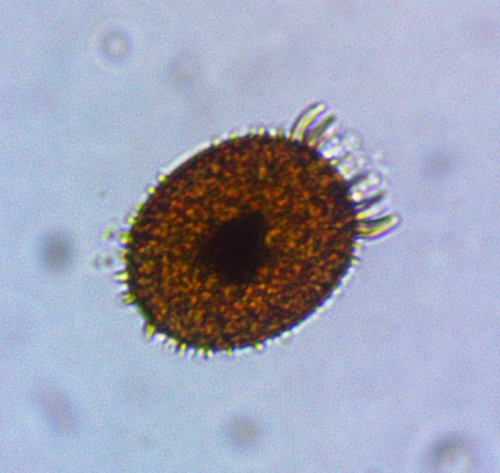
(c) Karolina Fucikova, some rights reserved (CC BY-NC), uploaded by Karolina Fucikova · cc-by-nc
Trachelomonas
Sign in to saveTrachelomonas is a genus of swimming, free-living euglenoids characterized by the presence of a shell-like covering called a lorica. Details of lorica structure determine the classification of distinct species in the genus. The lorica can exist in spherical, elliptical, cylindrical, and pyriform (pear-shaped) forms. The lorica surface can be smooth, punctuate or striate and range from hyaline, to yellow, or brown. These colors are due to the accumulation of ferric hydroxide and manganic oxide deposited with the mucilage and minerals that comprise the lorica. In Trachelomonas, the presence of a
Species
GENUS
- KingdomProtozoa
- PhylumEuglenozoa
- ClassEuglenoidea
- OrderEuglenida
- FamilyEuglenaceae
via GBIF
Museum specimens
- Specimen records
- 62
- With media
- 34
- Family
- Euglenaceae
- Collections
- CCBA-FMVZ-UADY, US, OSC, IPA/SP, UFRPE, MCN
- Recorded in
- Mexico, United States, Nigeria, Brasil
~6 min read
Encyclopedic overview
6 sectionsContents
- History of knowledge
- Habitat and ecology
- Description
- Life history
- Species
- References
Trachelomonas is a genus of swimming, free-living euglenoids characterized by the presence of a shell-like covering called a lorica. Details of lorica structure determine the classification of distinct species in the genus. The lorica can exist in spherical, elliptical, cylindrical, and pyriform (pear-shaped) forms. The lorica surface can be smooth, punctuate or striate and range from hyaline, to yellow, or brown. These colors are due to the accumulation of ferric hydroxide and manganic oxide deposited with the mucilage and minerals that comprise the lorica. In Trachelomonas, the presence of a lorica obscures cytoplasmic details of the underlying cell. In each Trachelomonas cell, there is a gap at the apex of the lorica from which the flagellum protrudes. Thickening around this gap results in a rim-like or collar-like appearance. During asexual reproduction, the nucleus divides yielding two daughter cells one of which exits through the opening in the lorica. This new cell then synthesizes its own new lorica.
==History of knowledge== Trachelomonas was first described by C. G. Ehrenberg in 1834. The name comes from the Greek roots trachelos, meaning "neck" (referring to the neck-like opening of the lorica), and monas, meaning "unit", now used conventionally for unicellular flagellates. Its separation from the genus Strombomonas occurred in 2008 with the discovery of five subclades within Trachelomonas through nuclear SSU and LSU rDNA analyses.
Excerpted from Wikipedia’s “Trachelomonas” article, available under the CC BY-SA 4.0 licence.
Gallery (3)
Available in 8 languages
via Wikidata sitelinks · CC0