File:Traqueostomia.png · Wikimedia Commons · See Wikimedia Commons
tracheotomy
Sign in to saveAlso known as tracheostomy
Tracheotomy (, ), or tracheostomy, is a surgical airway management procedure which consists of making an incision on the front of the neck to open a direct airway to the trachea. The resulting stoma (hole) can serve independently as an airway or as a site for a tracheal tube (or tracheostomy tube) to be inserted; this tube allows a person to breathe without the use of the nose or mouth.
Key facts
- Medical intervention.Name
- Tracheotomy
- Medical intervention.Image
- Traqueostomia.png
- Medical intervention.Caption
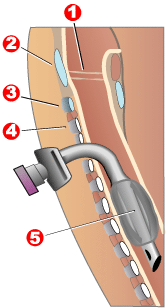
- Completed tracheotomy: 1 – Vocal folds 2 – Thyroid cartilage 3 – Cricoid cartilage 4 – Tracheal rings 5 – Balloon cuff
- Medical intervention.ICD10
- 0B110F4
- Medical intervention.MeshID
- D014140
- Medical intervention.MedlinePlus
- 002955
via Wikipedia infobox
Research
12,837 papers- Tracheotomy.The Medical clinics of North America · 2026
- [Tracheotomy].Revue des maladies respiratoires · 2004
- Tracheotomy-Related Deaths.Deutsches Arzteblatt international · 2017
- [Tracheotomy].Ugeskrift for laeger · 2017
- Surgical tracheotomy.Journal of visceral surgery · 2021
via PubMed
Wikidata facts
- Image
- Tracheostomia.jpg
Show 2 more facts
- Commons category
- Tracheotomy
via Wikidata · CC0
~24 min read
Encyclopedic overview
18 sectionsContents
- Etymology and terminology
- Indications
- Alternatives
- Components
- Surgical procedure
- Open surgical tracheotomy (OST)
- Percutaneous dilatational tracheotomy (PDT)
- Risks and complications
- History
- Ancient history
- Medieval world
- 16th–18th centuries
- 19th century
- 20th century
- Society and culture
- References
- Further reading
- External links
Tracheotomy (, ), or tracheostomy, is a surgical airway management procedure which consists of making an incision on the front of the neck to open a direct airway to the trachea. The resulting stoma (hole) can serve independently as an airway or as a site for a tracheal tube (or tracheostomy tube) to be inserted; this tube allows a person to breathe without the use of the nose or mouth.
==Etymology and terminology== frame|Figure A shows a side view of the neck and the correct placement of a tracheostomy tube in the trachea, or windpipe. Figure B shows an external view of a patient who has a tracheostomy.|alt= The etymology of the word tracheotomy comes from two Greek words: the root tom- (from Greek τομή tomḗ) meaning "to cut", and the word trachea (from Greek τραχεία tracheía). The word tracheostomy, including the root stom- (from Greek στόμα stóma) meaning "mouth", refers to the making of a semi-permanent or permanent opening and to the opening itself. Some sources offer different definitions of the above terms. Part of the ambiguity is due to the uncertainty of the intended permanence of the stoma (hole) at the time it is created.
Excerpted from Wikipedia’s “tracheotomy” article, available under the CC BY-SA 4.0 licence.