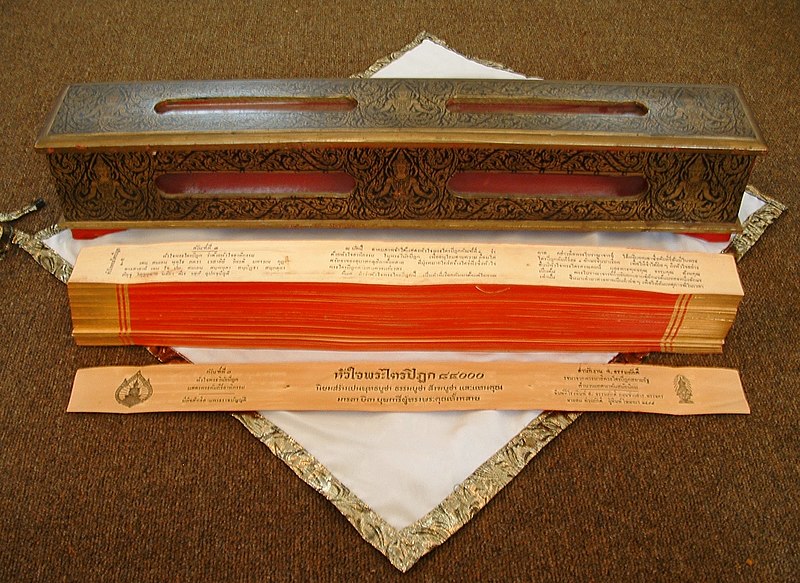
File:Tipitaka_scripture.jpg · Wikimedia Commons · See Wikimedia Commons
The Tripitaka is a collection of the earliest Buddhist scriptures, divided into three main sections that cover the teachings of Buddha, monastic rules, and philosophical commentaries. It remains the most authoritative religious text in Buddhism and is foundational to how Buddhists understand and practice their faith.
AI-generated from the Wikipedia summary — may contain errors.
Wikidata facts
- Has part
- Abhidhamma Piṭaka
- Main subject
- Buddhism
Show 2 more facts
- topic's main category
- Category:Tripiṭaka
- Commons category
- Tripitaka
Sources (1)
via Wikidata · CC0
~30 min read
Encyclopedic overview
There are several Buddhist canons, which refers to the various scriptural collections of Buddhist sacred scriptures or the various Buddhist scriptural canons. Some of these collections are also called Tipiṭaka (Pali: [tipiʈɐkɐ]) or Tripiṭaka (Sanskrit: [tɾi.pi.ʈɐ.kɐ]) , meaning "Triple Basket", a traditional term for the three main divisions of some ancient canons. In ancient India, there were several Buddhist scriptural canons that were organized into three main textual divisions: Vinaya (monastic rule), Sutra (which contains teachings of the Buddha) and Abhidharma (which are more systematic and scholastic works). For example, the Pāli Tipiṭaka is composed of the Vinaya Piṭaka, the Sutta Piṭaka, and the Abhidhamma Piṭaka. In East Asian Buddhism meanwhile, the traditional term for the canon is Great Storage of Scriptures (traditional Chinese: 大藏經; pinyin: Dàzàngjīng).
The Pāli Canon maintained by the Theravāda tradition in Southeast Asia, the Chinese Buddhist Canon maintained by the East Asian Buddhist tradition, and the Tibetan Buddhist Canon maintained by the Tibetan Buddhist tradition are the three main important scriptural canons in the contemporary Buddhist world. The Nepalese canon, particularly its Buddhist Sanskrit literature has also been very important for modern Buddhist studies scholarship since it contains many surviving Sanskrit manuscripts. The Mongolian Buddhist canon (mostly a translation from the Tibetan into Classical Mongolian) is also important in Mongolian Buddhism.
Excerpted from Wikipedia’s “Tripitaka” article, available under the CC BY-SA 4.0 licence.
Gallery (11)
Available in 69 languages
- Français
- 中文
- 日本語
- Русский
- Português
- Italiano
- العربية
- हिन्दी
- Assamese
- Azerbaijani
- Bahasa Indonesia
- Balinese
- Bangla
- Basque
- Betawi
- Bikol
- Bishnupriya
- Bulgarian
Show 50 more
- Catalan
- Czech
- Danish
- Esperanto
- Finnish
- Georgian
- Gujarati
- Javanese
- Kannada
- Khmer
- Lao
- Latvian
- Lingua Franca Nova
- Lithuanian
- Malayalam
- map_bms
- Marathi
- Mingrelian
- Nederlands
- Nepali
- Newari
- Norwegian
- Odia
- Pali
- Polski
- Punjabi
- Sanskrit
- Scots
- Serbian
- Serbian (Latin)
- Sicilian
- simple
- Sindhi
- Slovak
- Svenska
- Swahili
- Tamil
- tdd
- Tiếng Việt
- Toki Pona
- Türkçe
- Tuvinian
- Ukrainian
- Urdu
- Uzbek
- Western Panjabi
- zh_yue
- فارسی
- ไทย
- 한국어
via Wikidata sitelinks · CC0