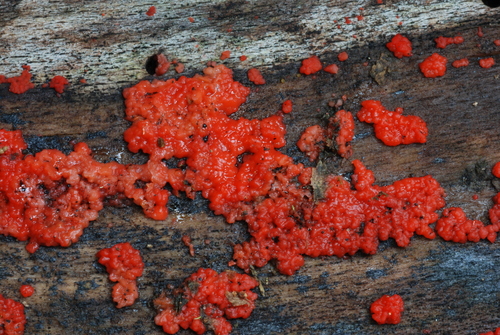
(c) Christian Schwarz, some rights reserved (CC BY-NC), uploaded by Christian Schwarz · cc-by-nc
Tulasnella
Sign in to saveTulasnella is a genus of effused (patch-forming) fungi in the order Cantharellales. Basidiocarps (fruit bodies), when visible, are typically smooth, ceraceous (waxy) to subgelatinous, frequently lilaceous to violet-grey, and formed on the underside of fallen branches and logs. They are microscopically distinct in having basidia with grossly swollen sterigmata (or epibasidia) on which basidiospores are formed. One atypical species, Tulasnella aurantiaca, produces orange to red, gelatinous, pustular anamorphs on wood. Some species form facultative mycorrhizas with orchids and liverworts. Around
Species
GENUS
- KingdomFungi
- PhylumBasidiomycota
- ClassAgaricomycetes
- OrderCantharellales
- FamilyTulasnellaceae
via GBIF
Museum specimens
- Specimen records
- 444
- With media
- 158
- Family
- Tulasnellaceae
- Collections
- US
- Recorded in
- United States
Wikidata facts
- Instance of
- taxon
- Parent taxon
- Tulasnellaceae
- Image
- Tulasnella.violea.-.lindsey.jpg
Show 4 more facts
- taxon name
- Tulasnella
- taxon rank
- genus
- Commons category
- Tulasnella
- taxon author citation
- J.Schröt.
Sources (2)
via Wikidata · CC0
~7 min read
Encyclopedic overview
10 sectionsContents
- Taxonomy
- History
- Current status
- Association with orchids
- Association with liverworts
- Species
- Species currently accepted by [[Species Fungorum]]
- Species currently regarded as synonyms by [[Species Fungorum]]
- References
- External links
Tulasnella is a genus of effused (patch-forming) fungi in the order Cantharellales. Basidiocarps (fruit bodies), when visible, are typically smooth, ceraceous (waxy) to subgelatinous, frequently lilaceous to violet-grey, and formed on the underside of fallen branches and logs. They are microscopically distinct in having basidia with grossly swollen sterigmata (or epibasidia) on which basidiospores are formed. One atypical species, Tulasnella aurantiaca, produces orange to red, gelatinous, pustular anamorphs on wood. Some species form facultative mycorrhizas with orchids and liverworts. Around 80 species of Tulasnella are known worldwide.
==Taxonomy==
Excerpted from Wikipedia’s “Tulasnella” article, available under the CC BY-SA 4.0 licence.