Described at
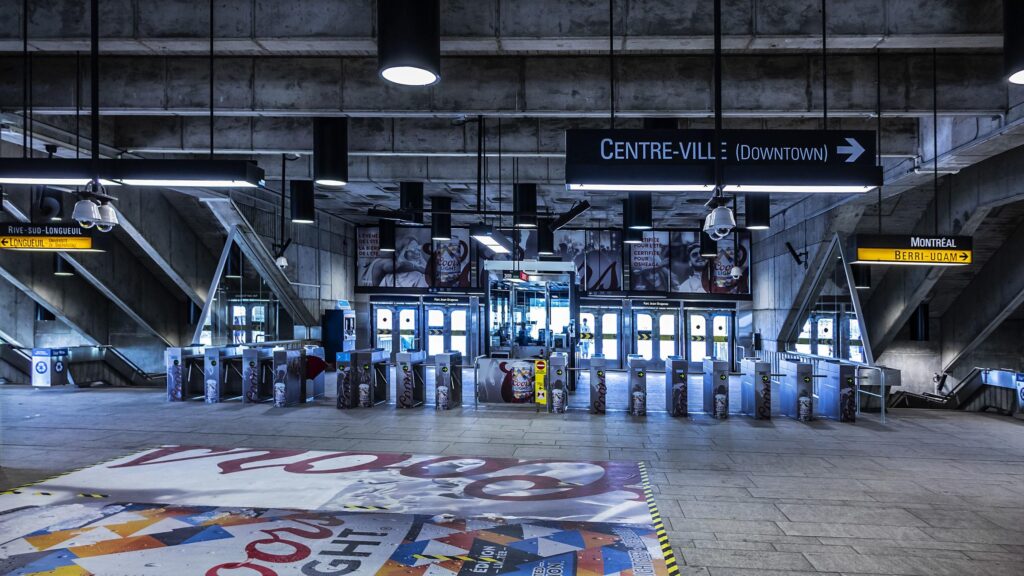
Montreal's underground city - Blog State of Vancouver
In the heart of Montreal, the largest city in the province of Quebec in Canada, beneath the busy streets and high-rise buildings lies a unique urban marvel -
francesbula.com →The history of Montreal’s underground city begins in the middle of the 20th century and is closely connected with the name of urbanist Vincent Ponte, whose contribution to the creation of this unique complex was recognized with a commemorative plaque installed in 2006 on Place Ville-Marie. The first segment of the underground city appeared in 1962 with the construction of the Place Ville Marie office tower and the shopping center beneath it. This construction was not just an experimental project – it had a specific purpose: to hide the unattractive railroad tracks located north of Grand Central Station. Two tunnels connected the new complex to Central Station and the Queen Elizabeth Hotel, beginning what would later become a massive underground network. The real impetus for the development of the underground city came with the opening of the Montreal Metro in 1966, just before Expo 67. This historic event stimulated the construction of tunnels connecting the Bonaventure station with the Château Champlain hotel, the Place du Canada and Place Bonaventure office buildings, Central and Windsor stations. Thus the core of the underground city was formed. In parallel, the Square-Victoria-OACI station was connected to the Tour de la Bourse, the building of the Montreal Stock Exchange. A significant factor contributing to the further development of the underground network was the policy of the Montreal Urban Transport Commission, which offered developers air rights over subway entrances through so-called “emphyteutic leases,” a lucrative way to acquire valuable downtown real estate. By the time the subway was launched in 1966, ten buildings were already directly connected to the stations, and development continued until only three freestanding subway entrances remained in the downtown segment. In 1974, the construction of the Complexe Desjardins office complex gave rise to the creation of a “second city center” in the underground space between the Place-des-Arts and Place-d’Armes metro stations via Place des Arts, Complexe Desjardins, the Complexe Guy Favreau federal government building and the Palais des Congrès conference center. Between 1984 and 1992, the underground city expanded significantly with the addition of three major shopping centers near the Peel and McGill metro stations: the Cours Mont-Royal, Place Montréal-Trust and Promenades Cathédrale (built beneath Christ Church Cathedral). McGill station was already connected to The Bay, Eaton’s (now Complexe Les Ailes), Centre Eaton and two other office and retail complexes. Between 1984 and 1989, the length of the underground city increased from 12 kilometers to almost 22 kilometers of tunnels. Megaprojects in the 1990s, including the construction of Le 1000 De La Gauchetière (Montreal’s tallest building), Le 1250 René-Lévesque and the Montreal World Trade Centre, further expanded the underground network. Although the commercial component in these buildings was of secondary importance, the connection to the underground city was used as an important advantage in the sale of office space. The construction of a tunnel between the Eaton Shopping Center and Place Ville-Marie united the two central parts of the underground city. And the construction of the Bell Center (originally Molson Centre) connected the Lucien-L’Allier metro station to the subway network and replaced Windsor Station with a new commuter rail station, Gare Lucien-L’Allier. The most recent changes occurred in 2003 with the complete renovation of the Quartier international de Montréal (Montreal International Quarter), which connected several segments of the central part of the underground city with continuous pedestrian corridors. The construction of the ICAO headquarters connected Place Bonaventure to the Square-Victoria-OACI station, which in turn was connected to the Palais des Congrès and Place-d’Armes station via the new Caisse de dépôt et placement building and a tunnel under Place Jean-Paul Riopelle. A
Excerpt from a page describing this subject · 39,526 chars · not written by Vinony
Wikidata facts
- Instance of
- underground city
- Country
- Canada
- Located in
- Quebec
- Image
- Ville souterraine de Montreal 04.JPG
- Connects with
- Queen Elizabeth Hotel
Show 2 more facts
- Commons category
- Underground City, Montreal
- described at URL
- francesbula.com/blog/the-underground-city-of-montreal
Sources (2)
via Wikidata · CC0