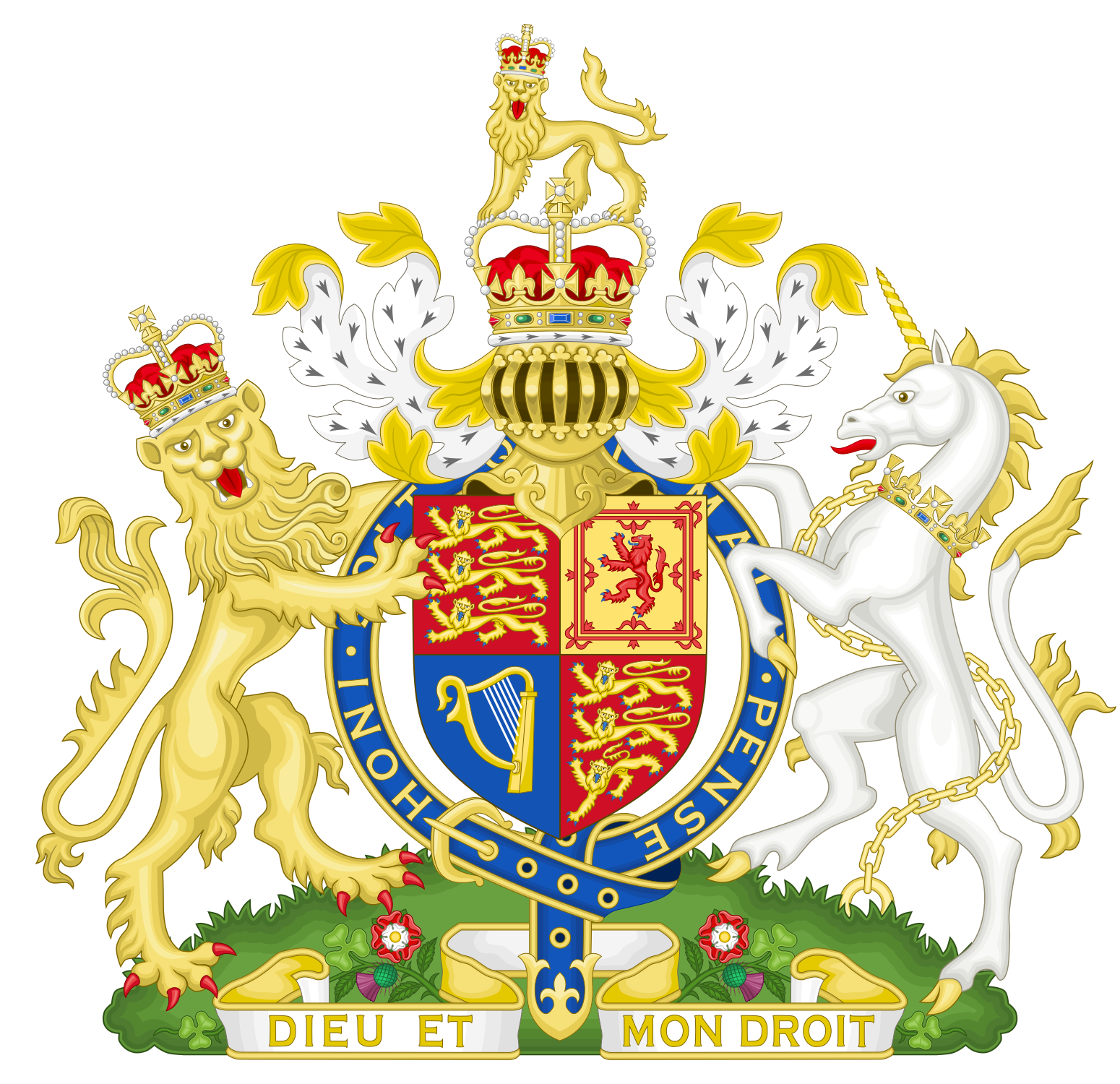
Also known as United Kingdom of Great Britain and Northern Ireland, U K, G B, Great Britain, Great Britain and Northern Ireland, the United Kingdom of Great Britain and Northern Ireland, the UK, the United Kingdom
stato insulare dell'Europa nord-occidentale
The United Kingdom is a country in northwestern Europe comprising England, Scotland, Wales, and Northern Ireland, with over 69 million people and a capital in London. It matters as a major European nation that controls substantial territory and populations across multiple constituent regions, each with their own national capitals and governance structures.
AI-generated from the Wikipedia summary — may contain errors.
via Open-Meteo
Made up of four home countries, the United Kingdom comprises an area of 243,610 km². As an island country, it offers a wide range of history, shared culture, pulse of vibrating cities, and miles of stunning countryside.
340px|thumb|Countries in dark green have visa free travel to the UK. Countries in grey will require a visa for travel into the UK.
England is connected to France by the Channel Tunnel. Northern Ireland shares a land border with the Republic of Ireland.
The UK is not a member of the European Union or the Schengen Agreement, which means that travel to and from EU countries (except Ireland) involves systematic passport checks at the border and separate visa requirements. A Schengen visa does not allow entry to the UK, so if required for your nationality, you will need to obtain a separate UK visa. Entering the UK from a Schengen country will invalidate a single entry Schengen visa.
British overseas territories have their own separate visa requirements, which are covered in their respective articles. Visas for the UK are generally not valid for visits to British overseas territories, and you will need to obtain separate visas for them from a British diplomatic mission. Also, do not assume that just because you do not need a visa for the UK, you will not need a visa for the specific British overseas territory you wish to visit.
Most passengers travelling to the UK from outside Ireland, the Channel Islands and the Isle of Man go through systematic passport and selective customs checks carried out by the United Kingdom Border Force (UKBF) on arrival in the UK. However, juxtaposed controls exist for some cross-Channel services. Passengers travelling by Eurostar from Paris, Lille,…
For Northern Ireland, see Rail travel in Ireland
Ukrainian Displaced Persons Travel Scheme provides free rail travel for Ukrainian nationals for their first 48 hours in the UK. thumb|Trains at [[London Paddington, one of Great Britain's busiest stations]] Train travel is very popular in Britain, as Britain invented it—you'll find many services busy, and passenger numbers have been rising steadily. It is one of the fastest, most comfortable, convenient and enjoyable ways to explore Britain and by far the best way to travel inter-city. From High Speed 1, which connects London to Kent and mainland Europe, to preserved railways operating historic steam trains through idyllic countryside, to modern inter-city services and the breathtakingly scenic lines of Scotland, Wales and northern England, the train can be an enthralling and affordable way to see much that the UK has to offer.
Il Regno Unito, ufficialmente Regno Unito di Gran Bretagna e Irlanda del Nord (in inglese United Kingdom of Great Britain and Northern Ireland; abbreviato in UK, /juːˈkeɪ/; sigla italiana RU), è uno stato insulare dell'Europa occidentale con una popolazione di circa 68 milioni di abitanti. Il Regno Unito di Gran Bretagna e Irlanda nacque con l'Atto di Unione del 1800, che univa il Regno di Gran Bretagna e il Regno d'Irlanda. Gran parte dell'Irlanda si separò poi nel 1922, costituendo lo Stato Libero d'Irlanda. Stato unitario, attualmente composto da quattro nazioni costitutive chiamate Home Nations (Inghilterra, Scozia, Galles e Irlanda del Nord), è governato da un sistema parlamentare, con Londra come capitale e sede del governo. Spesso viene impropriamente chiamato Gran Bretagna o Inghilterra, quando in realtà con il termine Gran Bretagna si indica un territorio geografico (l'isola maggiore) e con il termine Inghilterra si indica solo una delle quattro nazioni che compongono il regno. Situato al largo delle coste occidentali dell'Europa settentrionale e circondato a est dal mare del Nord, a sud dal Canale della Manica e ad ovest dall'oceano Atlantico e dal mare d'Irlanda, le Isole del Canale e l'Isola di Man sono dipendenze della Corona britannica, che non fanno parte del Regno Unito. La Gran Bretagna è l'isola comprendente la maggior parte del territorio dell'Inghilterra, del Galles e della Scozia. Le isole britanniche invece sono l'arcipelago comprendente la Gran Bretagna, l'Irlanda, l'Isola di Man, l'Isola di Wight, le isole Orcadi, le isole Ebridi, le isole Shetland, le Isole del Canale e altre isole minori. Si compone anche di quattordici territori d'oltremare che costituiscono i resti dell'Impero britannico, quali Anguilla, Bermuda, il Territorio antartico britannico, il Territorio britannico dell'Oceano Indiano, le Isole Vergini britanniche, le Isole Cayman, le Isole Falkland, Gibilterra, Montserrat, le Isole Pitcairn, Sant'Elena, Ascensione e Tristan da Cunha, Georgia del Sud e Isole Sandwich Meridionali, Akrotiri e Dhekelia e Turks e Caicos. Il Regno Unito è una monarchia parlamentare e il Re Carlo III è anche il capo di Stato di altri 14 paesi membri del Commonwealth delle nazioni (cui il Regno Unito aderisce dal 1931), detti reami del Commonwealth, dei quali il Canada, l'Australia, la Nuova Zelanda, la Papua Nuova Guinea e la Giamaica sono i più popolosi. Gli unici confini terrestri sono: * Irlanda del nord (confina con la Repubblica d'Irlanda) * Gibilterra (confina con la Spagna) * Akrotiri e Dhekelia (confina con la Repubblica di Cipro, la repubblica turca non-riconosciuta di Cipro del Nord e la Linea Verde, area demilitarizzata del corpo UNFICYP delle Nazioni Unite) * Territorio antartico britannico (confini sospesi dal Trattato Antartico) È stato il primo stato del mondo ad essere industrializzato e ha costituito storicamente (dagli inizi del XVIII secolo) il modello di democrazia parlamentare moderna al quale si sono poi rifatti quelli delle altre nascenti democrazie europee occidentali. Fu una potenza di prim'ordine, soprattutto durante il XVIII, il XIX e la prima metà del XX secolo, ma il costo economico delle due guerre mondiali e il declino del suo grande impero coloniale, nella seconda metà del XX secolo, segnarono un chiaro ridimensionamento della sua influenza nel mondo. Malgrado ciò, nonché in virtù della tenacia con la quale combatté nella seconda guerra mondiale sino alla vittoria contro le potenze dell'Asse, cosa che gli valse l'attribuzione del seggio permanente con diritto di veto nel Consiglio di sicurezza delle Nazioni Unite, il Regno Unito continua ad esercitare, a livello internazionale, una considerevole influenza in campo politico e militare, oltre che scientifico e finanziario. Il Regno Unito è inoltre provvisto di armi nucleari. Con un PIL nominale stimato sui 3000 miliardi di dollari secondo il Fondo monetario internazionale, è la quinta potenza economica mondiale, dopo Stati Uniti, Cina, Giappone, e Germania, e la seconda in Europa dopo la Germania. Il Regno Unito è uno Stato con uno degli indici di sviluppo umano più elevati del mondo. È membro fondatore dell'ONU, della NATO e membro del G8 e del G7. Il Regno Unito è stato inoltre un membro dell'Unione Europea dal 1º gennaio 1973 al 31 gennaio 2020, ma non ha mai fatto parte dell'unione economica e monetaria dell'Unione europea, ossia non ha mai adottato la moneta unica, l'euro, sottoscrivendo durante la firma del trattato di Maastricht una deroga che rendeva facoltativo l'adozione di questa moneta, abbandonando la sterlina.
2 mapped locations
Discovered by embedding cosine similarity (sentence-transformers MiniLM, 384-dim).
via REST Countries
via World Bank Open Data · CC BY 4.0
via Wikimedia Pageviews API
via PubMed
via Wikidata · CC0
All infrastructure is owned by the state while most trains are operated by private companies, usually multinational transport companies, which bid for temporary franchises from the government. The system is tightly controlled, both by the national government and the devolved governments in Scotland and Wales. Despite the presence of many franchises, the network provides seamless journeys even if travelling on multiple companies' trains. High-speed rail is provided on five upgraded railway lines running at top speeds of 125 mph (200 km/h) and one purpose-built high-speed line reaching 186 mph (300 km/h)…
thumb|[[Lake District National Park, a UNESCO World Heritage site in England]] From Land's End in the south to John O’Groats in the north, there is so much to see in the United Kingdom. There are hundreds of free museums to enjoy across the country, thousands of municipal parks to stroll through, tens of thousands of interesting communities to visit and many millions of acres of countryside to ramble across. And the country is home to 25 UNESCO World Heritage sites. There is certainly far more to do than just talking about the rain and seeing whether the King is home at Buckingham Palace.
The UK offers a wealth of opportunities for short breaks, often enhanced by ancillary travel services designed to make your trip more convenient and enjoyable. These additional services include extras such as bundled attraction tickets, dining packages, guided tours, and transport add-ons allow visitors to plan seamless experiences tailored to their interests.
For theatre lovers, London's West End provides numerous options for theatre breaks, which often include accommodation, discounted dining, and tickets to acclaimed productions like Les Misérables or Hamilton. Similarly, families can opt for packages that combine stays with tickets to popular attractions such as The London Eye, Legoland Windsor, or the Warner Bros. Studio Tour - The Making of Harry Potter.
These services aren’t limited to London. Cities like Edinburgh, with its historic castle and renowned festivals, or Stratford-upon…
Although most visitors will visit London at some point, it is well worth getting out of the capital to get a real taste of the country and important to not forget the diversity one can find in barely 50 miles. Whether it's countryside, coast, historic towns or vibrant cities you are after, there's something for everyone. For some of the best countryside, head for the national parks such as the Yorkshire Dales or Dartmoor, perhaps on a day trip or a longer stay. With the UK being an island nation, every direction you travel will get you to the coast in a couple of hours. The British coast is varied and dramatic, from the pretty beaches at places such as St Ives, traditional fishing ports like Whitby or seaside resorts such as Blackpool and Bournemouth. There's a wealth of historical cities in the United Kingdom, including Edinburgh and Cardiff with their medieval castles, to Bath and York and their Roman history. Shoppers looking beyond the capital may want to head to Manchester and Leeds in the North, Bristol and Exeter in the West or Glasgow in Scotland. The UK has an impressive heritage of music; see Music in Britain and Ireland. Also known as rambling, hiking or walking in the United Kingdom is popular with Britons and tourists, meaning there are many well-defined routes.
thumb|A traditional roast lamb Sunday Roast with Yorkshire pudding Despite the negative reputation it unjustly has, British food is very good, with many British people being proud of their native dishes and regional specialities. Restaurants and supermarkets in the middle and upper range have consistently high standards, and the choice of international dishes is among the best in Europe. Unlike their continental neighbours, many Britons still eat to live rather than living to eat, and as a result, food quality is variable at the budget end of the market. Moreover, as the UK is a culturally diverse nation, many different kinds of food are available due to the influence of immigration.
Britain is celebrated for its outstanding dairy offerings, including a wide range of cheeses, rich butters, and creamy milk that are cherished both locally and internationally. The country is particularly known for its high-quality meats, with British beef often regarded as some of the best in the world, thanks to the lush pastures and traditional farming methods. In addition to these culinary delights, Britain features lively food markets and bustling food halls that present fresh local produce, from seasonal fruits and vegetables to artisanal breads and gourmet treats. thumb|British cheese is world famous It can be an expensive place to eat out compared to, say, the more southern European countries, but relatively cheap in comparison with the Nordic countries and Switzerland. However, the foo…
thumb|Gin is very popular and has deep connections to Britain. The legal age for purchasing or consuming alcohol in a pub is 18. Bar staff can face consequences for serving underage patrons. Teens aged 16 and 17 can order alcohol with a meal at a restaurant or pub, but they can't pay for it themselves and must be accompanied by an adult. The decision to serve them depends on the pub's policies and staff discretion. Some establishments only permit those over 18. If you're over 18 but appear younger, you might need to show ID when buying alcohol. In certain places, if you look under 21 or 25, you have to prove you're over 18. Some venues require ID for all drinks after a specific time. If you're planning to drink, make sure to bring a valid UK ID or your passport. A photocopy is generally acceptable. In Scotland, you can't purchase alcohol in supermarkets between 10 PM and 10 AM.
Drinking is a significant aspect of British culture. Being intoxicated isn't illegal, but many places will refuse service to those who are clearly drunk. In the UK, staff have legal responsibilities when serving drinks. They can deny service to anyone they believe is causing trouble, regardless of how inebriated they appear. If you want to sober up, you can request free tap water, which establishments are required to provide by law. Driving under the influence is illegal. In Scotland, the limit is 50 mg of alcohol per 100 mL of blood, while in England and Wales, it's 80 mg. There is no safe level fo…
thumb|The famous Full English breakfast The UK offers a wide variety of hotels rated on a scale of stars, from 5-star luxury (and beyond!) to 1-star basic. There is also a vast number of privately run bed and breakfast establishments (abbreviated as "B&B"), offering rooms with usually a fried 'full English breakfast'. Alternatively, you can rent a private house which is let as a holiday home; many such holiday homes advertise on a wide variety of free websites or advertise on their own websites. Good deals can usually be found by using a search engine for "self-catering holiday accommodation".
The two most prominent budget (limited-service, and deliberately not star-rated) hotel chains in the country are Travelodge (which is wholly separate from the US chain of the same name) and Premier Inn - there is typically one of either or both of these in most major towns and multiple in large cities such as London and Manchester. While they are often more expensive than a bed and breakfast (ranging between £30 and £150 a night depending on time before booking, flexibility of rate and location) they are usually conveniently located, are full hotels that usually offer a hot breakfast (at a cost, usually about £10) and a restaurant for evening meals and have a relatively consistent standard of service and furnishing across their portfolio. Travelodge is typically the cheaper but more basic and spartan of the two, whereas Premier Inn is slightly more expensive (by around £10-20 a night) …
In general the UK is a safe place to visit; you won't go far wrong heeding the general advice and the advice for Europe.
See the main article: Dealing with emergencies thumb|A Scottish ambulance If you have a life-threatening medical emergency, telephone . In the UK, emergency medical response is prioritised on a clinical basis, and the operator or dispatcher will ask relevant questions to determine what responses are needed and how urgently. Answering the questions will not delay a response. You can also go (or be taken to) the nearest hospital with an Accident & Emergency (A&E) department.
Both ambulance and A&E provision can come under considerable demand, especially in the winter months. If your condition is not life-threatening, you are likely to be referred to other services, such as urgent treatment centres or walk-in clinics.
For urgent non-life-threatening emergencies, you should find or contact the nearest Urgent treatment Centre (UTC).
Alternatively, you can call the 24-hour NHS advice line on , stating the nature of the medical concern. These advice lines will then ask a series of questions to assess and triage the urgency of a condition. They will advise a visit to A&E, an urgent treatment centre, or make appointments at out-of-hours clinics accordingly.
Urgent treatment centres (England), also called minor injuries units (Northern Ireland, Scotland, Wales) and urgent care centres (parts of Northern Ireland) also provide treatment for less urgent conditions on a first come, first served basis. See NHS England for further details as to what services they can provide; these will …
Travel guide from Wikivoyage (CC BY-SA 4.0)
Abstract from DBpedia / Wikipedia · CC BY-SA
via Wikidata sitelinks · CC0