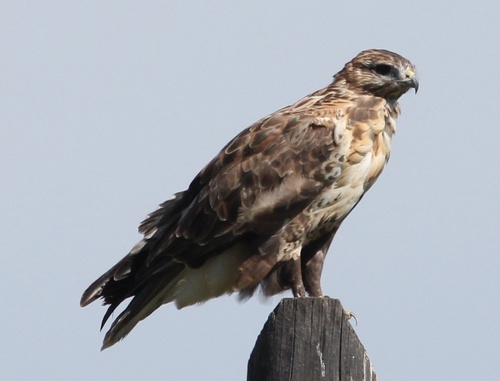
(c) Igor Fefelov, some rights reserved (CC BY-NC), uploaded by Igor Fefelov · cc-by-nc
OverviewAI-generated
The Upland Buzzard (*Buteo hemilasius*) is a species of bird classified within the genus *Buteo*. It is also referred to by the common names bwncath ucheldir, Mongolenbussard, and Busardo mongol. The species has a wingspan of 152 and an average litter size of 2.8, with an egg incubation period of 36.
This bird is endemic to Nameri National Park, Mahananda Wildlife Sanctuary, Singalila National Park, and Lachen. Its conservation status is listed as Least Concern by the IUCN Red List, a designation recorded in 2021. The species has been the subject of 2,638 observations on iNaturalist.
Synthesized by Vinony from 19 facts across 4 sources: Wikidata, iNaturalist, IUCN Red List, Vinony graph. Generated from structured data (not the Wikipedia text) and checked against those facts — may still contain errors.
Species
Least ConcernUpland Buzzard
species
via IUCN
Wikidata facts
Show 9 more facts
- taxon rank
- species
- IUCN conservation status
- Least Concern
- Commons category
- Buteo hemilasius
- taxon name
- Buteo hemilasius
- taxon common name
- bútio-do-planalto
- wingspan
- 152
- litter size
- 2.8
- egg incubation period
- 36
- endemic to
- Sela Pass
via Wikidata · CC0
~13 min read
Encyclopedic overview
The upland buzzard (Buteo hemilasius) is a species of bird of prey in the family Accipitridae. The largest species of the Buteo genus, this buzzard lives in mountainous grassy and rocky areas in areas of Central Asia, northern South Asia and East Asia from Kazakhstan to Korea. The upland buzzard is migratory but typically covers a short distance apparently to avoid snow cover that may hamper prey capture. This species primarily subsists on small mammals but does not shun alternate prey from small to large birds and insects. This little-known raptor has a large range, and though generally uncommon, it is not thought to be rare or declining as a species. As a result, it is classified as least concern by the IUCN.
Taxonomy and systematics
Excerpted from Wikipedia’s “Upland Buzzard” article, available under the CC BY-SA 4.0 licence.