Encyclopedia of Life · EOL (see source)
Urnula
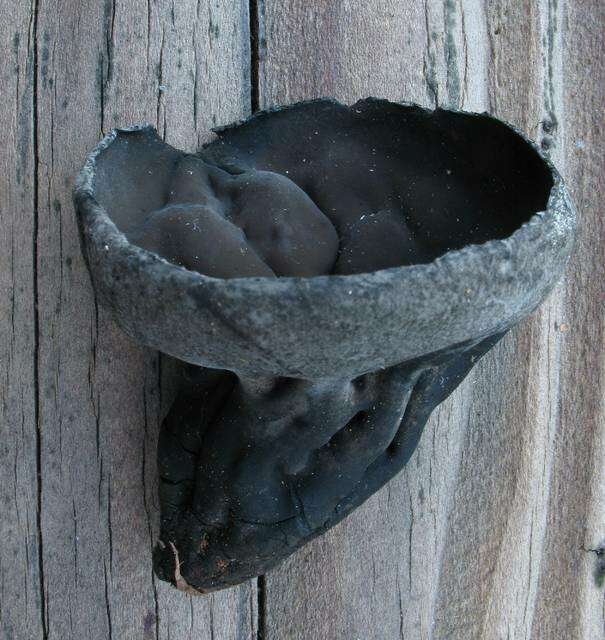
Sign in to saveUrnula is a genus of cup fungi in the family Sarcosomataceae, circumscribed by Elias Magnus Fries in 1849. The genus contains several species found in Asia, Europe, Greenland, and North America. Sarcosomataceae fungi produce dark-colored (brown to black), shallow to deep funnel-shaped fruitbodies with or without a stipe, growing in spring. The type species of the genus is Urnula craterium, commonly known as the devil's urn or the gray urn. Urnula species can grow as saprobes or parasites having an anamorphic state. The anamorphic form of U. craterium causes Strumella canker, on oak trees.
Species
Genus
- PhylumForaminifera
- ClassMonothalamea
- OrderAstrorhizida
- FamilyLacustrinellidae
Urnula – rodzaj grzybów należący do rodziny Sarcosomataceae[1]. Systematyka i nazewnictwo Pozycja w klasyfikacji według Index Fungorum: Sarcosomataceae, Pezizales, Pezizomycetidae, Pezizomycetes, Pezizomycotina, Ascomycota, Fungi[1]. Gatunki Urnula brachysperma Brunelli 1998[2] Urnula craterium (Schwein.) Fr. 1851 Urnula groenlandica Dissing 198 Urnula hiemalis Nannf. 1949 Urnula mediterranea (M. Carbone, Agnello & Baglivo) M. Carbone, Agnello & P. Alvarado 2013 Urnula mexicana (Ellis & Holw.) M. Carbone, Agnello, A.D. Parker & P. Alvarado 2012 Urnula microcrater (Hazsl.) Sacc. 1889[2] Urnula padeniana M. Carbone, Agnello, A.D. Parker & P. Alvarado 2012 Urnula philippinarum Rehm 1914 Urnula torrendii Boud. 1911 Urnula versiformis Y.Z. Wang & C.L. Huang 2014 Urnula viridirubescens (Bagnis) Boud. 1907 Wykaz gatunków (nazwy naukowe) na podstawie Index Fungorum[3]. Przypisy ↑ a b Index Fungorum (ang.). [dostęp 2016-05-25]. ↑ a b Takson niepewny ↑ Index Fungorum (gatunki) (ang.). [dostęp 2013-10-20].
via
Museum specimens
- Specimen records
- 65
- With media
- 57
- Family
- Sarcosomataceae
- Collections
- LSUM, NCU, FLAS, VPI, TENN-F, CUP
- Recorded in
- United States, China, New Zealand, Australia
Wikidata facts
- Instance of
- taxon
- Image
- Urnula craterium closeup.jpg
Show 5 more facts
- taxon rank
- genus
- taxon name
- Urnula
- taxonomic type
- Urnula craterium
- Commons category
- Urnula
- taxon author citation
- Fr.
via Wikidata · CC0
~3 min read
Encyclopedic overview
6 sectionsContents
- Taxonomy
- Description
- Imperfect states
- Species
- Habitat and distribution
- References
Urnula is a genus of cup fungi in the family Sarcosomataceae, circumscribed by Elias Magnus Fries in 1849. The genus contains several species found in Asia, Europe, Greenland, and North America. Sarcosomataceae fungi produce dark-colored (brown to black), shallow to deep funnel-shaped fruitbodies with or without a stipe, growing in spring. The type species of the genus is Urnula craterium, commonly known as the devil's urn or the gray urn. Urnula species can grow as saprobes or parasites having an anamorphic state. The anamorphic form of U. craterium causes Strumella canker, on oak trees.
==Taxonomy== Elias Magnus Fries circumscribed the new genus Urnula in 1849, and set what was then known as Peziza craterium as the type species. The genus name means "little urn"; the specific epithet is derived from the Latin cratera, referring to a type of bowl used in antiquity.
Excerpted from Wikipedia’s “Urnula” article, available under the CC BY-SA 4.0 licence.
Gallery (2)
Available in 11 languages
via Wikidata sitelinks · CC0