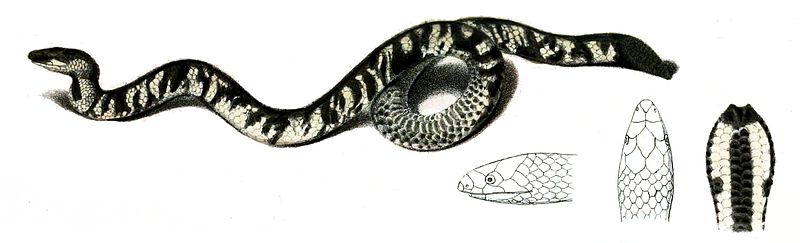
File:Silybura_shortii.jpg · Wikimedia Commons · See Wikimedia Commons
Uropeltidae
Sign in to saveThe Uropeltidae, also commonly known as shield-tail snakes, shield-tailed snakes or earth snakes, are a family of primitive, nonvenomous, burrowing snakes native to Peninsular India and Sri Lanka. The name is derived from the Greek words ('tail') and ('shield'), indicating the presence of the large keratinous shield at the tip of the tail. Seven or eight genera are recognized, depending on whether Teretrurus rhodogaster is treated in its own genus or as part of Brachyophidium. The family comprises over 50 species. These snakes are not well known in terms of their diversity, biology, and natura
OverviewAI-generated
Uropeltidae is a family of animals within the class Squamata and phylum Chordata. It belongs to the kingdom Animalia and is classified under the parent taxon Alethinophidia. The family name is governed by the International Code of Zoological Nomenclature.
Records for this taxon are associated with India, Sri Lanka, and Australia. A specific dataset from the institution NMV contains 13 records for the family. The broader occurrence database lists 4,404 occurrences for the taxon.
Synthesized by Vinony from 21 facts across 5 sources: Wikidata, GBIF, Gbif Occ, iDigBio, Vinony graph. Generated from structured data (not the Wikipedia text) and checked against those facts — may still contain errors.
Species
FAMILY
- KingdomAnimalia
- PhylumChordata
- ClassSquamata
- FamilyUropeltidae
盾尾蛇科(Uropeltidae)又名針尾蛇科,是蛇亞目下的一個科,這個科內的蛇類都具備洞棲性,主要分佈於印度南部及斯里蘭卡。盾尾蛇的學名「Urapeltidae」語源來自希臘語的「ura」及「pelte」,意思分別是「尾巴」與「盾牌」,表示盾尾蛇的尾部尖端的大型角質盾狀物。目前,盾尾蛇科內有8個屬共47個品種已被確認。[2] 目录 1 特徵 2 地理分佈 3 飲食及繁殖 4 品種 5 備註 6 外部連結 特徵 盾尾蛇屬於小型蛇,成年的盾尾蛇大約有20至75公分長。盾尾蛇棲身於地下,牠們的骨骼構造比較原始,彈性亦不足,顎骨僵硬,骨塊呈四方形,下顎仍然保留喙狀骨,但卻眼窩骨卻已經消失。同時,盾尾蛇頭頂上側的骨骼組織亦呈退化跡象,雙眼細小,而且開始變質(蛇類眼睛上應有一片薄膜,但盾尾蛇的眼睛卻有一塊多邊形的甲塊),盆骨亦已消失。[3]另外,針尾蛇的尾部是最具特色的地方。 地理分佈 盾尾蛇主要分佈於印度南部及斯里蘭卡。[1]在印度裡,盾尾蛇主要是沿西高止山脈分佈;在斯里蘭卡,盾尾蛇只聚集於氣候與西高止山脈接近的地區,例如斯里蘭卡的西南部。 飲食及繁殖 盾尾蛇主要進食無脊椎動物,例如蚯蚓。不過相關研究仍相當貧乏,因此盾尾蛇的飲食習慣也許尚有商榷之處。另外,所有盾尾蛇都是卵胎生動物。 品種 屬[2] 學名及命名者[2] 種數[2] 異名 地理分佈[1] Brachyophidium Brachyophidium,Wall,1921 1 印度西南部 頦溝蛇屬 Melanophidium,Günther,1864 3 印度南部喀拉拉邦及泰米爾納德邦 扁槌蛇屬 Platyplectrurus,Günther,1868 2 印度南部及斯里蘭卡 槌尾蛇屬 Plectrurus,A.H.A. Duméril,1851 4 印度南部 凸尾蛇屬 Pseudotyphlops,Schlegel,1839 1 斯里蘭卡中部及烏沃省與薩伯勒格穆沃省的南部 銼尾蛇屬 Rhinophis,Hemprich,1820 12 印度南部及斯里蘭卡 鑽尾蛇屬 Teretrurus,Beddome,1886 1 印度南部 針尾蛇屬T Uropeltis,Cuvier,1829 23 印度南部及斯里蘭卡 備註 ^ 1.0 1.1 1.2 McDiarmid RW、Campbell JA、Touré T:《Snake Species of the World: A Taxonomic and Geographic Reference, vol. 1》頁511,Herpetologists' League,1999年。ISBN 1-893777-00-6 ^ 2.0 2.1 2.2 2.3 Uropeltidae. Integrated Taxonomic Information System. 2007 [
via GBIF
Museum specimens
- Specimen records
- 13
- Family
- Uropeltidae
- Collections
- NMV
- Recorded in
- India, Sri Lanka, Australia
Wikidata facts
- Instance of
- taxon
- Parent taxon
- Alethinophidia
- Image
- Silybura shortii.jpg
Show 6 more facts
- Commons category
- Uropeltidae
- taxon name
- Uropeltidae
- taxon rank
- family
- Code of nomenclature
- International Code of Zoological Nomenclature
- topic's main category
- Category:Uropeltidae
- Commons gallery
- Uropeltidae
Sources (1)
via Wikidata · CC0
~5 min read
Encyclopedic overview
10 sectionsContents
- Description
- Behaviour and natural history
- Geographic range
- Evolutionary significance
- Feeding
- Reproduction
- Genera
- See also
- References
- Further reading
The Uropeltidae, also commonly known as shield-tail snakes, shield-tailed snakes or earth snakes, are a family of primitive, nonvenomous, burrowing snakes native to Peninsular India and Sri Lanka. The name is derived from the Greek words ('tail') and ('shield'), indicating the presence of the large keratinous shield at the tip of the tail. Seven or eight genera are recognized, depending on whether Teretrurus rhodogaster is treated in its own genus or as part of Brachyophidium. The family comprises over 50 species. These snakes are not well known in terms of their diversity, biology, and natural history.
==Description== thumb|left|Tails of Uropeltidae Snakes in the family Uropeltidae are small snakes, with adults growing to a total length (including tail) of . They are adapted to a fossorial way of life, which is apparent in their anatomy. The skull is primitive and inflexible, with a short, vertical quadrate bone and rigid jaws; the coronoid bone is still present in the lower jaw. The orbital bones are absent, the supratemporal is vestigial, and the eyes are small and degenerate, not covered by a brille, but by large polygonal shields. However, the pelvis and hind limbs, the presence of which is also considered a primitive trait, have disappeared in this family.
Excerpted from Wikipedia’s “Uropeltidae” article, available under the CC BY-SA 4.0 licence.